
TuneLab-at-Revvity Federated Learning Program

Overview
This document outlines:
-
The functioning of this collaborative AI/ML early drug discovery platform initiated by Eli Lilly and Company (Lilly) and co-funded with Revvity Signals.
- How your data contribute while preserving your IP
- How to join the program
Program Overview
Lilly TuneLab™ is a first-of-its-kind collaborative AI/ML drug discovery platform.
- Lilly provides participating biotech companies access to powerful models trained on decades of data to accelerate their own therapeutics programs
- Participants contribute training data via privacy-persevering federated learning for models to better understand their chemical space.
Revvity Signals operationalizes the TuneLab program by providing
- Necessary software to host, invoke and manage TuneLab models
- Free modeling tokens
- Signals secure scientific data platform
Roles & Responsibilities of Partners
- Eli Lilly: Program initiator who provides the original AI/ML models, funds and leads the program
- Revvity Signals: Provides the software and secure cloud environment necessary for operationalization of the TuneLab program
- Participating Organizations: Access TuneLab model predictions in exchange for retraining models with proprietary data within the Signals platform, and share updated models with Lilly federation partners.
- Lilly Federation Partners: Third-party companies with AI expertise whose role is to aggregate models updated by all participating organizations, monitor model performance, and, once validated, distribute back the new global models in your Signals cloud environment, ready to be used.
Workflow Process
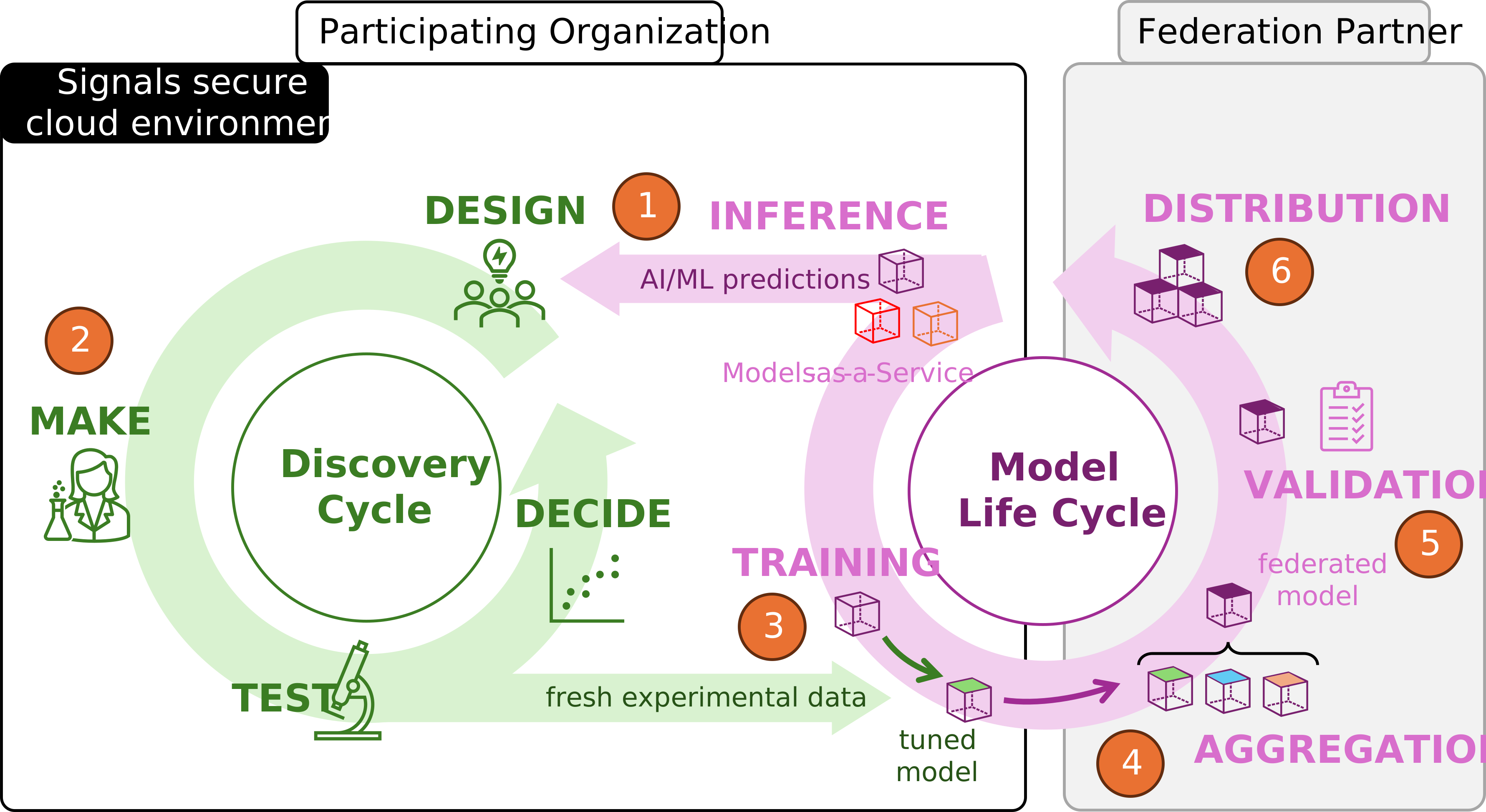
- Biologists and medicinal chemists use TuneLab models to prioritize and select molecules for synthesis in the laboratory. Depending on the computational cost of the invoked models, a certain number of modeling tokens will be consumed.
- Selected molecules are experimentally profiled, including assays with endpoints to TuneLab models.
- Molecular structures and experimental endpoints are used to retrain corresponding models within your Signals secure environment.
- Updated models are securely shared with the federation partner selected by Lilly
- Federation partners aggregate updated models into a new global model that is verified and distributed back to your Signals secure cloud environment.
- The cycle then repeats with models that are better aligned with your research
Benefits for Participating Organizations
- Access to premium AI/ML models generated by TuneLab directly from the software they use daily. Model performance will further improve as they are retrained with participants’ data.
- Complimentary licenses for a 1-year period specifically for use with the TuneLab program:
- Up to 5 licenses of Signals One (multi-tenant)
- Up to 5 licenses of Signals Synergy (multi-tenant)
- Up to 5 licenses of Signals ChemDraw
- Access to Signals Xynthetica to host and manage TuneLab models in their own environment.
- Free starter pack of modeling tokens. Additional modeling tokens may be purchased.
- Participant will also get access to other commercial and public models via Xynthethica (eg. ACD/Labs models)
TuneLab Models
Small Molecule Models
Models for small molecules include ADMET models (classification and regression models) such as thermodynamic and kinetic solubility, MDCK apparent permeability, fraction unbound in plasma of various species, microsomal stability in various species, CYP inhibition of several isoforms, hERG binding.
See Addendum #1 for more information
Antibody Models
Models for antibodies provide insight into their developability with properties such as thermal stability, hydrophobicity and viscosity.
Information About your Proprietary Data
Experimental protocol sharing
For AI models to perform, standardized quality data are essential. Consequently, Lilly will ask participating organizations to share their experimental protocols.
Data Contribution (volume)
Federated learning programs allow access to larger and more diverse datasets which increases the accuracy and predictability domain of a given model. Diversity is a direct consequence of the number of organizations who participate in the TuneLab program.
All organizations are requested to provide a minimum of 1,000 experimental endpoints each year. For example, 200 molecules profiled on 5 endpoints suffice.
See Addendum #3 for more information
Organizations working with antibodies are requested to provide at least 1 endpoint with 125 sequences.
See Addendum #4 for more information
Historical data and new data are acceptable contributions.
Data Protection
Protection of participating organizations’ proprietary data and IP is essential for the success of the program. The TuneLab-at-Revvity program ensures security by design. In this regard, the following key security measures should be mentioned:
- Proprietary data of participating organizations (molecules – existing and virtual-, predictions, experimental results) remain within your Signals cloud environment which is safeguarded by a “defense in depth” security strategy [learn more]
- TuneLab models are hosted within your Signals cloud environment, so your small molecules or antibodies will never leave this secure infrastructure.
- Updated model sharing with Lilly’s federation partner will be encrypted
- Federation partners will only send back updated models, making it impossible for other organizations -including Lilly- to know about the training data.
How to join the Program?
Eligibility Criteria
- Revvity Signals customers currently licensing Signals software.
- Drug discovery organizations, primarily biotech companies and startups investigating small molecules and/or antibodies. Other organizations, pharmaceutical companies, and research institute are invited to apply as well.
- Small molecule organizations contribute a minimum of 1,000 experimental data points per year and antibody companies contribute at least 1 endpoint with 125 sequences per year relevant to retraining TuneLab models within the federated learning framework implemented by Lilly (see list of endpoints in Addenda #3 and #4)
Organizations applying to the TuneLab program will be reviewed and approved by Lilly before joining.
Legal Agreement
A Models Sharing agreement between Eli Lilly and each selected organization will be required.
Experimental protocols followed by selected organizations will be shared as part of the agreement package.
Onboarding Process
Newly approved participating organizations will be provided access to relevant software, TuneLab models, and modeling tokens by the Revvity Signals service department directly within your Signals cloud environment.
Apply to join the TuneLab at Revvity Program
Organizations interested in accessing Lilly TuneLab can complete the form available here.

End-to-end workflow support across scientific disciplines.

The Standard for Chemical Drawing.

End-to-end Clinical Data Science Platform.