
Signals Xynthetica™
A Tectonic Shift is Here: AI-Powered Design Converges with Experimental Science
Today, artificial intelligence enables scientists to generate candidate molecules, predict their properties, and virtually screen vast chemical spaces before synthesis. When tightly integrated with experimental science, this convergence creates a virtuous cycle in which predictions improve, fewer experimental cycles are needed, and discovery accelerates.
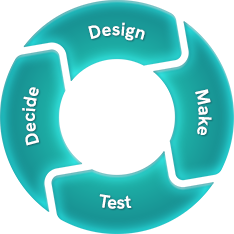
AI and machine learning are transforming the traditional Design-Make-Test-Decide workflow. The greatest impact is in Design, where fast, data-driven in silico exploration is evolving into its own continuous cycle, guiding, and accelerating the rest of the discovery process.
The modern design cycle begins with generative AI proposing novel candidate structures. Machine learning models then predict their properties at scale, followed by virtual screening to identify the most promising candidates for experimental follow-up. By focusing effort on high-value designs rather than brute-force enumeration, scientists can move from ideas to synthesized compounds with greater precision and confidence.
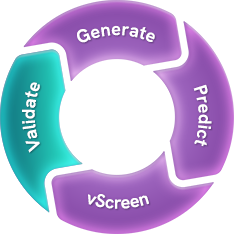
At the intersection of in silico design and wet-lab science, Signals Xynthetica brings predictive models, experimental data, and laboratory workflows together in one unified platform. Leveraging Revvity Signals’ deep expertise in scientific data capture, secure collaboration, and bench-scientist workflows, Xynthetica enables AI-Augmented discovery to scale across R&D organizations.

AI-Powered In Silico Design

Data-guided Molecular Generation
By learning from high-quality experimental data, generative models such as large language models and diffusion models can propose new molecules that match predefined property profiles or design constraints. These models capture hidden structure–activity relationships and suggest candidates beyond classical intuition, helping scientists explore regions of chemical space that would be difficult to reach with manual design alone.

Hybrid Property Prediction
Newly generated molecules are evaluated with a combination of machine learning and physics-based models to estimate key properties, liabilities, and developability metrics. Machine learning models are continuously updated as fresh experimental results become available, while physics-based simulations provide mechanistic insight, together delivering a more reliable and nuanced view of each candidate’s potential.

Multi-objective Optimization
In the final step, candidate designs are ranked against multiple objectives at once, such as performance, manufacturability, and risk-related constraints. The system balances these often-competing criteria to identify candidates with the strongest overall trade-offs, resulting in a focused shortlist for experimental follow-up.

Data Fuels AI – AI Empowers Scientists

Models, embedded in scientific workflows
Predictive models are available as a service directly inside Signals One™, Signals Synergy™, and Signals ChemDraw™. This tight integration ensures predictions are part of routine scientific decision-making, enabling AI-augmented design to run continuously as research progresses.

Privately fine-tune with fresh data
As new experimental results are generated, organizations can privately fine-tune selected models on their own high-value data. This continuous learning loop sharpens prediction accuracy for their specific chemistry and biology, without exposing proprietary information.

Governed models, scalable impact
Models are managed, versioned, and governed centrally while being applied consistently across teams and projects. This ensures predictions remain transparent, auditable, and reproducible—so AI-augmented design can scale reliably across the organization.
Pre-register for Early Access
Revvity Signals has a proven track record of turning complex scientific technologies into secure, easy-to-use software services. Signals Xynthetica extends this strength to AI-augmented design by delivering predictive models as a service.
If your organization is interested in gaining early access to Xynthetica please register below.

FAQs
What is MaaS?
MaaS (Models as a Service) is a way to deliver AI and machine learning models as secure, cloud-based services that scientists can access on demand, without having to build or maintain the underlying infrastructure.
What is Signals Xynthetica?
Signals Xynthetica is Revvity Signals’ new AI-augmented molecular design capability which is currently under development that will bring together generative design, property prediction, and virtual screening as models delivered as a service to bench scientists.
How does Signals Xynthetica relate to MaaS?
Signals Xynthetica is the first realization of Revvity’s MaaS vision in molecular design, providing curated, industry-leading models through the Signals platform so scientists can use them directly in their everyday workflows.
Why is data so important for Signals Xynthetica?
High-quality experimental data drives better generative and predictive models, and fresh results can be used to refine models over time, improving prediction accuracy for each organization’s specific chemistry and biology.
Who can benefit from Signals Xynthetica?
Signals Xynthetica is designed for R&D teams, especially bench scientists and their partners, who want to use AI to accelerate molecular design without becoming AI infrastructure experts.
How can my organization get involved?
Organizations interested in Signals Xynthetica can fill out the form on the page to receive updates about the product and indicate their interest in early access opportunities.
What can I expect if I pre-register for Early Access?
By pre-registering, you’ll be among the first to receive details on how to apply for early access in early 2026.



Ready to take the next step?


TuneLab™ at Revvity
Lilly TuneLab models will be directly accessible from Signals Xynthetica

Stay up to date.
Get the latest research, industry insights, and product news delivered straight to your inbox.