
Governed AI for Clinical Trial Compliance

Introduction
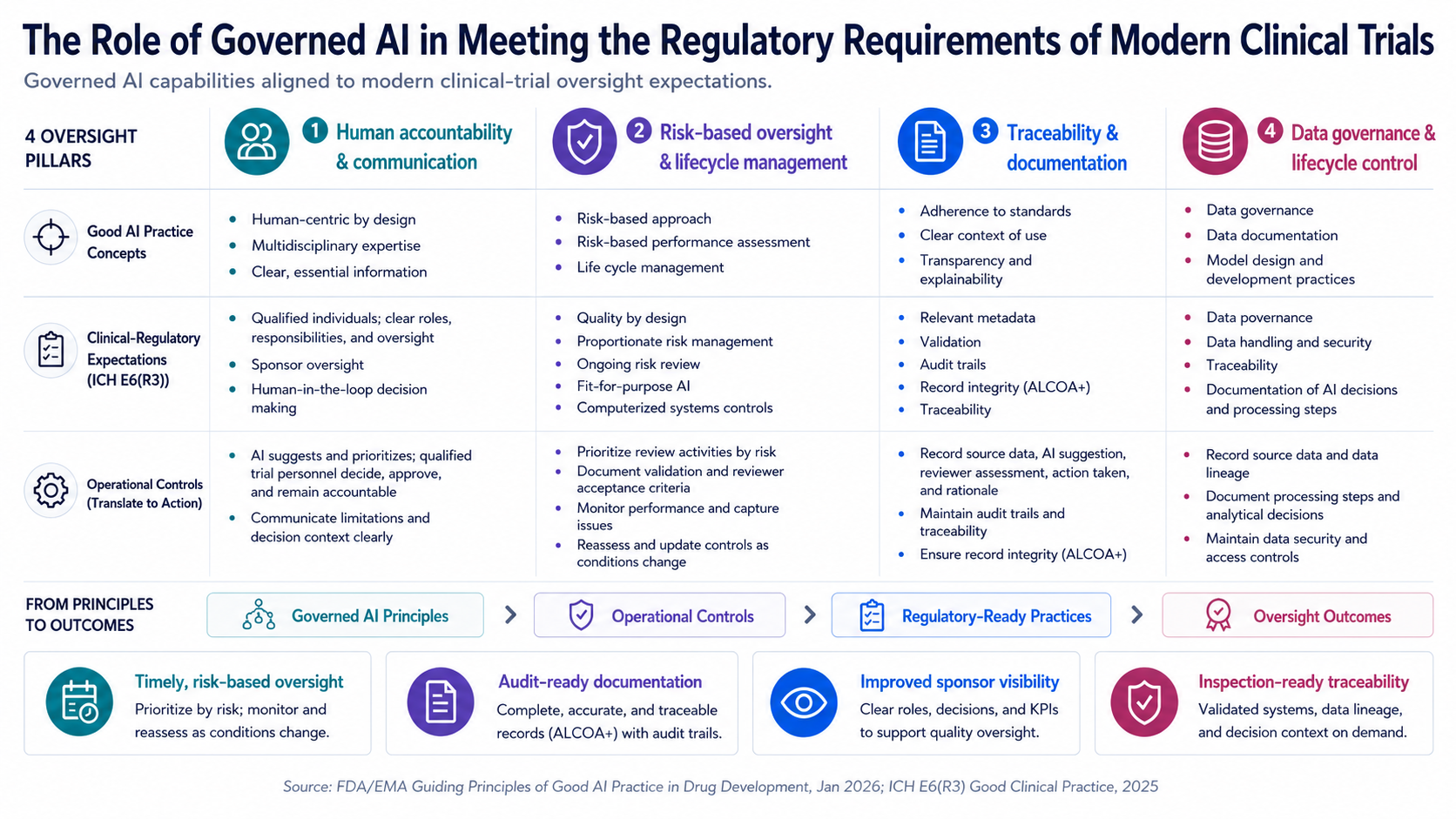
The Role of Governed AI in Meeting the Regulatory Requirements of Modern Clinical Trials
Clinical trials have become increasingly data-rich and complex. In view of the exponential data growth, decentralized study models, and complex vendor relationships involved in today’s clinical trials, regulatory bodies have outlined evolving expectations for clinical trial governance, with an emphasis on risk management, continuous oversight, and the traceability of both data and decision making. Governed, assistive AI, used in conjunction with a centralized data management system, can help drug sponsors meet these regulatory requirements by supporting risk-based monitoring, more timely and centralized oversight, and audit-ready documentation, improving traceability and accountability across the entire clinical trial life cycle.
New Regulatory Expectations for Clinical Trial Management
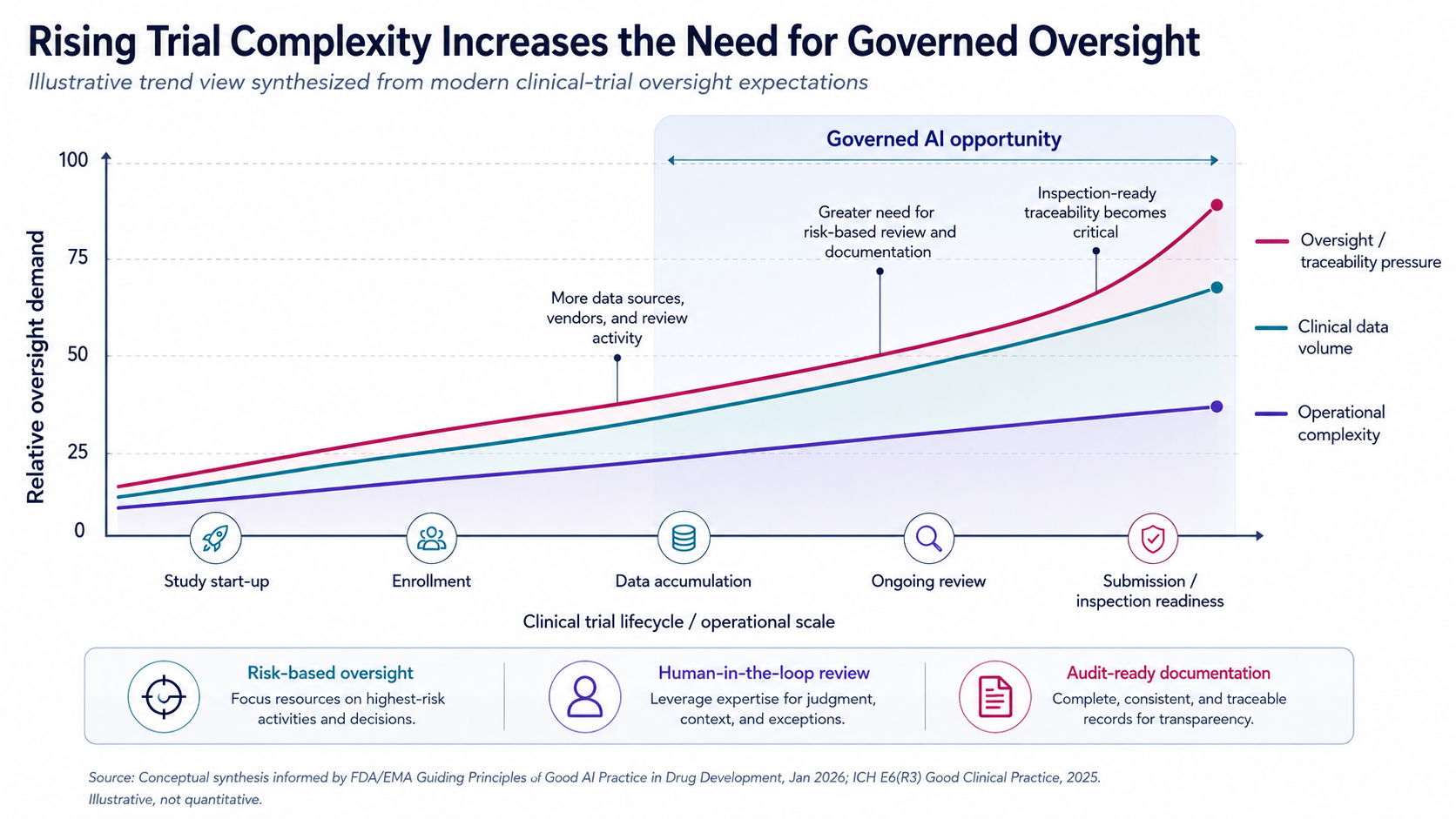
In today’s regulatory landscape, the focus has shifted to greater sponsor accountability with more timely, risk-based, and appropriately documented oversight across the clinical trial lifecycle Perhaps most importantly, a consistent theme across new regulatory frameworks from the International Council for Harmonisation of Technical Requirements for Pharmaceuticals for Human Use (ICH) and the U.S. Food and Drug Administration (FDA) is that sponsors retain responsibility for ensuring proper monitoring, investigator compliance, and protection of clinical trial participants, even if clinical research organizations (CROs) or other third-party vendors conduct these activities.
It is critical that sponsors understand evolving regulatory expectations for clinical trials, as well as how to respond to these changes to ensure trials are conducted in compliance with applicable regulations and guidance.
Current Oversight Framework
ICH E6(R3)
The framework set forth in ICH E6(R3)1 represents a substantial evolution in Good Clinical Practice. The guideline states that the sponsor should implement an appropriate system to manage quality throughout all stages of the trial process, integrating quality into planning, execution, monitoring, and continuous improvement activities.
This requirement necessitates the identification of Critical-to-Quality (CtQ) factors, defined as the elements that are essential to ensuring data integrity and the safety of participants enrolled in a clinical trial. Sponsors are expected to perform structured risk assessments, implement mitigation strategies, and provide ongoing review of risks identified through clinical trial data, rather than treating risk management as a one-time activity.
Importantly, E6(R3) makes it clear that while sponsors may delegate trial activities, they must maintain documented oversight of CROs and other vendors. Oversight must be ongoing and risk-based and supported by documentation that allows regulators to reconstruct decision-making processes. This emphasis on traceability and auditability is a significant change from earlier requirements that focused more on the presence of documentation rather than the proactive management and supervision of trials based on near-real-time data.
ICH E8(R1)
ICH E8(R1)2 reinforces these requirements, emphasizing the need for proactive quality management by embedding Quality by Design (QbD) into clinical trial management. This guidance calls for trials to be intentionally designed around CtQ factors, ensuring that key objectives related to safety and data reliability are prioritized from the very beginning.
Under E8(R1), sponsors must identify and evaluate risks during the design of the clinical trial, rather than addressing risks after a trial has begun. This assessment extends to not only clinical risks, but also to operational and data-related risks, including complexities related to the flow and management of data, and the determination of clinical endpoints. The intent is that integrating and understanding these broader considerations early will reduce the likelihood of downstream problems that compromise trial quality. The regulatory expectation now is that quality is not a result of regulatory oversight after a trial has begun but is instead baked into the trial design at the outset.
FDA Expectations Under 21 CFR
In the United States, the FDA’s regulatory expectations for clinical trial oversight are spelled out in various sections of chapter 21 of the Code of Federal Regulations (21 CFR). Although these regulations have been in place for years, their interpretation continues to evolve based on modern risk-based approaches.
Under 21 CFR 312.503, sponsors are explicitly responsible for ensuring proper study conduct, including oversight of investigators and protection of study participants. Sponsors retain responsibility for appropriate oversight, even when tasks are transferred to CROs or other vendors.
In addition, monitoring requirements under 21 CFR 312.56 require that sponsors review ongoing investigations and evaluate evidence relating to safety and effectiveness. Historically, this requirement was often operationalized through frequent on-site monitoring visits. Today, however, the FDA promotes risk-based monitoring approaches5 aligned with ICH E8(R1), including the use of data analytics and centralized review to quickly identify emerging risks.
In another nod to the realities of modern clinical studies, where digital and automated systems capture and manage data, 21 CFR Part 11 establishes requirements for electronic records and signatures, mandating validated systems, secure access controls, and computer-generated audit trails. Sponsors must ensure these systems support not only data integrity but also the traceability of actions and decisions.
Finally, FDA expectations for documentation and recordkeeping extend beyond the mere existence of records. Guidance on safety reporting and compliance emphasizes that records must be complete, accurate, and sufficient to support regulatory inspection. Increasingly, regulators expect these records to enable reconstruction of decision-making processes, linking identified risks to actions taken and the resulting outcomes.
FDA Initiatives in Data Centralization and Transparency
The FDA’s recent launch of the Adverse Event Monitoring System (AEMS)6 further reflects this shift toward more centralized, accessible data environments. AEMS consolidates adverse event reporting across multiple product areas into a single platform, improving the usability and transparency of safety data. By replacing fragmented legacy systems with an integrated environment, the FDA is advancing its ability to support more timely identification of potential safety signals and more efficient analysis of large-scale data.
While adverse event reports have inherent limitations, the agency has emphasized that improved infrastructure and accessibility can enhance the ability to identify patterns and potential risks. This evolution reinforces the importance of systems that enable centralized access to data, traceability of analysis, and consistent, well-documented review processes across the clinical trial lifecycle.
How Oversight Breaks Down
These updates from regulatory bodies provide drug sponsors with a solid framework for ensuring compliance. Yet the outdated systems used by many sponsors hinder their ability to meet these evolving expectations.
In many legacy systems, clinical trial oversight is fragmented across a range of methods and technologies, including email, spreadsheets, PDFs, and other static documents. With disparate systems capturing data, gaps in audit trail completeness are hard to avoid, making it difficult to create a unified and traceable record of decisions and actions within a clinical study.
Sponsors also frequently struggle with limited visibility into CRO-led activities. Even if sponsors understand that they retain responsibility for trial oversight, timely insight into CRO performance and decision-making is often lacking, particularly in complex, multi-vendor environments.
Another common problem is inconsistent or incomplete documentation of risk management. In older systems, even if risks are identified and discussed, the rationale for decisions—such as why a signal was either actively managed and escalated or ultimately dismissed—is not always systematically recorded.
Additionally, many sponsors still rely on periodic review cycles. The result is reactive, rather than proactive, identification of vital safety or data quality signals, an approach that runs counter to the FDA’s expectations for risk-based and timely data review and timely intervention to manage risks.
Technology, Including AI, Aids Demonstrable Oversight
Modern technologies can help sponsors meet current regulatory expectations. Centralized data management platforms designed specifically for clinical trials provide visibility across studies, sites, and vendors. These tools can aggregate clinical, operational, and safety data into a single environment, readily available to study managers with the click of a mouse. Rather than waiting for scheduled monitoring cycles, clinical and data managers can more continuously evaluate trends, identify anomalies, and prioritize review activities based on risk.
Just as important are tools for structuring and documenting data for review. Today’s AI-enabled systems can automatically capture and record when data was reviewed, what issues were identified, how they were assessed, and what actions were taken. This changes oversight from the fragmented, manual processes of the past into a systematic and reproducible workflow, supporting documentation of how decisions were made and the results of those decisions.
In modern clinical trials, the concept of “audit readiness” has shifted from a periodic state to a more continuous process. A core requirement under 21 CFR Part 11 is the provision of secure, computer-generated audit trails. For systems subject to Part 11, secure, computer-generated, time-stamped audit trails are expected to record relevant operator entries and actions that create, modify, or delete electronic records. Modern technologies can support this requirement by capturing user actions, data changes, and review activities in a more consistent and reviewable format.
A centralized data management system also provides strict control over who can access clinical trial data, and for what purpose. Role-based controls ensure that only the appropriate people tasked with managing specific areas of a trial gain access to data, thus improving internal governance of a clinical study.
Finally, these systems support alignment with ALCOA+ principles—that all data should be Attributable, Legible, Contemporaneous, Original, and Accurate, plus Complete, Consistent, Enduring, and Available. By using systems that embed these principles in data capture and review workflows, drug sponsors can ensure that all documentation meets regulatory standards without relying on retrospective remediation.

The Appropriate Role of AI in Regulated Clinical Environments
Artificial intelligence (AI) has emerged as a powerful enabling technology to help drug sponsors meet evolving regulatory expectations. As part of electronic data capture (EDC), integration, interrogation, and review, AI can significantly improve efficiency by automating what were once manual tasks. AI can also support earlier identification of potential safety signals, by rapidly scanning large datasets to identify anomalies, trends, and potential risk signals. This power is particularly valuable in modern trials, where the volume and complexity of data exceed what can be efficiently reviewed manually.
But AI must be deployed as an assistive tool, not an autonomous decision-maker.
AI Suggests, Humans Decide
Consistent with ICH E6(R3)’s emphasis on defined responsibilities and oversight, AI-generated outputs should remain subject to human review and accountability. Accordingly, AI-generated insights should incorporate a human-in-the-loop for validation and decision oversight. Further, the distinction between an AI-generated suggestion and a human-made decision must be explicit, documented, and traceable. This clarity preserves human accountability while still allowing AI to automate a range of tasks. AI can help prioritize, highlight, and contextualize information, but final judgements should remain with appropriately qualified trial personnel.
Controlled, Transparent and Fit-for-Purpose AI
To serve as a valuable tool for clinical studies, AI needs to operate within clearly defined frameworks. Information generated for decision-making should be fit for intended use, appropriately controlled, and governed, and sufficiently consistent and reproducible for the workflow in which it is used. Equally important is the use of controlled and reliable data sources. AI systems must operate on data that meets regulatory standards to support that any insights generated are based on reliable information.
In addition, AI systems used in clinical trial workflows should be grounded in study-specific, contextually relevant data. Systems that rely on generalized or non-study-specific data sources may increase the risk of outputs that are not aligned with the protocol, data structure, or clinical context of a given trial. By contrast, AI that operates within a defined, study-bound data environment can support more consistent, relevant, and traceable outputs aligned to the specific trial.
Transparency and Audit-Readiness in AI Use
Transparency is another foundational principle for the proper use of AI in clinical data management. Too often, AI outputs come from a so-called “black box.” But in clinical trials, the information and analyses provided by AI should be understandable and explainable, allowing humans to evaluate how conclusions were made. The use of AI in clinical trials should increase transparency, not introduce ambiguity.
In addition, AI-generated information should be documented in an audit-ready manner, with clear records of all data sources, processing steps, and resulting recommendations. Combined with the role-based access controls described above, this approach helps ensure that AI is used appropriately and within defined boundaries.
AI systems grounded in study-specific, governed data environments further support transparency by ensuring outputs are directly tied to the protocol, data structure, and clinical context of the trial.
Accelerated Data Integration Increases Trial Safety
When implemented within proper guardrails, AI can significantly enhance and improve risk-based oversight. It enables faster and more consistent identification of critical data elements and can help sponsors prioritize which elements of a clinical trial require the most attention to ensure patient safety and data integrity.
AI also strengthens centralized monitoring workflows by analyzing incoming data on an ongoing basis and flagging potential issues in a more timely manner. It supports ongoing quality management by automating routine review tasks, tracking risk signals, and supporting the completion of mitigation actions. By automating what were once repetitive and time-consuming manual processes, AI allows human experts to focus on higher-order analysis and decision-making.
Preparing for the Next Inspection Paradigm
Regulatory inspections are evolving in parallel with evolving clinical trial expectations, including the expectation that sponsors shift from retrospective evaluation to more proactive, risk-based oversight. Drug sponsors, therefore, should be prepared to demonstrate measurable review timelines, how quickly issues were identified, and how promptly they were addressed. Structured workflows supported by modern systems enable this level of visibility.
Inspectors will also expect sponsors to demonstrate their independence in CRO relationships. Regulators expect clear evidence that sponsors maintain active oversight, rather than relying passively on vendors. To meet this expectation, sponsors will need systems that provide direct visibility into trial data and review activities, independent of CRO reporting.
Systems that provide study-specific, governed access to trial data support this expectation by enabling sponsors to independently review, validate and document decisions based on the underlying data.
Building an Oversight Model Aligned with Modern Regulation
The modern regulatory environment is prompting drug sponsors to fundamentally rethink how clinical trial oversight is conducted. Frameworks such as ICH E6(R3) and ICH E8(R1) emphasize that oversight should be proportionate, risk-based, ongoing, and demonstrable.
At the core of these expectations are requirements for documentation, traceability, and governance. Governed, assistive AI plays an important role in this transformation. When implemented with appropriate controls, including keeping a human-in-the-loop, AI can enhance efficiency, improve data consistency, and strengthen the defensibility of clinical trial data and results.
Organizations that invest in modern clinical trial management systems will be better positioned to meet current regulatory expectations and to adapt to any new guidance. Technology solutions such as Signals Clinical, from Revvity Signals, exemplify how integrated data environments and governed AI capabilities can support today’s clinical trials and allow drug sponsors to move from fragmented compliance toward timely, demonstrable oversight.
References
1. International Council for Harmonisation of Technical Requirements for Pharmaceuticals for Human Use (ICH); E6(R3) Good Clinical Practice (GCP), 2025. https://database.ich.org/sites/default/files/ICH_E6%28R3%29_Step4_FinalGuideline_2025_0106.pdf
2. ICH, E8(R1) General Considerations for Clinical Studies, 2021. https://database.ich.org/sites/default/files/ICH_E8-R1_Guideline_Step4_2021_1006.pdf
3. US Government Printing Office, 21 CFR 312.50 — General responsibilities of sponsors; https://www.ecfr.gov/current/title-21/section-312.50
4. 21 CFR § 312.56 - Review of ongoing investigations; https://www.ecfr.gov/current/title-21/chapter-I/subchapter-D/part-312/subpart-D/section-312.56
5. US FDA, A Risk-Based Approach to Monitoring of Clinical Investigations Questions and Answers Guidance for Industry, 2023. https://www.fda.gov/media/121479/download
6. US FDA, FDA Adverse Event Monitoring System (AEMS), https://www.fda.gov/safety/fda-adverse-event-monitoring-system-aems (accessed March 27, 2026).

End-to-end workflow support across scientific disciplines.

The Standard for Chemical Drawing.

End-to-end Clinical Data Science Platform.