
The AI Co-Scientist: Why Scientific Intelligence Requires More Than Language Models

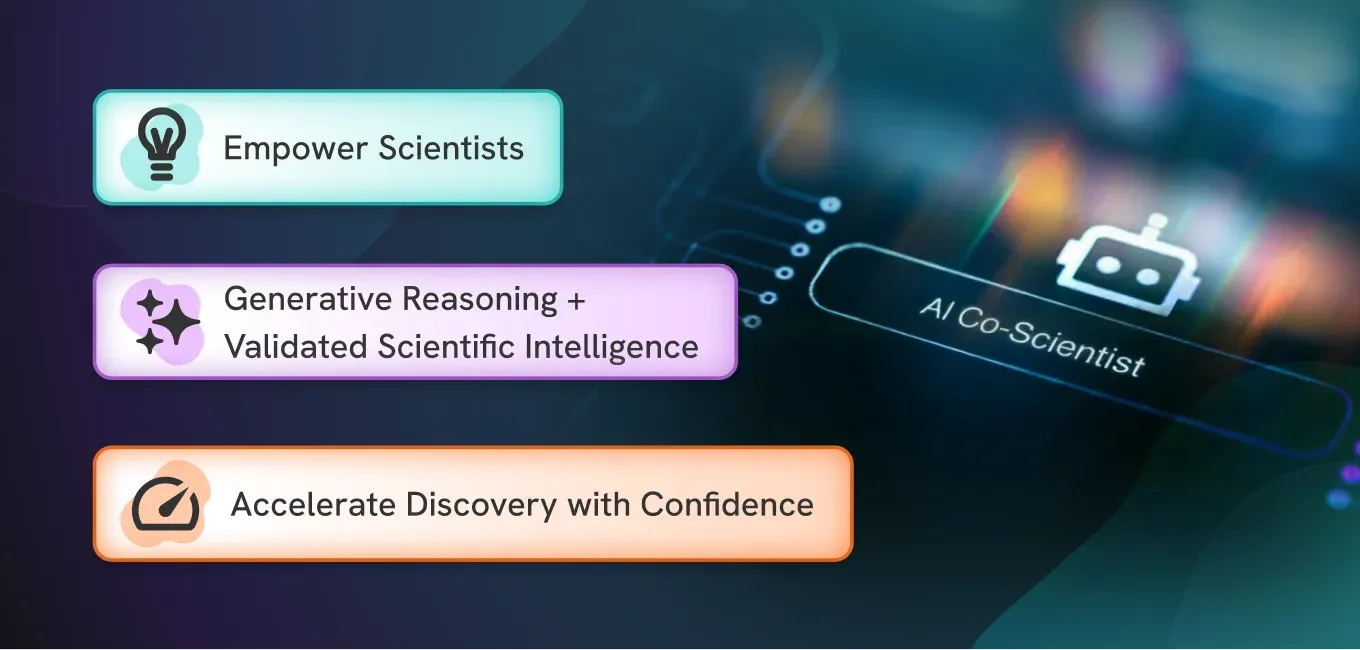
At Revvity Signals, we believe the next generation of scientific AI must go beyond fluent language to become a true co-scientist — one that knows when to reason, when to calculate, and when to ask the human expert. In this post, David Gosalvez, Ph.D., Chief Strategy Officer at Revvity Signals, shares his perspective on what it takes to build an AI assistant worthy of that name.
Summary
Scientific AI should not rely solely on large language models. The most trustworthy AI co-scientists combine generative AI with scientific databases, validated algorithms, simulations, predictions, structured scientific data, and expert workflows to deliver reproducible, testable scientific outcomes.
Science Demands More Than Persuasive Answers
Artificial intelligence is changing the way scientists work with information. A scientist can now ask a question in natural language and get a useful explanation of a biological pathway, a summary of recent literature, a proposed experimental plan, or a set of hypotheses to explore. That is a profound shift. It makes scientific knowledge more accessible, accelerates early thinking, and helps researchers move more quickly from question to action.
I believe this kind of generative intelligence will become a core part of scientific discovery. But as we move from AI assistants to AI “co-scientists,” we need to be clear about what makes scientific work different from many other knowledge tasks. Science is not only about forming persuasive explanations. It is about reaching conclusions that can be experimentally tested, reproduced, trusted, and acted on.
That requires more than language.
The goal is to enable scientists to ask better questions in natural language and have the system connect those questions to the right capabilities. Sometimes that capability will be a language model. Sometimes it will be a deterministic algorithm, a domain-specific machine learning model, a simulation, a database search, a visualization, or a human expert. The optimal AI co-scientist is not a system that asserts knowledge it doesn’t actually have, but one that knows when to reason, when to calculate, when to validate, when to visualize, and when to ask the scientist.
The GPS Lesson: The Interface is not Intelligence
A simple analogy may help. Most of us interact with GPS through a clean, conversational interface. We type or voice the destination, and the system tells us where to go. From the user’s perspective, it feels simple: ask a question, get an answer. But no one would build a reliable navigation system using language alone.
Imagine a GPS system that tried to navigate the world only from textual descriptions of places: travel guides, road names, addresses, construction notices, historical documents, business listings, and written accounts of how people move through cities. It might know a great deal about the idea of a place. It might even generate a plausible route. But without maps, coordinates, satellite positioning, routing algorithms, traffic data, road rules, and arrival times, it would not be a system you would trust to get you where you need to go.
The voice interface is just the visible layer. The intelligence comes from the combination of interaction, structured data, algorithms, and real-world validation. Scientific AI needs to evolve the same way.
Language Models are a Starting Point, not the Destination
A generative language model has proven to be an extraordinary interface to science. It can explain, summarize, reason, and guide. But when the task requires scientific rigor, validated interpretation, or formal representation of scientific data, the model should not be left to improvise or produce the statistically most likely, best-sounding response. The better answer is for the model to know which scientific tools, algorithms, and models to invoke, and how to orchestrate them.
Underneath the Language is a Structured Reality
Much of today’s excitement around artificial intelligence emanates from the power of language to describe the world. But language alone is an insufficiently effective proxy for reality. Our understanding of science is substantially, though not comprehensively, captured in language through papers, protocols, lab notes, reports, patents, regulatory submissions, and conversations among experts. But underneath all that language is a highly structured reality.
Why a Molecule is More Than Its Name
A molecule, for example, is not just a name or a picture. It is a precise three-dimensional arrangement of atoms and bonds. Its shape matters. Its stereochemistry matters. Its sequence and structure matter profoundly. Small differences can change whether a compound is safe, active, inactive, toxic, patentable, or even the same molecule at all.
To a computer system, these differences must be captured in a rigorous representation that can be stored, searched, shared, and validated. If a co-scientist is going to reason about chemistry, it cannot only understand the words around a molecule. It must also connect to the systems that represent the molecule accurately. The same principle applies across scientific domains. Biological sequences, materials structures, experimental measurements, spectra, images, assay results, and clinical observations all have their own specialized forms of representation. A credible scientific AI system needs to respect those forms, not flatten them into a text-only simplification of the world.
When “Plausible” Isn’t Good Enough: The Case for Formal Naming
Even when text is the right representation of a scientific concept, a formal approach remains essential. Chemical naming may seem mundane until you understand what is at stake. A chemical name is not just a label. In many contexts, it is a formal identity. In a patent, the name of a compound may define the boundaries of intellectual property. In a regulatory submission, it may help identify exactly what substance is being evaluated. In manufacturing or quality control, it may connect a material to specifications, procedures, and safety information.
A language model may often generate a plausible chemical name. But “plausible” is not the bar in these settings. The bar is correctness, consistency, and repeatability. For formal scientific and legal workflows, deterministic naming algorithms remain essential because they apply established rules in a controlled way. The same structure should produce the same name. The method should be explainable. The result should be traceable.
This is not a rejection of generative AI. It is exactly where generative AI can add value. A co-scientist should make these capabilities easier to use. It should help scientists ask for the right name, understand what the name means, compare alternative representations, and detect inconsistencies. But the final act of formal naming should rely on the best validated method available.
NMR spectroscopy provides an even richer example.
Nuclear magnetic resonance (NMR) is one of the most important techniques scientists use to understand molecular structure. In simple terms, it helps confirm whether they made the molecule they intended to make. It is also crucial for identifying unknown structures or unexpected impurities. That matters because making a molecule is not enough. A scientist must prove what was made and understand whether it is suitable, pure, and safe.
An NMR spectrum is like a molecular fingerprint, containing peaks that reflect how atoms behave in their local chemical environment. Interpreting those peaks can help determine how atoms are connected and whether the proposed structure is correct. For simple cases, an expert chemist may look at a spectrum and quickly gain confidence. For more complex molecules, the task becomes much harder. Samples often contain impurities, meaning that there are several possible fingerprints, some unexpected. Experimental conditions can shift results. Peaks can overlap. Similar structures can produce similar signals. Sometimes one-dimensional data is not enough, and scientists need additional experiments to resolve ambiguity.
Where Generative AI Shines and Where it Needs Backup
This is precisely the kind of problem where generative AI is exciting. A language model can explain the reasoning, compare possibilities, suggest follow-up experiments, and help a scientist think through the evidence. But spectral interpretation is not only a reasoning exercise. It is also a computational problem involving signal processing, prediction, assignment, databases, empirical models, physical principles, and expert rules developed over decades.
So, the question should not be whether a language-only model can discuss NMR. Clearly, it can. The better question is whether an AI co-scientist, when asked for a trustworthy molecular interpretation, should rely only on generated language or connect to specialized spectral prediction and structure-elucidation tools built for that purpose.
The Strongest Scientific AI Combines LLMs and Specialized Algorithms
The strongest scientific AI will combine both. It will use generative reasoning to frame the problem, explain the evidence, and guide the scientist. It will use specialized algorithms and models to perform the calculations, predictions, comparisons, and validations that require scientific rigor.
That is how we move from an impressive demo to a trusted scientific workflow.
The debate should not be framed as language models versus expert scientific systems. That is a false dichotomy. The AI co-scientist should be an orchestration layer that brings together natural language, scientific data, expert algorithms, predictive models, simulations, visualizations, and human judgment into one coherent experience.
Some may worry that emphasizing validation, algorithms, and expert systems slows down the AI revolution. I see it differently. Rigor is what allows scientific AI to matter. In consumer applications, a plausible answer may be good enough. In science, plausibility is only the beginning. Scientific conclusions influence research programs, investment decisions, regulatory strategies, manufacturing processes, and ultimately human health.
A co-scientist that is fluent but unreliable will, at best, create noise. In the worst case, it could become dangerous. A co-scientist that combines fluent reasoning with validated scientific computation can empower scientists to accelerate discovery with greater confidence.
Building a Co-Scientist Worthy of the Name
Generative AI gives science a new interface and a new reasoning engine. Decades of scientific software, models, algorithms, and data infrastructure give it the grounding that it needs to be useful in the real world. At Revvity Signals, this is the foundation we are building from: the trusted chemical representation scientists know through ChemDraw, the spectral interpretation and prediction capabilities of ACD/Labs, and the purpose-built scientific models from our teams and partners. The point is not to wrap AI around existing tools. It is to connect generative reasoning to the validated scientific intelligence that empowers scientists to work with greater speed, confidence, and rigor.
This is why the most powerful scientific AI will not be the system that pretends to know everything. It will be the system that knows when to reason, when to calculate, when to validate, when to visualize, and when to ask the scientist. That is how we build co-scientists worthy of the name: not by replacing scientific expertise, but by amplifying it.
To learn more about Artificial Intelligence at Revvity Signals, visit: Signals AI | Revvity Signals Software

David Gosalvez, PhD
Chief Strategy Officer, Revvity SignalsWith nearly three decades of experience in scientific software, David Gosalvez brings a rare combination of technical and domain expertise with broad knowledge across scientific use cases. He is a passionate advocate for improving the efficiency and quality of science via innovative software solutions. David works with scientists and IT across pharma and chemical industries to set the direction of the Signals Software portfolio. He also works with other scientific software vendors to integrate complimentary capabilities into our solutions.
As Director of Cheminformatics, he was responsible for the sustained growth of ChemDraw and Spotfire® Lead Discovery. Previously, David headed the interdisciplinary Science & Technology team chartered with creating the novel data management technologies that currently underpin Signals Software’s Signals platform. David also served as Executive Director of Application Development at CambridgeSoft where he brought to market the Oracle Chemistry Cartridge and ChemBioOffice Enterprise Suite.