
Signals AI
From Data to Discovery — Faster, Smarter
Reimagine how your science unfolds with Signals One’s native agentic framework. By dynamically recasting your data and knowledge into actionable insights, Signals AI boosts productivity, sharpens decision-making, and unlocks new discoveries across your R&D organization.
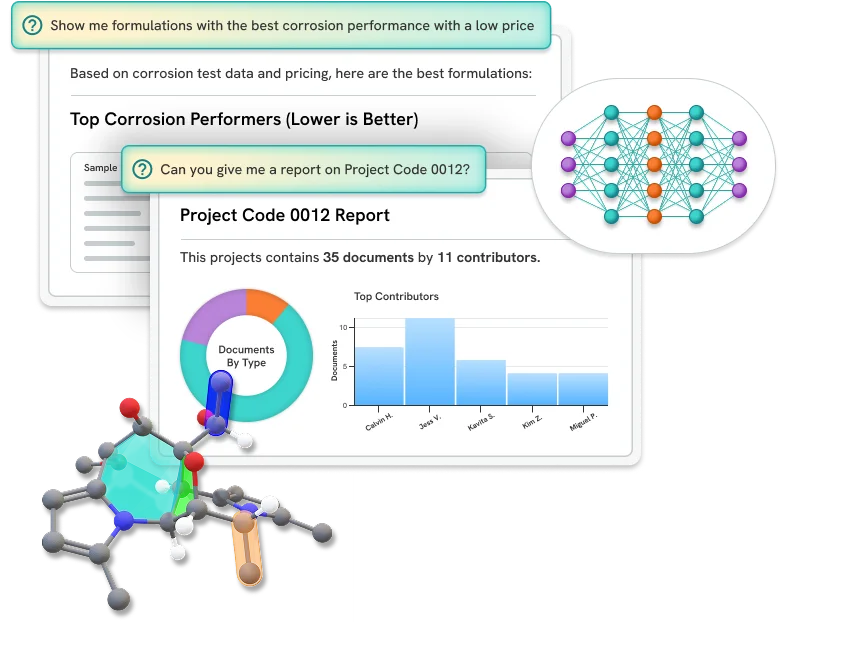

Increase Research Impact with Native Agentic Intelligence
With Signals AI, scientists spend less time searching and more time discovering. Interactive, context-aware answers replace static outputs. Hypotheses are generated, data dynamically recast, and results shared, all within Signals. For R&D organizations, this translates into measurably higher efficiency, greater accuracy, and a stronger probability of success at every stage.
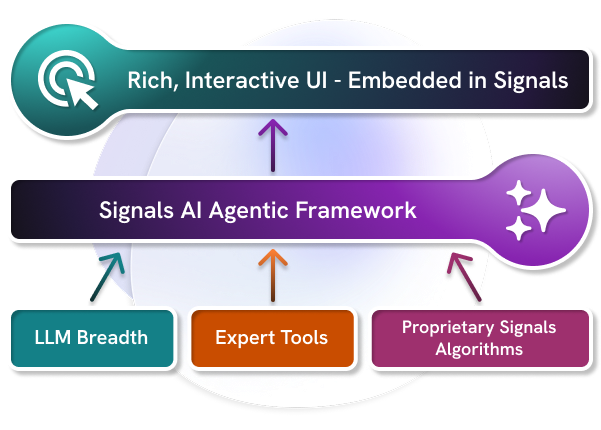
Signals AI is a native agentic framework: LLM breadth provides general reasoning and broad scientific understanding; expert tools deliver purpose-built rendering for scientific content; proprietary Signals algorithms supply proven chemical and biological intelligence. Orchestrated as one, these three pillars form the intelligence layer of Signals One, always within the user's context.
Raise Probability of Success
Propel your research with AI that truly accelerates discovery. Signals AI automates data analysis, surfaces hidden patterns, and operationalizes models to generate ideas and predict outcomes, enabling faster, better decisions.
Let Signals AI handle the heavy lifting while you focus on innovation. Our intelligent algorithms help you generate ideas, search, predict, report and summarize to accelerate time-to-discovery across your entire research pipeline.
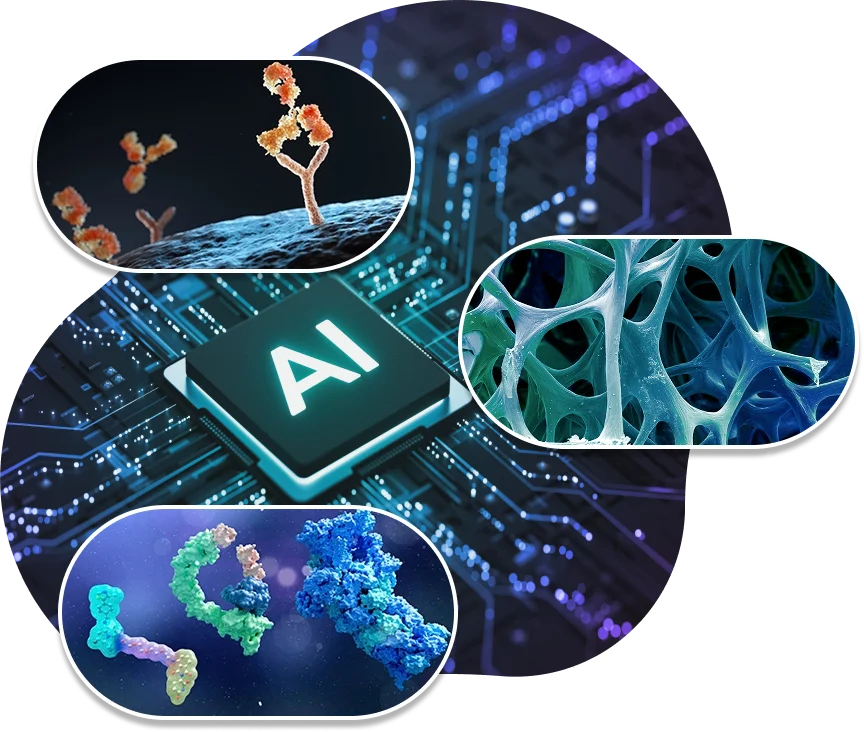
Empower your Research with Signals AI Solutions


Leveraging the power of AI within secure, reliable solutions that power scientific progress.








Resources
Leverage AI to Unleash Your Science


Signals AI FAQs
Revvity Signals embeds AI across the full R&D lifecycle: from digital research assistant and semantic search in Signals One, to AI-powered clinical listing generation in Signals Clinical, to molecular design operationalized by Signals Xynthetica. Rather than bolting AI onto existing tools, Revvity Signals takes an "AI-first" approach, delivering capabilities directly inside the workflows scientists already use — in pharma, biotech, and materials sciences alike.
Most informatics platforms address AI at the feature level (a copilot here, a search assistant there) without connecting predictive models to the experimental data that validates them. Revvity Signals takes a fundamentally different approach: a unified platform spanning data management (Signals One), domain-specific AI model access (Signals Xynthetica MaaS), and a federated learning framework — all governed, compliant, and applicable across pharma, biotech, and materials sciences. The result is an end-to-end, continuously improving AI ecosystem built on proprietary experimental data — not a collection of standalone tools stitched together after the fact.
Revvity Signals makes data "AI-ready" before any model is applied: Signals One standardizes assay data across biology, chemistry, materials, and formulation workflows, and is built on FAIR principles (Findable, Accessible, Interoperable, Reusable) to ensure data quality from the outset. AI tools are only as effective as the underlying data — which is why unifying and structuring data is the foundational pillar of the Revvity Signals AI strategy.
Revvity Signals pursues a three-pronged strategy: embedding LLMs and generative AI into current workflows for immediate productivity gains; providing access to domain-specific scientific models through Signals Xynthetica; and making data AI-ready as the foundational prerequisite for all of it. The goal is to help pharma, biotech, and materials science organizations reduce experimentation cycles by an order of magnitude — not by replacing human expertise, but by amplifying it.
Revvity Signals operates on a Zero Trust architecture with AES-256-bit encryption for data at rest and in transit, weekly vulnerability scans, and strict data segregation — ensuring proprietary research data is never exposed or shared without consent. The platform holds SOC 2 Type 2, ISO 27001, and CIS certifications, independently verified by third parties.
Yes — Signals One and Signals Xynthetica are cloud-native SaaS offerings, so organizations of any size can access governed AI models without building AI infrastructure. The Lilly TuneLab collaboration additionally co-funds access for selected biotechs, democratizing models previously available only to large pharma.
Signals Xynthetica is Revvity Signals' Models-as-a-Service (MaaS) offering that unifies in-silico generation, property prediction, multi-objective optimization, and experimental validation in a single governed environment — applicable to both molecular and materials design. Its differentiator is that AI models operate directly where experimental data is already captured, creating a continuous design-predict-validate loop that improves model accuracy over time.
In early 2026, Revvity announced a partnership with Lilly to deliver TuneLab's predictive models, trained on decades of research data, to the broader scientific community via Signals Xynthetica, using a federated framework. This allows organizations to access world-class models while keeping their proprietary data private and secure, without needing to build or maintain AI infrastructure themselves.



Ready to take the next step?

Explore New AI Features
Discover how AI-powered design is converging with experimental science with Signals Xynthetica™.

TuneLab™ at Revvity
Discover how Lilly TuneLab models will be directly accessible from Signals One

Get in Touch
We’re here to help with any questions about our products, pricing, implementation or beyond.