
From Design to Decision
A Connected Approach to Accelerating Biologics Discovery

Modern Discovery is Fragmented
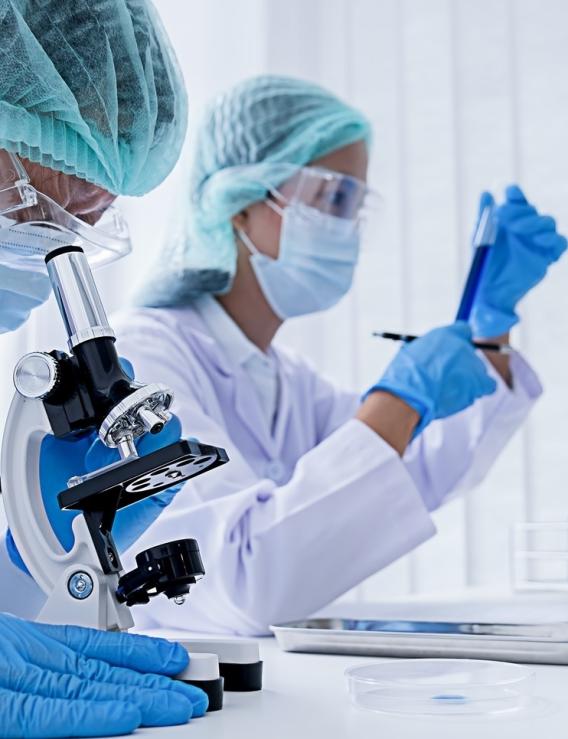
Today’s scientific teams operate across a wide range of modalities, disciplines, and organizational structures, each with its own workflows. Even within a single company, individual needs differ from one end of the development pipeline to the other. Bench scientists need flexible electronic laboratory notebook (ELN) workflows that won’t get in their way while they’re engaged in exploration and discovery. Assay scientists have a whole different set of requirements; for them, structure, repeatability, and tightly controlled processes are essential. Analytics teams, meanwhile, need coherent, well-contextualized data across experiments to support informed and confident decision-making.
To support these different groups, many organizations rely on a patchwork of point solutions, each optimized for a specific task but rarely designed to work together. This approach introduces real risk, especially in today’s high-speed, data-driven world of biologics development. Revvity Signals products share a common technology framework, enabling seamless integration, connected data, and intuitive movement across the ecosystem.
The Cost of Point Solutions
When exploratory research and process-driven workflows operate in different universes—the result of relying on a daisy chain of siloed software solutions—handoffs between teams are difficult, institutional knowledge is limited, and instead of doing science, scientific teams are overburdened with manual data entry and low-value rework.
These problems multiply as companies add new modalities to their pipeline, such as antibodies, peptides, proteins, cell and gene therapies, and mRNA vaccines. Each modality introduces additional layers of complexity. As scientists spend more time navigating this complexity, there’s little organizational bandwidth left to implement AI-driven workflow tools and other advanced digital strategies. Companies caught in this capabilities gap may be left behind as the industry moves further into the digitalization era.
In the absence of a more effective approach, these challenges multiply, introducing friction each time teams generate and share large volumes of data. To better understand both the impact of this friction and potential solutions, the team behind Signals One™ has been studying key scientific workflows across modalities, with special consideration for the challenges unique to each one. As a starting point, this white paper focuses on one of the most foundational of these workflows: cell line propagation and creation.
Spotlight on Cell Line Propagation and Creation
Cell entities, whether propagated or engineered, are the backbone of both exploratory and regulated science. They must be reliable, traceable, and consistently recorded; even small gaps or irregularities in documentation can impact the confidence of downstream teams.
For that reason, the cell line propagation and creation workflow provides a useful lens for examining the structural challenges that arise in fragmented, point-solution environments, and the possibility of addressing these challenges with a different type of environment: one that’s unified across an ecosystem of software solutions.
Where Traditional Point Solutions Break Down
Uncoordinated Ownership of Cell Entities
Scientists rely on a shared understanding of a cell line’s versioning, provenance, and availability. This source of truth is essential for ensuring reproducibility and confident decision-making. But getting there is tricky when cell line data is scattered across external registries or in databases maintained by multiple internal groups. As different teams propagate or engineer the same cell lines under varying conditions, parallel variants emerge. When those variants are poorly documented or inconsistently named, it becomes difficult to know which cell entity is which, making rigorous interpretation and comparison a challenge.
Lineage Complexity Generates Confusion
From propagation to differentiation to cryopreservation, each step in this workflow introduces new branches in a cell line’s history, particularly when genetic engineering is involved. For scientists working across disconnected systems without a standardized approach to capturing lineage, tracking this data can be a source of frustration. That pain is often passed along from team to team, amplifying with each handoff and making it difficult to assess reproducibility, investigate unexpected results, or reconstruct a particular cell entity.
Important Metadata Gets Lost
To interpret a scientific result systematically and comprehensively, scientists must reference a cell line’s growth conditions, engineering parameters, quality control results, aliquot or cryostorage details, and other experimental metadata. When that data is scattered across spreadsheets, PDFs, and other ad hoc documents, this systematic analysis is time-consuming at best and, at worst, nearly impossible.
When a Data Management Solution Supports the Science
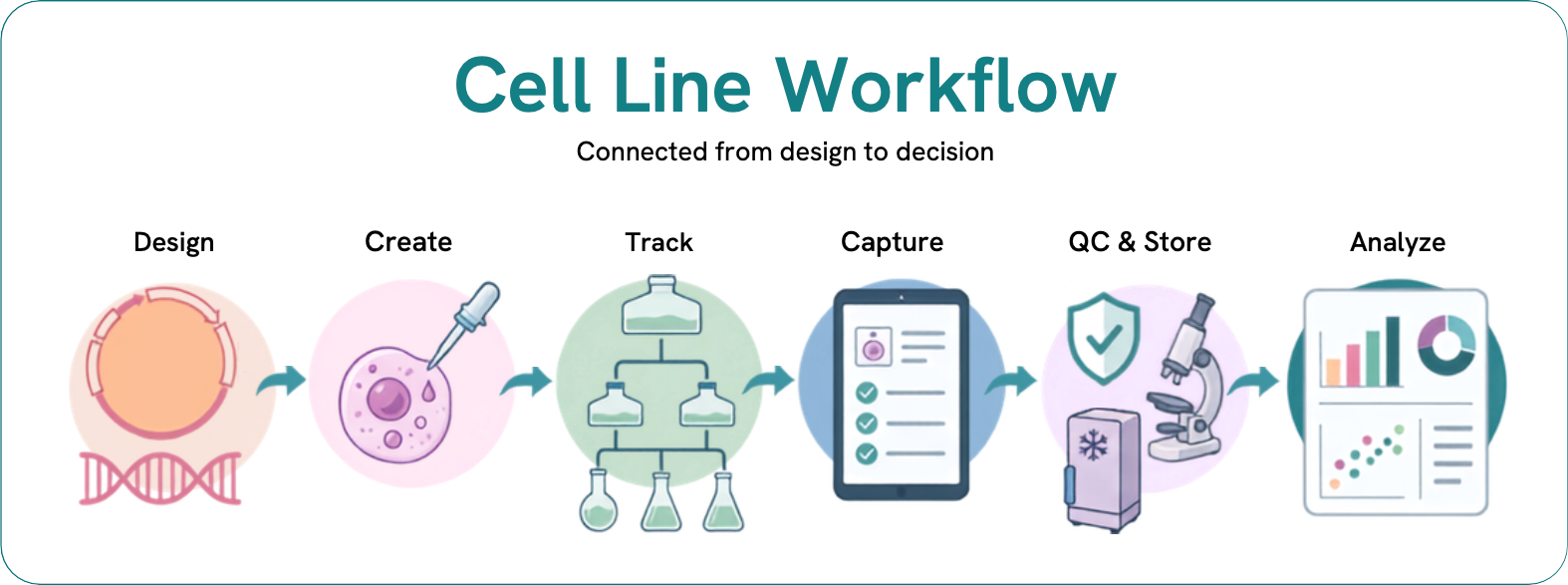
By anchoring cell line workflows in an ecosystem of software solutions, scientific teams can address these structural challenges at their source.
From Uncoordinated Ownership to a Single Source of Truth
By working in an ecosystem of connected solutions, scientific teams can establish and maintain a shared understanding of cell line identity, provenance, and availability. A unified cell line registration, integrated directly with the ELN, provides a single authoritative point of reference for cell entities as they evolve over time. With standardized terminology and an internal library of versioned protocols to rely on, scientists can leave ambiguity behind and feel confident that they’re working from the same source of truth, even as propagation and cell line engineering continue.
From Lineage Confusion to End-to-End Traceability
To continue building integrity into the experimental process, scientists need reliable lineage tracking that’s native to the ELN. This foundation enables robust secondary analysis, which in turn supports consistent, like-for-like comparisons across cell line workflows. By reducing the friction involved in recording and contextualizing every transformation in a cell line’s lifecycle, this approach ensures that scientific teams can trace exactly how a cell entity was created.
From Lost Metadata to Structured, Accessible Knowledge
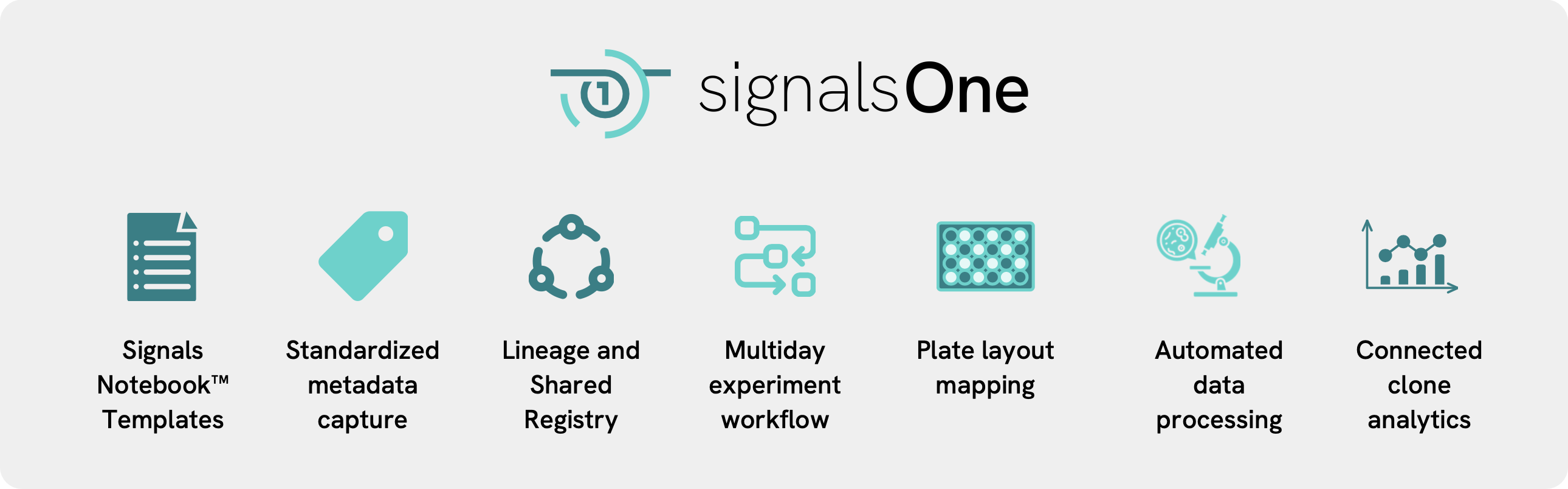
Trial-ready templates support the needs of both bench scientists and protocol-driven assay scientists by making it easy to capture standardized data at each step, without overburdening team members with administrative tasks. As a result, critical metadata doesn’t disappear in disconnected files; instead, it’s structured, searchable, and linked to the cell entity and its lineage. This consolidation creates a trusted foundation for analytics, giving teams greater confidence in their insights and the decisions that follow while reducing costly rework and duplication.
Different Workflows, Same Challenges
In practice, many organizations engage workflows that are far more complex and specialized than the relatively “simple” task of cell line propagation and creation—workflows involving in-vitro systems or plate-based assays with imaging, for example. In such scenarios, scientific teams need a way to capture nuance without sacrificing ease of execution or reproducibility.
When a Data Management Solution Supports the Science
Scientists rely on a robust CIS registration and testing workflow to enable unbiased, “apples-to-apples" comparisons across experiments.
That’s not easy to establish, especially given that CIS experiments can take days and involve multiple interdependent steps such as differentiation, organoid derivation, growth, and dosing. At each step, the volume of experimental metadata increases, often spanning multiple systems and formats. Data that’s stored outside of a given point solution, such as imaging or omics outputs, adds to this complexity.
What Changes with a Connected Data Management Solution:
With structured, multiday experimental templates in place and built-in checkpoints to enable clean restarts if something goes wrong, scientific teams working from an ecosystem of software solutions can share data with minimal friction and ensure that they’re working from a single, traceable scientific record.
Plate-Based Assays with an Imaging Endpoint
High-content imaging generates a large volume of data and introduces additional layers of interpretation, making reproducibility difficult to maintain across runs or between different sites and scientific teams. Some teams handle this complexity manually by entering or annotating data themselves, but this approach increases the risk of bias and human error. Meanwhile, disconnected imaging and assay systems impair a team’s ability to compare results.
What Changes with a Connected Data Management Solution:
With the right solution in place, teams can rely on an automated flow of data between imagers, plate readers, and analytics tools, reducing the risk of user-to-user variability. The result is a consistent link between assay results, imaging outputs, and experimental context, giving scientific teams confidence when comparing outcomes across different experiment runs, sites, and conditions.
Plate-Based Assays with an Imaging Endpoint
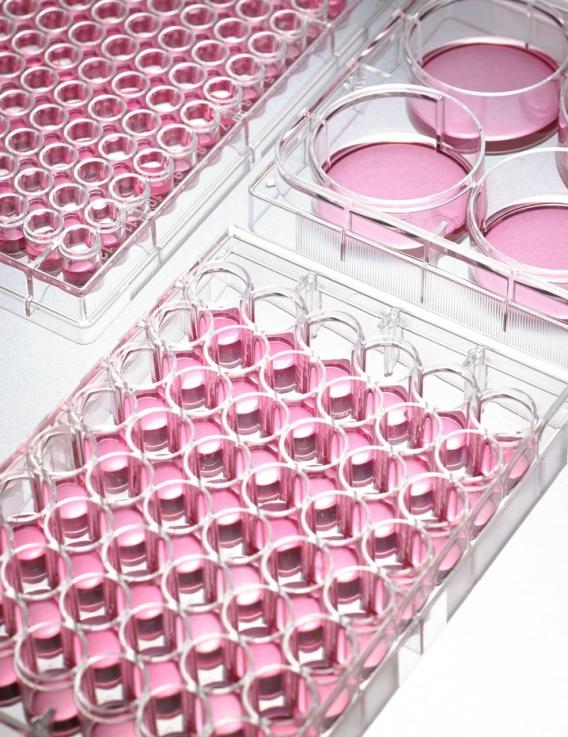
High-content imaging generates a large volume of data and introduces additional layers of interpretation, making reproducibility difficult to maintain across runs or between different sites and scientific teams. Some teams handle this complexity manually by entering or annotating data themselves, but this approach increases the risk of bias and human error. Meanwhile, disconnected imaging and assay systems impair a team’s ability to compare results.
What Changes with a Connected Data Management Solution:
With the right solution in place, teams can rely on an automated flow of data between imagers, plate readers, and analytics tools, reducing the risk of user-to-user variability. The result is a consistent link between assay results, imaging outputs, and experimental context, giving scientific teams confidence when comparing outcomes across different experiment runs, sites, and conditions.

Toward an End-to-End Ecosystem of Solutions for Scientific Workflows
All scientific workflows share a common need for connected, well-governed, end-to-end data they can trust. To meet that need, organizations must move away from isolated point solutions and toward a cohesive ecosystem that supports science from early exploration through further development. That’s the vision behind the Signals ecosystem, which is expanding to include two new solutions—a major step toward a more connected, streamlined future of data-driven scientific discovery.
Signals BioDesign
Extending Workflow Readiness for Molecular Biology and Construct Design
Molecular biology and cloning workflows are foundational to exploratory research and advanced development. Constructs designed at this molecular level often serve as the starting point for further downstream experimentation; in other words, these upstream design workflows feed directly into engineered cell line development. This reinforces the importance of capturing early design context and connecting it to experimental execution and lineage tracking, ensuring clarity across a cell line’s lifecycle.
The software supporting these workflows must evolve alongside the science, helping teams sustain continuity and clarity from one end of a biologics program to the other. Signals BioDesign aims to meet this need. As a key part of the broader Signals ecosystem, it will extend the same principles of connectivity and traceability into construct design, giving scientific teams the capabilities they’ve historically been missing:
- Simpler, browser-based cloning: Signals BioDesign brings construct design into a unified, cloud-driven environment, reducing complexity and addressing issues related to version sprawl, accidental overwrites, and ambiguity regarding which construct is most current.
- Streamlined, enterprise-ready capabilities: Signals BioDesign is built to support parallel and combinatorial workflows at enterprise scale. Multiple scientists can design, modify, and register construct variations concurrently without compromising traceability or data integrity.
-
Looking ahead: A shared construct record across teams and partners: Signals BioDesign will evolve to offer a central construct record. This will allow scientific teams to collaborate smoothly across sites and between external partners, including CMOs, while maintaining alignment from initial design through later stages of development.
Drug Discovery for the Digital Age
As biologics discovery grows more complex, the limitations of fragmented environments built around point solutions are increasingly hard to ignore. The fact is, scientific teams need more than standalone tools. They need connected systems that reflect how science is actually done: collaboratively, iteratively, and backed by an ever-expanding volume of complex data.
Revvity Signals is building a network of solutions designed to address those needs head-on. By connecting data, workflows, and teams within a cohesive software environment, the Signals ecosystem helps organizations leave software sprawl behind and move toward comprehensive, interoperable scientific workflows. In that vision of the future, scientists are not only more efficient but also more confident, because every decision they make is grounded in a trusted, end-to-end scientific record.
Want to see Signals One in action? Request a demo today.
New in 2026!
For Coordinating Complex Scientific Workflows.
Managing scientific workflows across dozens of teams working in parallel is inherently complex. Historically, companies have navigated this complexity using existing laboratory informatics systems (LIMS, ELN, LES, and MES), but that approach can impede the flow of data between teams or drug development phases.
The Signals ecosystem is designed to harmonize this fragmented exchange of data. Coming in 2026, Signals LabGistics extends the capabilities of this ecosystem even further, building on today’s informatics investments rather than replacing them. Designed with coherence, efficiency, and scalability at its core, it’s a forthcoming workflow orchestration solution that streamlines the end-to-end flow of complex scientific data such as bioprocessing data. The result is shorter discovery timelines, smoother collaboration between teams, and improved scalability as discovery programs move into manufacturing.

End-to-end workflow support across scientific disciplines.

The Standard for Chemical Drawing.
End-to-end Clinical Data Science Platform.