
Absolv™
Calculate Abraham Solvation Parameters
Predict solvation-associated properties from chemical structure to support solvent selection and compound behavior analysis.

Trusted By Companies Worldwide






Explore
Predict Solvation-Associated Properties from Chemical Structure
Calculate Abraham Solvation Parameters and various solvation-related properties of solutes, directly from structure.
Use Absolv™ to:

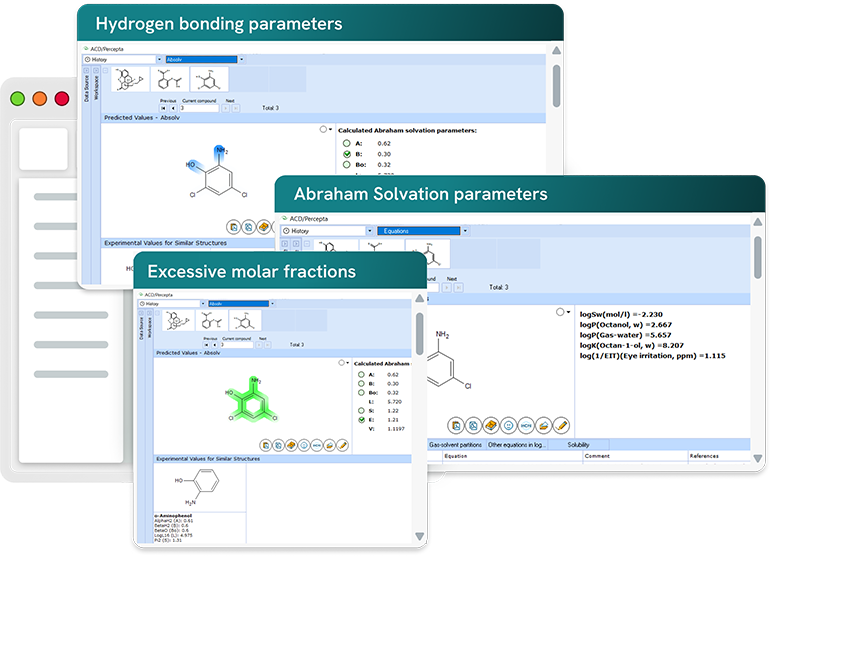
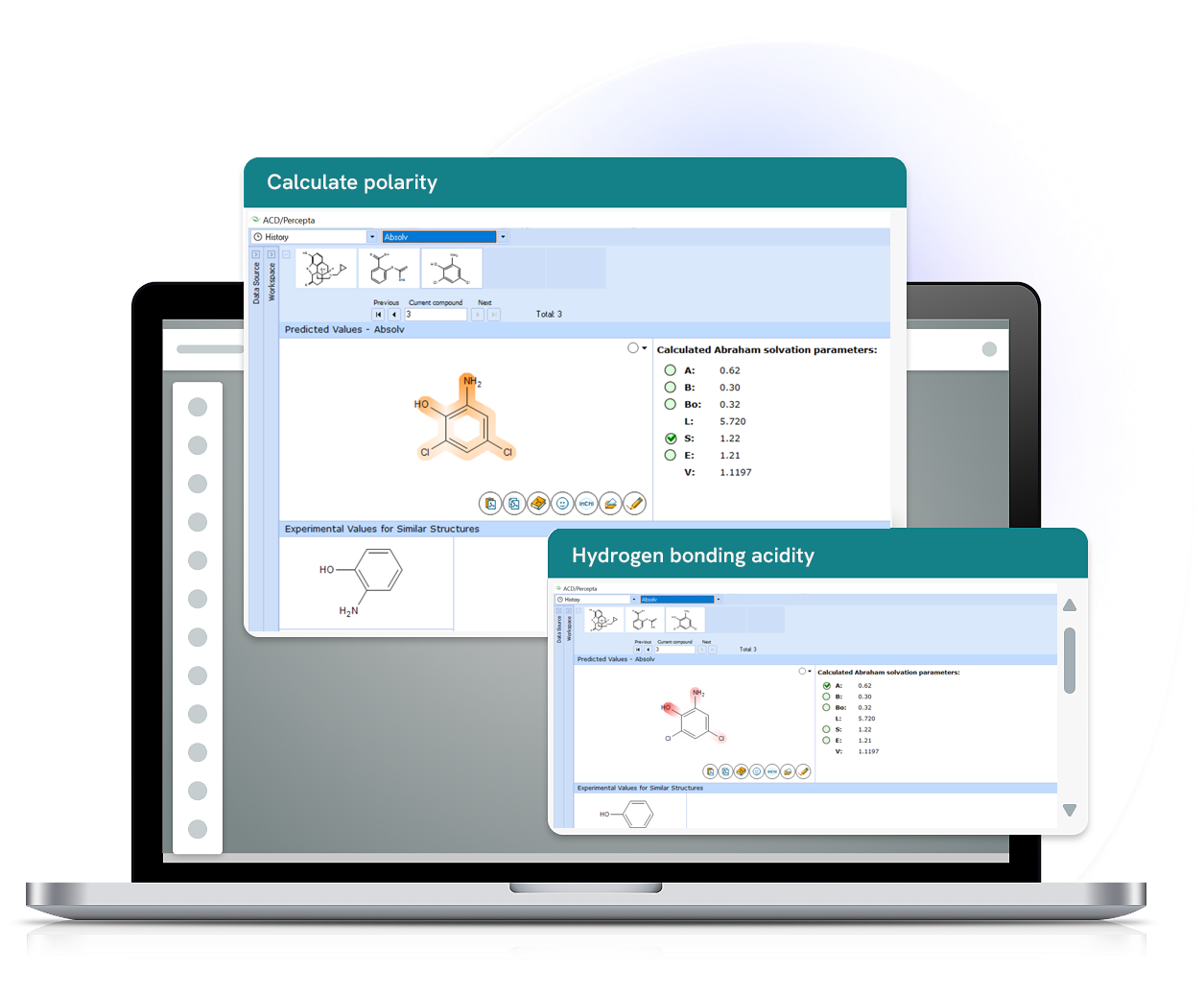
Predict solvation parameters A, B, BO, E, S, L, and V.

Calculate various solvent-solvent or gas-solvent partition coefficients.

Visualize the contributions of each atom in the structure to each Abraham solvation parameter and assess the relevance of the result.

Access a database of Abraham coefficients for more than 5,000 compounds.
Benefits
Everything You Need in a Calculator for Abraham Solvation Parameters


Accurate, Reliable Results
- Developed in collaboration with Prof. M. H. Abraham—author of the Abraham general solvation model.
- Easily evaluate the reliability of the result with reliability index, a display of similar structures in the database, and literature references for the original experimental data.


Convenient Visualization
- See the contribution of each atom to a parameter with color-mapping on the structure.
- User-defined color-coding of results in a spreadsheet helps you identify favorable and unfavorable compounds in a library.

Deeper Insights
- Identify trends and prioritize compounds easily—create scatter plots, browse, filter, sort, and rank libraries.
- Calculate various solvent-solvent or gas-solvent partition coefficients from more than 100 predefined Abraham-type equations.

Absolv FAQs
Abraham solvation parameters are molecular descriptors used to characterize how a compound interacts with its environment through properties such as hydrogen bonding, polarity, polarizability, and molecular size. They form the basis of the Abraham solvation model and are widely used in QSAR, environmental chemistry, and property prediction.
The quantitative solute properties calculated by Absolv are:
- A—Hydrogen bonding acidity of solute (Σα2H)
- B and BO—Hydrogen bonding basicity parameters (Σβ2H–B and Σβ2O–BO)
- S—Polarity/polarizability (π2H)
- L—Partitioning coefficient between gas phase and hexadecane (logL16)
- V—McGowan volume characteristic (Vx)
- E—Excessive molar refraction (R2)
Together, these descriptors provide a quantitative representation of solute behavior and are used in predictive modeling and property calculations.
Absolv is most reliably applicable to small-to-medium-sized compounds for which solvation is dominated by the intermolecular interactions represented by the Abraham descriptors, including dispersion and cavity effects, polarity and polarizability, and hydrogen-bond acidity and basicity. The training sets contain a range of relatively simple high-production-volume (HPV) and environmental chemicals, including hydrocarbons and mono-functional compounds such as alcohols, ethers, aldehydes and ketones, amines, nitriles, nitro compounds, and halogenated hydrocarbons. For drug-like compounds containing multiple functional groups and heteroatoms, the applicability can be reasonably summarized as the classic Lipinski Rule-of-5 chemical space.
An important limitation is that the Absolv models implemented in Percepta are based on the original work of Prof. M. H. Abraham and do not include the later extension involving J+ and J− parameters. Predictions are therefore applicable to non-electrolytes or the neutral species of compounds that can become ionized.
Yes. Absolv can use the concept of Linear Solvation Energy Relationship (LSER) equations to calculate solvation-related properties, including partition coefficients. Within Percepta, the Absolv Equations module contains 252 pre-defined equations, primarily for calculating water-solvent partition coefficients (logP) and gas-solvent partition coefficients (logK), as well as other, more complex partitioning-related properties such as human skin permeation, baseline aquatic toxicity, nasal pungency, and solubility. Users can also add custom equations in the same format.
The Abraham solvation equations find widespread use in environmental chemistry where these simple models can provide quick estimates of the behavior of new compounds. The solvation parameters (A, B, BO, E, S, L, and V defined above) characterize the hydrogen bonding potential of a compound. They are essential characteristics of solutes and key determinants of many biological properties.
Abraham solvation parameters can be used as molecular descriptors in QSAR to develop predictive models for properties and endpoints related to solubility, partitioning, permeability, environmental behavior, and biological activity.
Absolv is available as a desktop application (thick client), batch processing for high-throughput workflows on Windows and Linux, and via Percepta Portal (thin client) for browser-based access or a number of APIs for programmatic access to a corporate calculation server (Percepta Kernel).
Predictive algorithms for each Abraham solvation parameter were developed using experimental data from more than 5,700 compounds. The models use a fixed set of Platts-type fragmental descriptors, PLS for statistical analysis, and additional optimization procedures.
The underlying approach assumes that Abraham-type equations (LSERs), while intended for whole-molecule applications, can also be applied to the molecular fragments used in the model. For example, the contribution of a carboxylic acid fragment to each Abraham solvation parameter should be related to its contribution to the whole-molecule logPoct value through the corresponding solvation equation (LSER). The fragmental coefficients derived from the initial PLS analysis were therefore further fitted against independently determined fragment contributions across several partitioning systems, improving the accuracy and robustness of the models.


Ready to learn more?

Talk to Our Team
Connect with a solutions expert to discuss what you need and explore best pricing options for you.

Beyond solvation calculations
Explore the full predictions capabilities of Percepta Suite from pKa and logP calculations to full ADME and tox assessments.

Stay up to date
Stay up-to-date on all the latest insights, research and product news from Revvity Signals.