
PhysChem Suite™
Calculate Physicochemical Properties
Predict logP, logD, pKa, aqueous solubility, and other key physicochemical properties from chemical structure

Trusted by Companies Worldwide



















Explore
Understand the Properties That Drive Molecular Behavior
The physicochemical properties of a molecule can help you better understand its likely behavior, support QSPR high-throughput screening (HTS) of libraries, and enable data-driven lead optimization.

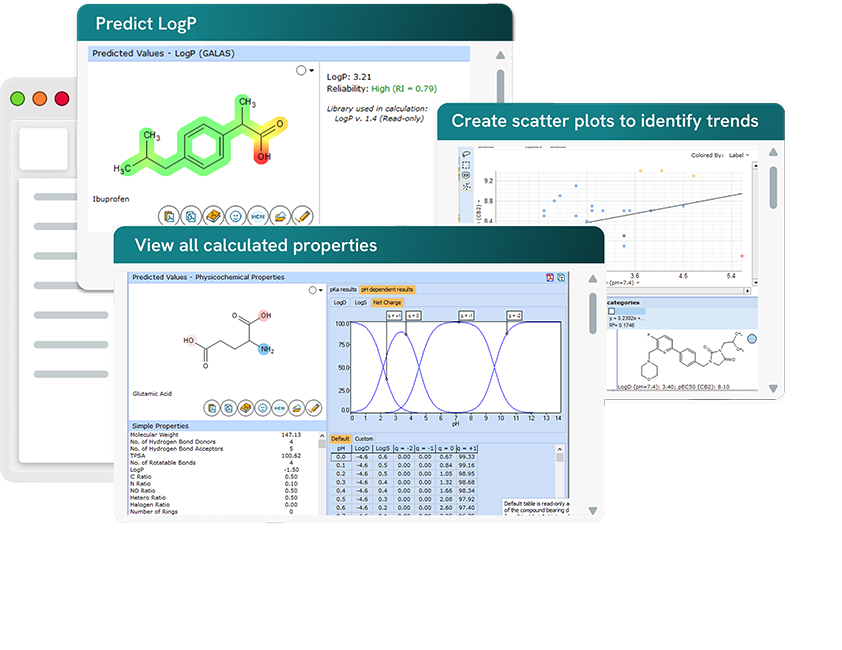
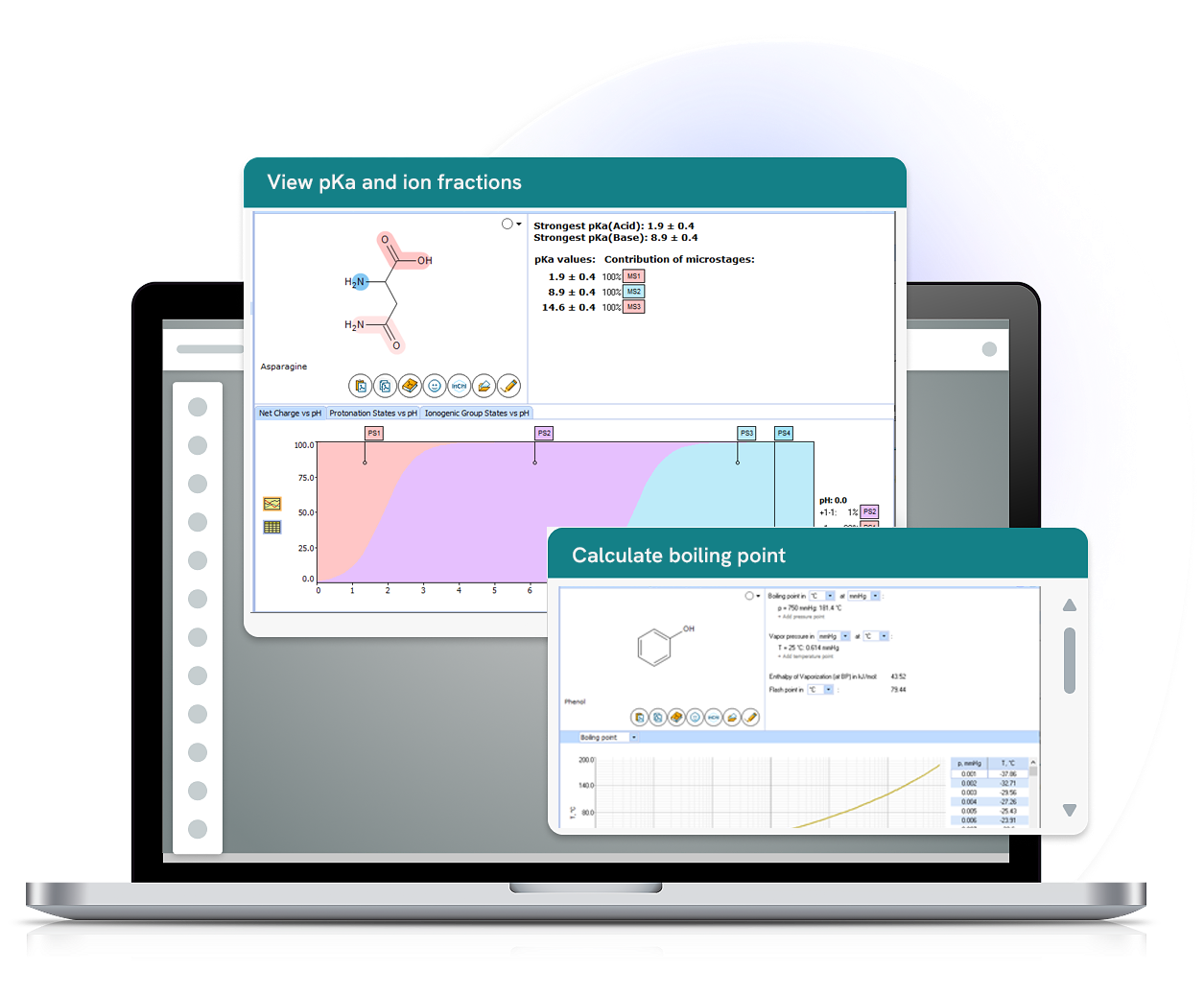
Predict physicochemical properties from structure including aqueous solubility, boiling point, logD, logP, pKa, Sigma, and other molecular descriptors for organic compounds

Evaluate results and assess prediction reliability using sorting and plotting tools, reliability metrics, and supporting data

Investigate structure-property relationships to support lead optimization, structure modifications, and target profile development

Train models with experimental data and incorporate in-house algorithms to better reflect novel chemical space
Benefits
Everything You Need in a Physicochemical Property Calculator


Easy to Use
- Simply draw your structure for predictions. PhysChem Suite makes makes property prediction easy for medicinal, synthetic, and research chemists
- Train models code-free. No programming or computational chemistry experience is required to improve prediction accuracy for novel chemical space.


Fast, Accurate, Reliable Results
- Quickly calculate properties for single compounds or tens of thousands
- Predictions are based on carefully curated databases of experimental data
- Easily evaluate the reliability of results using a reliability index, similar structures, and literature references.

Improve Predictions with Machine Learning
- Get the accuracy of an in-house model from a commercial platform by training with your own experimental pKa data
- Expand the applicability domain into proprietary chemical space using project-specific data
- Build curated training sets for each project to achieve fine-tuned prediction accuracy

Deeper Insights
- Identify trends and prioritize compounds easily with tools to create scatter plots, browse, filter, sort, and rank libraries
- Make decisions confidently with a complete property profile of each molecule in one place

Convenient Visualization
- Visualize the substructure/atomic contributions to a property value with color-mapping on the structure
- Quickly identify favorable and unfavorable compounds in a library with user-defined color-coding of results in the spreadsheet

Augment Structured Data for AI/ML
- Annotate large structured datasets with physicochemical, ADME and toxicity property predictions to provide additional context before feeding them into machine learning (ML) and artificial intelligence (AI) models
Physicochemical Property Predictions You Can Trust


PhysChem Suite FAQs
PhysChem Suite predicts core physicochemical properties including:
- LogP*
- LogD
- pKa*
- Aqueous solubility*
- Boiling point/vapor pressure
- Substituent constants from various LFER models (e.g., sigma para and sigma ortho from Hammett analysis)
*Trainable Modules
As well molecular descriptors including:
- Molecular Weight
- Density
- Freely Rotatable Bonds
- H-Bond donors and acceptors
- Index of Refraction
- Molar Volume
- Polar Surface Area
- Polarizability
- Rule-of-5
- Surface Tension
Yes, PhysChem Suite supports physicochemical property prediction across a wide chemical space, including complex beyond Rule-of-5 compounds such as PROTACs and other large, flexible molecules.
The underlying models have been extended and refined using additional experimental data to improve coverage of emerging modalities, helping maintain prediction performance even in structurally complex chemical space.
Yes—logP, pKa, and aqueous solubility modules can be trained using public and proprietary experimental data to improve prediction accuracy and better reflect an organization's specific chemical space. Adding new experimental data helps extend the model applicability domain and improve performance for compounds relevant to internal research programs.
Training prediction models with reliable in-house experimental data can improve prediction accuracy for proprietary and novel chemical space. Commercial prediction models are typically built using publicly available datasets and may not fully represent the compounds being investigated in a specific research program. Training helps expand the model applicability domain, reduce prediction error for relevant chemistries, and can save time compared to building and validating entirely new models from scratch.
PhysChem Suite is used by scientists in pharmaceutical, biotechnology, agrochemical, environmental, and consumer product industries, as well as academic researchers, to support structure-based prediction of physicochemical properties.
It is applied in drug discovery to support ADMET assessment and lead optimization, in agrochemical development to evaluate distribution and environmental impact, in environmental science to model compound behavior in water and soil, in formulation, and in materials research to model compound behavior and support product development.
Prediction models developed by different vendors may use different statistical techniques, training datasets, and approaches, which can lead to differences in performance across chemical classes and applicability domains. Comparing predictions from multiple sources can help scientists improve confidence, broaden chemical space coverage, and identify compounds that may require additional investigation.
Different prediction models may perform differently depending on chemical class, molecular complexity, applicability domain. Providing multiple prediction models allows scientists to compare approaches, evaluate prediction confidence, and select methods appropriate for their specific chemical space and workflows. This multi-model approach provides broader coverage of chemical space compared to relying on a single prediction method. Some models may also offer advantages in calculation speed, making them suitable for high-throughput screening or large-scale compound profiling.
For example, PhysChem Suite provides multiple prediction algorithms for both logP and pKa calculations. LogP predictions are available using Classic, GALAS, and Consensus models, while pKa predictions can be performed using Classic and GALAS algorithms.
The way PhysChem Suite assesses prediction reliability depends on the modeling methodology used.
Classic models express reliability using confidence intervals around the calculated property value. An uncertainty range comparable to the typical experimental measurement error for the property indicates high reliability, while larger uncertainty ranges indicate lower reliability. Rule-based warnings also identify predictions that may fall outside the model’s applicability domain, for example, when the predicted value is far outside the range of experimental values in the training set or the compound contains unknown fragments.
GALAS models use a Reliability Index (RI), ranging from 0 (lowest reliability) to 1 (highest reliability). Each prediction is automatically assigned a reliability classification, from Not Reliable, indicating that the compound is completely outside the applicability domain, to Highly Reliable, based on its RI value.
Consensus models do not provide an intrinsic quantitative reliability measure because they combine methods that use different approaches to assess reliability. However, the reliability information from the Classic and GALAS models is used to determine the weighting of their predictions in the Consensus value. The reliability of a Consensus prediction can therefore be assessed by examining the reliability of the contributing Classic or GALAS prediction with the greater weight.
Yes. PhysChem Suite provides several options for comparing physicochemical properties across large compound libraries. The Spreadsheet workspace, available in all GUI-based deployments, allows predictions for multiple compounds to be compared side-by-side and is suitable for libraries ranging from tens to thousands, and even low tens of thousands, of compounds.
For larger libraries, PhysChem Suite Batch and PhysChem Suite Kernel can generate predictions for virtually unlimited numbers of compounds and export selected properties to standard SDF or delimited TXT files. These results can then be used for analysis, comparison, visualization, or as inputs for custom AI/ML model development.
Yes. PhysChem Suite supports integration of third-party and in-house models within computational workflows via a number of programmatic APIs such as RESTful webservice, including integration through platforms such as KNIME. This enables predictive molecular property data to be incorporated into existing modelling, automation, and AI/ML pipelines.
PhysChem Suite is available as a desktop application (thick client), batch processing for high-throughput workflows on Windows and Linux, and via Percepta Portal (thin client) for browser-based access or a number of APIs for programmatic access to a corporate calculation server (Percepta Kernel).


Ready to generate reliable property predictions for faster, more confident decision-making?

Request a Quote
Connect with a solutions expert to discuss what you need and explore best pricing options for you.

Talk to Our Team
Schedule a consultation with our scientific solutions experts to discuss your specific research workflows, requirements, and implementation needs.

Stay up to date
Stay up-to-date on all the latest insights, research and product news from Revvity Signals.