
MS Fragmenter™
Predict MS Fragments for Your Compound
Predict MS fragmentation patterns from molecular structure to support confident compound identification, structural elucidation, and interpretation of mass spectra.

Trusted By Companies Worldwide






Explore
Rules-Based Fragment Prediction for Mass Spectrometry
MS Fragmenter helps you predict mass spectral fragmentation in seconds. Have more confidence in your compound IDs, learn about fragmentation mechanisms, and publish your results easily.
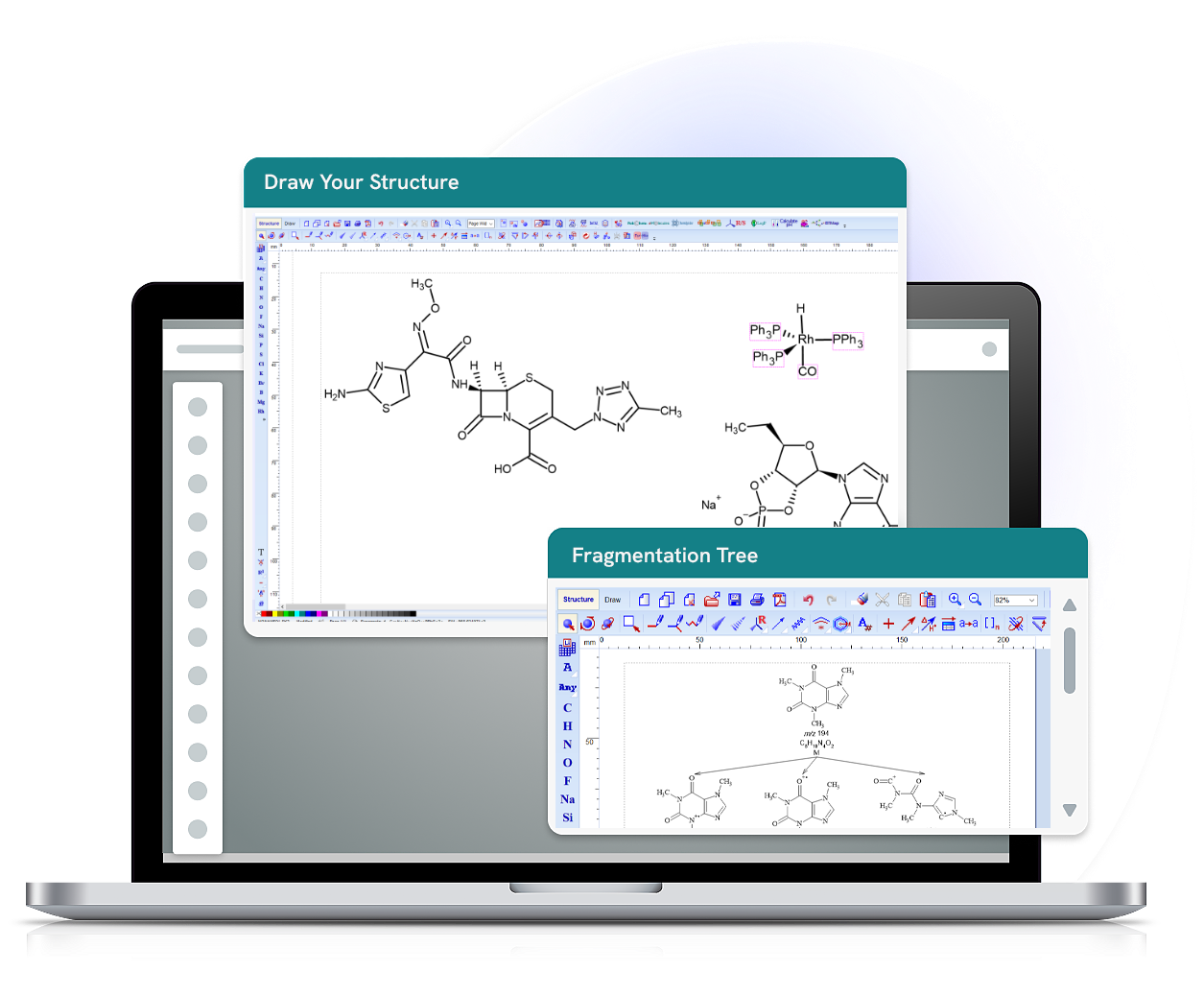
It’s as simple as this:

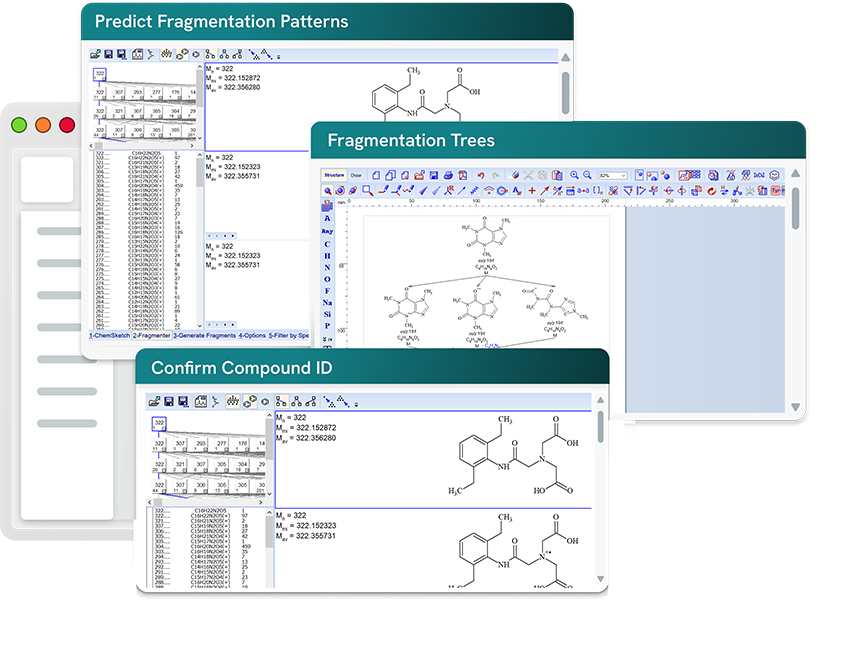
Draw your compound

Select the ionization polarity and fragmentation options

View its fragmentation tree
Benefits
Accelerate Compound Identification with MS Fragmenter


Predict MS Fragmentation Patterns
- Draw a structure and see its complete fragmentation tree
- Select ionization and reaction type


Confirm Your Compound IDs
- Have confidence that your spectrum shows the compound you’re expecting
- Select an experimental spectrum, and the software will compare the predicted fragments with the spectral peaks

Quickly Compile Fragmentation Pathways for Publication
- Compile mass spectral fragmentation pathways for reports or publications with a few clicks
- Edit the results template to suit your needs


MS Fragmenter FAQs
MS Fragmenter is a mass spectrometry software tool that predicts MS fragment ions directly from a chemical structure. It helps chemists interpret mass spectra, assign fragment ions, and confidently characterize compounds without prior experimental data. It is widely used in impurity profiling, metabolite identification, and unknown compound characterization across pharmaceutical and chemical research.
MS Fragmenter is designed for analytical chemists, mass spectrometrists, and scientists in pharmaceutical, biotech, chemical, and environmental industries. It supports small molecules including APIs, metabolites, impurities, degradants, and reaction mixtures, helping teams accelerate structure elucidation and improve confidence in analytical decision-making.
Identify unknown compounds by matching experimental MS/MS fragment ions to predicted fragmentation patterns from candidate structures. MS Fragmenter supports data acquisition, candidate structure generation, in silico fragmentation prediction, and spectral comparison—helping scientists quickly prioritize, confirm, or eliminate structures with higher confidence and faster decision-making.
Yes, MS Fragmenter compares predicted fragmentation patterns with experimental mass spectra to confirm structural assignments. It uses advanced algorithms to match theoretical fragments against observed peaks, enabling confident structure elucidation, impurity identification, and metabolite characterization with visual comparison tools.
Fragmentation prediction can support a wide range of mass spectrometry workflows, including LC/MS, LC/MS/MS, GC/MS, GC/MS/MS, and high-resolution mass spectrometry (HRMS). It is particularly valuable for analyzing small molecules, pharmaceutical impurities, degradants, metabolites, reaction products, and unknown compounds where structural confirmation is required.
Spectral libraries are valuable when reference spectra exist, but many compounds, including novel impurities, degradants, metabolites, and proprietary molecules may not be represented in available databases. Fragmentation prediction provides structure-based evidence that can help identify compounds even when no library match is available.
Unlike basic rule-based calculators that generate theoretical fragments, MS Fragmenter helps scientists connect predicted fragments to experimental spectra and evaluate structural hypotheses within a broader analytical workflow. This provides greater context for spectral interpretation and supports more informed decision-making.
MS Fragmenter is part of the Spectrus Platform, which is designed to support data integration across analytical workflows. This helps laboratories working with multiple instrument vendors standardize data interpretation, improve collaboration, and maintain consistency across projects.
Get more details here.


Ready to Take the Next Step?

Talk to our Team
Schedule a consultation with our experts to discuss your workflow, requirements, and implementation needs

Take a Tour
Explore how you can quickly interpret spectra, compare experimental and predicted fragments, and accelerate confident structure elucidation.

Stay up to Date
Stay up-to-date on all the latest insights, research and product news from Revvity Signals.