Search

Your Notifications (0)

There are currently no notifications. You're all set!

Luminata®

Enterprise Decision Support Software for Pharmaceutical and Chemical Product Development

Turn disconnected analytical data into actionable scientific insight. Luminata connects experiments, structures, and results in a single enterprise platform to support faster, more confident development decisions.
Luminata

Explore

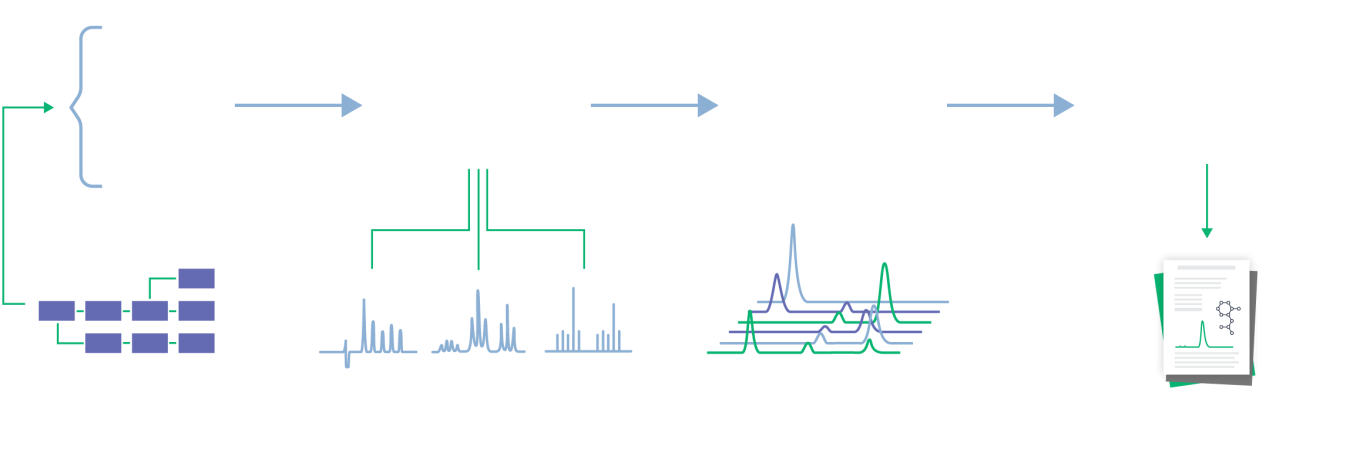
The Only Software That Brings Your Team’s Process and Analytical Data Together in One Place

The future of science is collaborative

Modern pharmaceutical and chemical development teams need seamless data sharing across scientists, locations, and instruments. 

Your data should be useful

More sources of data mean more spreadsheets, incompatible files, and time spent tracking down results. Information becomes siloed and data management gets in the way of research.
 

Make your data work for you with Luminata

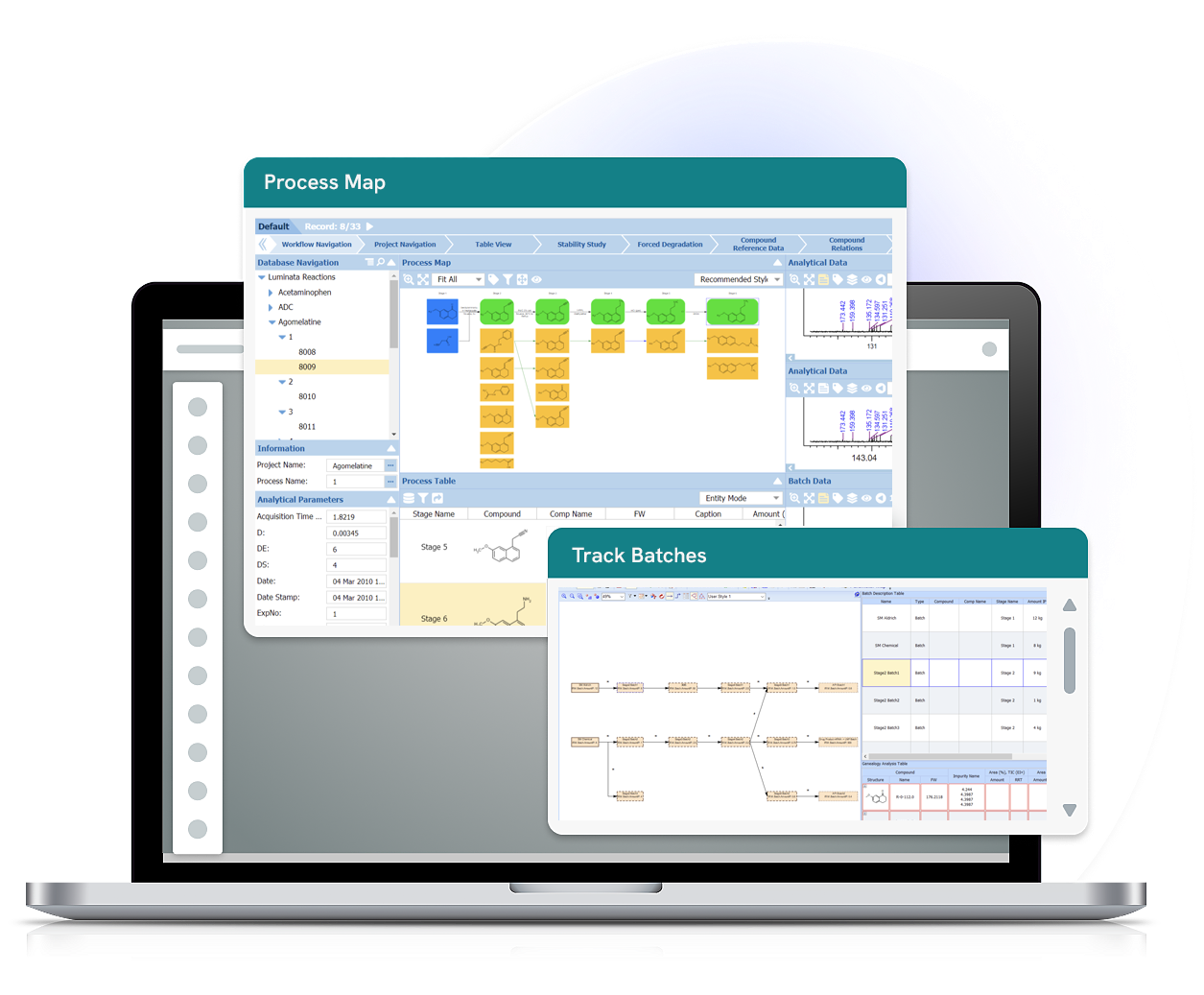
Luminata lets your team store, search, map, process, and reuse all your chemical, analytical, and process data in one application. Streamline your chemical and pharmaceutical development with Luminata's digital environment. 
Benefits

Let Scientists Focus on Science

Accelerate Your Development

  • Reduce time spent assembling, processing, and sharing data
  • Stop repeating experiments because of lost data

Seamless Sharing

  • Access all the chemical and analytical data across the project
  • Use visualization tools to quickly review results without graphing software

Chemically Intelligent

  • Search by structure or substructure
  • Integrates into data science and artificial intelligence initiatives

Data Integrity

  • Connect data to the original experiments for simplified verification and review
  • Reduce the risk of transcription errors and using outdated data

The Data Management Solution for Your Entire Team

Analytical Chemistry

  • Consolidate analytical data in one application that supports more than 150 data formats and connect your analytical and process data.

Process Development and Control

  • Simplify reaction planning, impurity management, and control strategy development with process maps.

Team Leads and Management

  • Track project progress across locations, assess batch data, and accelerate regulatory submissions with report building tools.
  • Integrates into data science and artificial intelligence initiatives.

Expert Insights
Webinar

Dealing with Data Paralysis in Pharmaceutical Process Development

Discover how AbbVie overcame data overload and transformed fragmented analytical information into actionable insights for faster, more confident decisions.

Webinar

How Pfizer is Using Luminata to Support Pharmaceutical Development

Discover how Pfizer uses Luminata to connect analytical data, scientific knowledge, and workflows to support faster, more informed pharmaceutical development decisions.

Application Note

Accelerate Stability Assessment

Discover how Luminata connects analytical data, scientific knowledge, and workflows to support faster, more informed pharmaceutical development decisions.

How it Works

Map Process Scheme

Features of Luminata

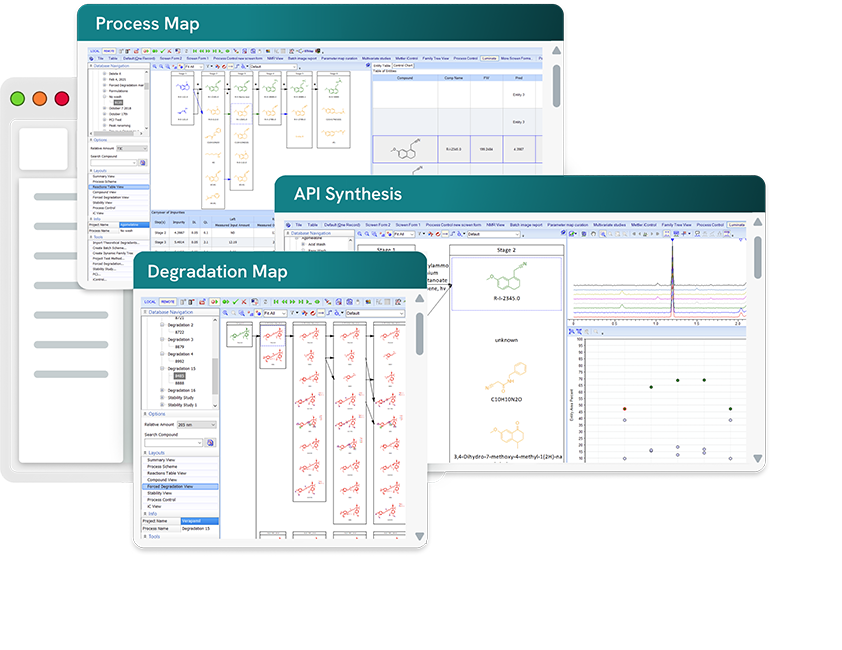
    Consolidate all your process development information in one location. Connect analytical data with route schema to ensure a complete understanding of multi-stage process routes.

    • Build comprehensive maps for your evolving process
    • Link analytical data to each chemical in your scheme
    • Create process maps by importing LC/UV/MS datasets or select existing compounds from the reference dictionary
    • Categorize entries in the process scheme as Starting Materials, Intermediates, APIs, Impurities, Degradants, Solvents, or Reagents
    • Auto-populate output tables by linking attribute maps (process, formulation, stability, etc.) with analytical data

    Establish effective process and analytical impurity control strategies based on live spectral data and route knowledge, in an environment built for Quality by Design (QbD) in pharmaceutical drug development.

    • Use an impurity map to automatically track fate and purge data
    • Auto-calculate impurity carryover from analytical results
    • Access data from in-process control experiments during scale-up
    • Build control strategies using the filters and searching functionality of impurity master mode
    • Avoid errors and save time using built-in reporting tools

    Assemble degradation maps that cover complete drug substance and drug product forced degradation studies.

    • Import and process forced degradation HPLC and MS datasets
    • Make formulation decisions based on kinetic plots automatically created from analytical data
    • Search for impurities by structure across forced degradation experiments
    • Automatically process time-point datasets to create forced degradant maps and kinetic plots
    • Add theoretical degradants to the process scheme (e.g., through import of a *.sdf file) and store them with observed degradants

    Luminata’s drug formulation tools accelerate the transition from drug substance to drug product by integrating analytical and process data in one place.

    • Perform drug-excipient comparability studies, test formulations, and excipient case studies
    • Use accelerated stability simulation tools to predict degradant formation
    • Ability to add elemental impurity metadata
    • Include data from formulation studies such as dissolution rates
    • Build comprehensive formulation maps
    • Append micrograph images to visually track the composition of batches during crystallization experiments

    Use Luminata’s supply chain data management tools to attach analytical data to each batch for real-time decision-making and batch genealogy tracking.

    • Create a comprehensive family tree of every batch
    • Identify irregularities by comparing analytical data to a reference batch
    • Use structure search to quickly find where an impurity or entity appears within the supply chain
    • Do batch-to-batch comparison with analytical data
    • Register and integrate all batches created internally and externally
    • Create a custom report per project and/or supply chain record

    Luminata is built on the Spectrus platform, allowing you to import, process, and store your analytical data.

    • A single standardized and harmonized data format for the analytical techniques used to characterize compounds and formulations in your labs. LC/MS, GC/MS, NMR, Chromatography, Raman, IR, UV, Visible, and more.
    • Native support for more than 150 data formats including major instrument vendors, open-source formats, and emerging standards (e.g., AnIML, JCAMP, and ADF from Allotrope).
    • Luminata will detect the type of data you’re importing and offer tools for processing and analysis.
    • Export your data in machine-readable formats (e.g., JSON) that are ready for data science and artificial intelligence applications.
    • Connect and assign full chemical and biochemical structures, structure fragments, Markush structures, or atoms to spectra and chromatograms.

    Product Comparison

    Capability Luminata Competitors (e.g., ELNs, LIMS, Excel)
    Unified CMC Data Platform
    (Process Analytical and Chemical Data Together)
    Half_Bullet.svg
    Interactive Live Analytical Data
    Empty_Bullet.svg
    Vendor Neutral Instrument Compatibility 
    Empty_Bullet.svg
    End-to-End CMC Workflows 
    Half_Bullet.svg
    Scientific Knowledge Capture and Search
    Half_Bullet.svg
    Structured AI-Ready Data
    Half_Bullet.svg
    Overlay Live Analytical Data for Chemical Reaction Steps
    Empty_Bullet.svg

    Yes     Partial/Limited     No

    What Our Customers Say About Luminata

    Quote from Jordan Stobaugh

    “Having a set of tools that is specific to the work that we do is incredibly powerful.”

    Jordan Stobaugh AbbVie

    Quote from Hannah Davies

    “Luminata facilitates rapid decision making within CMC, across process development, forced degradation and stress testing, batch genealogy, excipient compatibility and formulation development.”

    Hannah Davies Pfizer

    Quote from Senior Research Scientist

    “Using Luminata one person in two weeks did what would normally take four people three months to do.”

    Senior Research Scientist Top 20 Pharmaceutical Company

    Quote from Senior Research Toxicologist

    “Luminata provides a versatile platform which enables efficient collaboration between our toxicology and process chemistry teams during product development.”

    Senior Research Toxicologist Top 5 Pharmaceutical Company

    Compatible with All Your Instruments and Techniques

    Luminata FAQs

    Luminata is an enterprise decision support platform designed for pharmaceutical and chemical product development. It helps teams centralize analytical, chemical, and process data in one environment to improve collaboration, accelerate decision-making, and simplify workflows. 

    Luminata helps pharmaceutical teams manage early- to late-stage process studies for process development, impurity control, formulation development, material studies (e.g., forced degradation, stability studies) and batch genealogy by connecting analytical data with chemical and process context. 

    Luminata consolidates fragmented analytical and process data into a single searchable platform, reducing time spent assembling files, minimizing transcription errors, and improving data accessibility across teams and locations.

    Luminata streamlines forced degradation and stability workflows by automatically processing analytical datasets, generating degradation maps and kinetic plots, and enabling structure-based impurity searches across experiments. For forced degradation studies, Luminata helps scientists create and manage a bird’s-eye view of each stress study and track the progression of each. By bringing together analytical results, experimental metadata and proposed degradation pathways in a single environment, Luminata makes it easier to identify studies that contain a specific degradant. This connected view helps teams compare outcomes across stress conditions and identify condition-specific degradation behavior.

    Luminata provides a centralized, chemically intelligent environment for evaluating impurity trends, process changes, batch genealogy, and stability data, helping teams make faster and more confident CMC decisions.

    Luminata enables scientists across departments, sites, and external partners to access and share live analytical and process data through a centralized web-based environment. This allows scientists to reduce the time spent assembling, processing, and sharing data, improving communication and reducing duplicate work. 

    Luminata standardizes and structures analytical and chemical data into machine-readable formats, making it easier to support FAIR data strategies, advanced analytics, and AI/ML initiatives. 

    Yes. Luminata supports more than 150 analytical data formats, including LC/MS, GC/MS, NMR, IR, Raman, and chromatography data from major instrument vendors, open-source formats, and emerging standards.

    Get more details here

    ELNs are primarily used to document experiments, while LIMS are primarily used to manage samples and test workflows.

    Luminata is different because it connects whole synthetic pathways, every generated batch/lot, chemical structures, impurities/degradants, live analytical data and metadata in a single structure-aware environment. This allows scientists to consolidate data from multiple sources, track impurities across synthetic steps, compare processes, calculate carryover and generate dynamic reporting tables directly from analytical data. Rather than replacing ELN or LIMS systems, Luminata complements them by turning disconnected experimental, sample and analytical data into actionable drug development insight.

    Unlike spreadsheets, Luminata is chemically intelligent software built specifically for scientific workflows. It enables structure searches, analytical data visualization, impurity mapping, and connected reporting while improving data integrity and traceability. Luminata connects data to original experiments for simplified verification and review, reducing the risk of transcription errors and using outdated data. 

    Ready to Take the Next Step?

    Talk to our Team

    Schedule a consultation with our experts to discuss your workflow, requirements, and implementation needs

    Contact Us

    Take a Tour

    See how Luminata transforms disconnected analytical data into connected scientific knowledge for faster, more confident R&D decisions.

    Request a Demo

    Stay up to Date

    Stay up-to-date on all the latest insights, research and product news from Revvity Signals.

    Stay up to Date