
Impurity Profiling Suite™
Assess the Safety Profile of Pharmaceutical Impurities
Predict genotoxic and carcinogenic endpoints to meet ICH M7(R2) guidelines.

Trusted By Companies Worldwide














Explore
Support Confident Impurity Risk Assessment
Predict toxicological endpoints from chemical structure to support ICH M7(R2) workflows. Developed through a collaborative agreement with the U.S. Food and Drug Administration (FDA), Impurity Profiling Suite helps prepare regulatory submissions with confidence.

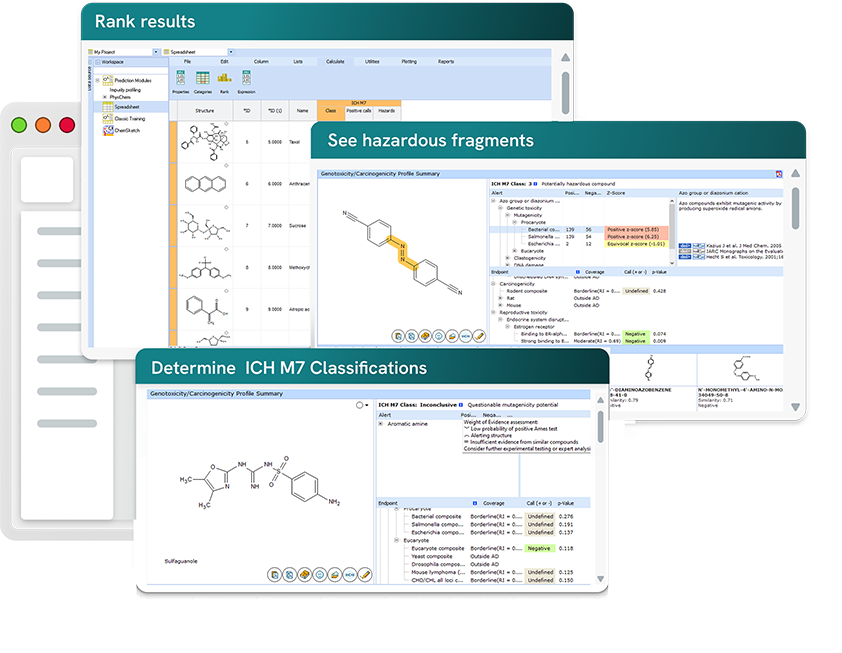
Determine the ICH M7(R2) classification for impurities and degradants.

Identify potentially hazardous structural fragments responsible for genotoxic and carcinogenic activity.

Gain insight into the possible mechanisms of toxic effects.

Assess the reliability of predictions.
Benefits
Why Choose Impurity Profiling Suite?


Make Data-Driven Decisions with Confidence
- Classify structures according to ICH M7(R2) guidelines for your review
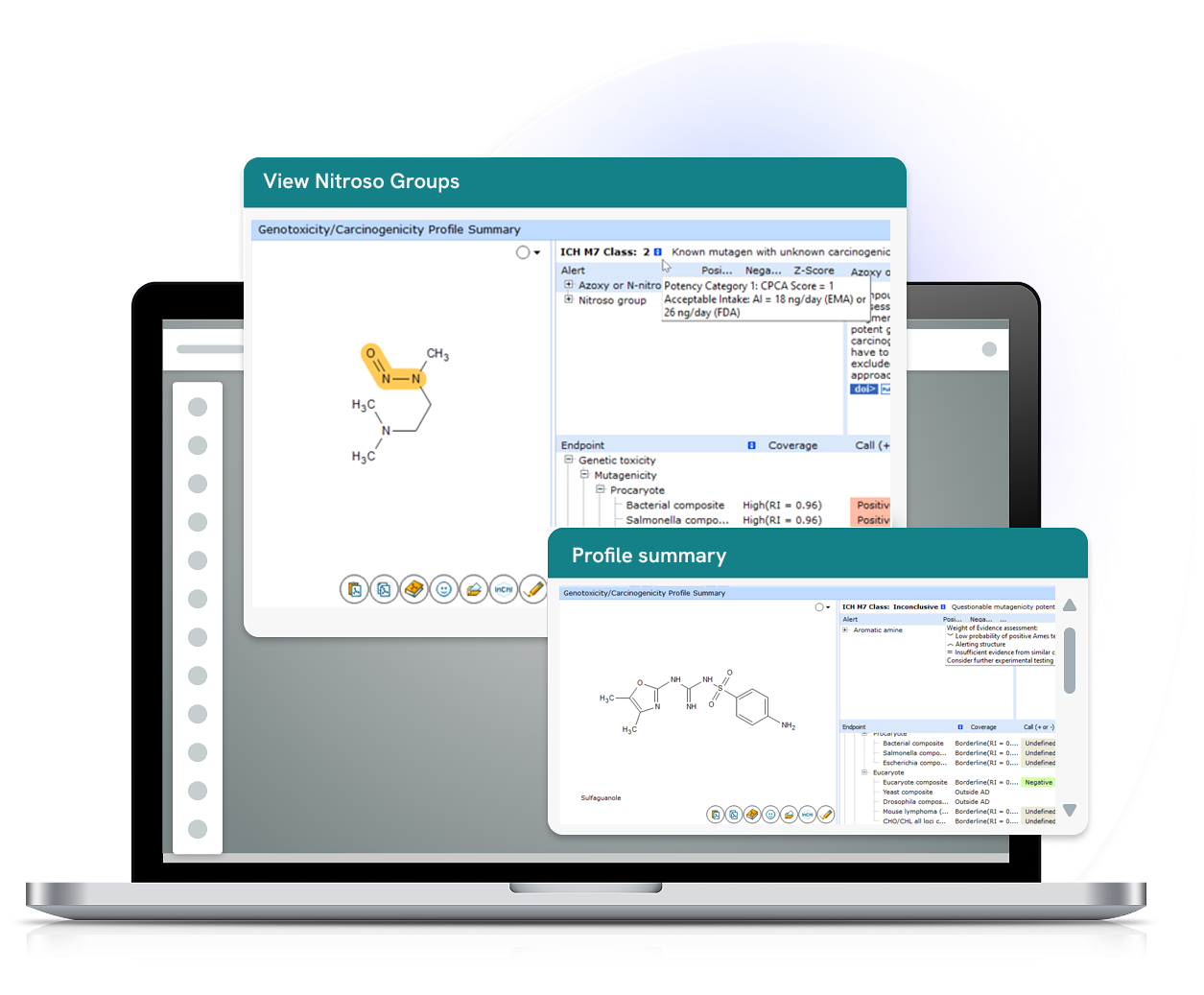
- Review the supporting evidence behind each classification, with recommendations for appropriate control measures
- Assess the toxicity of single compounds or compound series to prioritize further evaluation


Trust in Reliable Predictions
- Predictions are based on curated public and regulatory data (provided by the FDA)
- The expert system identifies 67 literature-derived toxicophore alerting groups associated with genotoxic and carcinogenic mechanisms
- Evaluate prediction reliability using a reliability index, similar structures, and literature references

Compliant with the ICH M7(R2) Guidelines
- Includes both probabilistic and knowledge-based models
- Models follow OECD validation principles
- A weight of evidence (WoE) approach provides information when experimental data are inconclusive
- Results are accepted by the FDA, European Medicines Agency (EMA), and other regulatory agencies

Impurity Profiling Suite FAQs
Impurity Profiling Suite is designed for various types of organic impurities that can arise during the manufacturing, synthesis, or storage of an active pharmaceutical ingredient (API), including unreacted starting materials and intermediates, unwanted by-products, and degradation products resulting from the breakdown of the drug substance over time.
Under the ICH M7 guideline, computational safety assessment alone can be used for impurities present at an intake level of 1 mg/day or less. Therefore, whether computational assessment is sufficient depends not only on the identity of the impurity but also on the amount present. The same impurity may require only computational assessment in one formulation, while experimental safety assessment may be required in another if the impurity is present at a higher intake level.
ICH M7(R2) provides a framework for the identification, assessment, qualification, and control of DNA-reactive (mutagenic) impurities to limit potential carcinogenic risk in pharmaceuticals. The guideline permits the use of two complementary QSAR methodologies, following Organization for Economic Co-operation and Development (OECD) validation principles, as an alternative to expensive in vitro testing.
Developed through a collaborative agreement with the U.S. FDA, Impurity Profiling Suite supports ICH M7(R2) workflows by helping scientists assess the genotoxic and carcinogenic potential of impurities and degradants. The software predicts relevant toxicological endpoints and helps determine ICH M7(R2) classifications to support impurity risk assessment and regulatory submissions.
Impurity Profiling Suite predicts 21 toxicological endpoints, including mutagenicity, clastogenicity, DNA damage, carcinogenicity, and endocrine disruption.
Yes. Impurity Profiling Suite can evaluate multiple compounds within a single project, including the parent API and a set of its impurities and degradants. Compounds can be analyzed individually or together as a project, with the software tracking which alerts are shared between the impurities and the parent compound.
The OECD recommends that QSAR models have a defined endpoint, an unambiguous algorithm, a defined domain of applicability, appropriate measures of goodness-of-fit, robustness and predictivity, and, where possible, a mechanistic interpretation. These principles help ensure that predictions are scientifically robust and suitable for regulatory use.
Yes. Impurity Profiling Suite supports the Carcinogenic Potency Categorization Approach (CPCA) for N-nitrosamines, enabling automatic assessment of compounds containing N-nitroso (N–N=O) functional groups when experimental data is unavailable. The software assigns a CPCA category, estimates CPCA scores and contributing factors, and provides acceptable intake limits directly within the interface and ICH M7 reports.
Impurity Profiling Suite is designed for organizations of all sizes, from small and medium-sized companies to large pharmaceutical and biotechnology organizations.
Impurity Profiling Suite uses a weight of evidence (WoE) approach to resolve ambiguous predictions. The WoE algorithm takes into account a variety of factors:
- Raw values reported by statistical models
- Presence of alerting groups known from literature
- Evidence from experimental data for the most similar compounds
- Other mitigating factors
The algorithm summarizes these data to determine whether the compound can be treated as potentially safe (Class 5), or as requiring further attention (Class 3).
Reliability of predictions is assessed using a Reliability Index (RI), ranging from 0 to 1, which supplements the statistical model predictions in Impurity Profiling Suite. The RI helps determine whether predictions can be confidently classified as positive or negative and indicates whether a compound falls within the model’s applicability domain.
Impurity Profiling Suite is available as a Windows-based thick client application. The software can be installed on individual computers or made available on a network from a central source. The graphical user interface of Impurity Profiling Suite offers all the tools you need to assess the safety of compounds.


Ready to take the next step?

Talk to our team
Schedule a consultation with our experts to discuss your workflow, requirements, and implementation needs.

Beyond impurity assessments
Explore the full predictions capabilities of Percepta Suite from pKa and logP calculations to full ADME and tox assessments.

Stay up to date
Stay up-to-date on all the latest insights, research and product news from Revvity Signals.