
What are the challenges in antibody drug discovery — and how can they be addressed?

Introduction
Unlocking the full potential of antibody discovery requires navigating a complex landscape of molecular design and data-driven decision-making.
Bringing an antibody drug to market can take more than a decade and cost billions, yet many candidates fail early. Un like traditional drug modalities, antibodies must be optimized across multiple dimensions, making discovery inherently complex. Traditional stepwise workflows are now giving way to more connected, data-driven approaches, where success depends on making better decisions earlier in the process.
What makes antibody discovery uniquely challenging?
Antibody drug discovery presents a unique set of challenges, and that complexity continues to grow as therapeutic ambitions expand. One of the earliest hurdles is target selection and validation. Antibodies are largely limited to extracellular and cell-surface targets, which narrows the accessible biology and can exclude many disease-relevant mechanisms. Many emerging targets — including intrinsically disordered proteins and conformational epitopes — are difficult to engage with high specificity, as they lack stable binding sites or shift between structural states. This increases the risk of failure at early discovery stages.
Even when a viable target is identified, binding affinity alone isn't enough. Antibodies must drive specific functional outcomes: receptor modulation, immune activation, or targeted payload delivery in antibody–drug conjugates (ADCs). A molecule that binds tightly but fails to trigger the right biological response offers limited therapeutic value. Discovery teams must therefore evaluate candidates against functional endpoints, not just binding metrics, from the start.
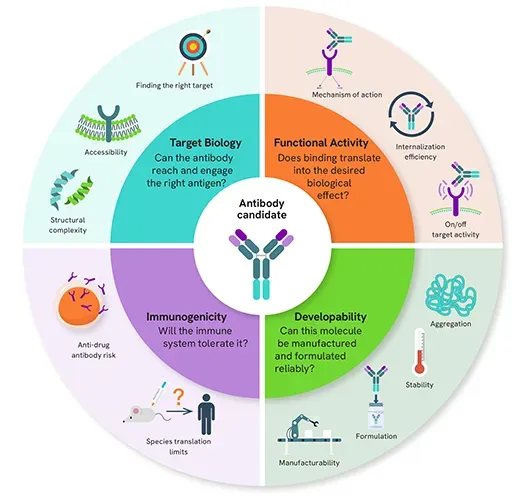
Immunogenicity is another persistent challenge. Even fully human or humanized antibodies can trigger anti-drug antibody (ADA) responses, which can compromise efficacy or cause adverse immune reactions. Computational and in vitro tools can help identify potential T cell epitopes and sequence liabilities, but they can't fully replicate the complexity of the human immune system. Immunogenicity remains a risk that must be managed continuously throughout development. All these challenges highlight why antibody discovery demands more integrated and predictive approaches than traditional drug development workflows.
How can teams efficiently design and optimize antibody candidates?
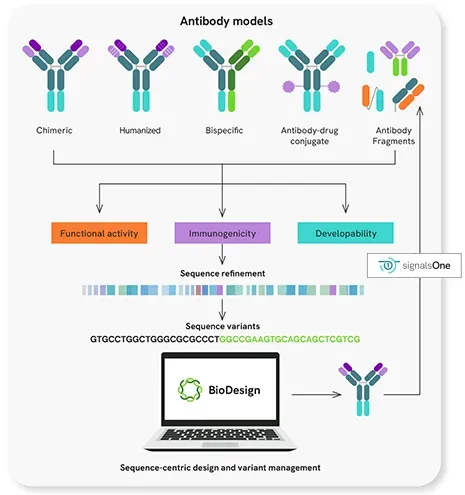
Modern antibody programs span a wide range of formats — chimeric and humanized monoclonal antibodies, bispecifics, ADCs, and fragments — each requiring tailored sequence design. Signals BioDesign™ addresses this complexity by providing a unified environment for sequence-centric design and variant management: auto mating cloning strategy selection, primer design, and sequence validation. It scales to handle up to 1,000 constructs in a single workflow, enabling teams to rapidly explore combinations of heavy and light chain variants and engineered formats.
Efficiency in antibody design also depends on incorporating functional activity, immunogenicity, and developability considerations as early as possible. Rather than assessing these properties in isolation or late in development, integrating experimental and analytical data earlier helps researchers refine candidates more effectively. By connecting sequence design in Signals BioDesign with data captured and contextualized in Signals One™, teams can iteratively link molecular design with emerging insights. Signals One also supports BioRegistration capabilities that help researchers capture and manage the complex relationships between biologic entities throughout development. Beyond sequence registration, teams can track metadata, calculated properties such as molecular weight and isoelectric point, and lineage relationships across plasmids, cell lines, heavy and light chains, anti bodies, linkers, payloads, and ADCs. Together, these capabilities provide a more complete view of candidate performance, helping prioritize molecule with stron ger overall profiles.
How can integrated workflows accelerate antibody development?
To address the growing complexity of antibody discovery, teams are moving beyond fragmented workflows toward integrated systems that support continuous iteration across the design–make–test–decide (DMTD) cycle. During the design phase, molecular modeling, sequence optimization, and early developability assessment help align antibody structure with intended function. These designs then move into the make phase, where construct generation and recombinant expression are captured alongside the experimental context needed for traceable handoffs.
In the test phase, functional assays, binding and kinetics studies, and biophysical characterization generate multidimensional data across antibody variants. When these results are directly linked back to their originating sequences and constructs, they provide a more complete view of candidate performance. This enables more effective comparison across variants and reduces the risk of over looking critical liabilities.
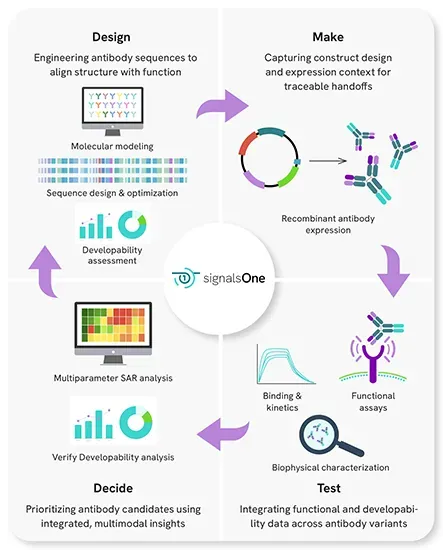
In the decide phase, integrated analysis of functional and developability data supports more informed prioritization of candidates. Because all data remain connected, from initial sequence design through experimental outcomes, insights can be carried forward into subsequent rounds of optimization, strengthening each iteration of the cycle.
By combining sequence-centric design capabilities in Signals BioDesign with ex perimental tracking, data management, and analytics in Signals One, integrated digital ecosystems allow teams to operate within a shared framework that pre serves context, metadata, and ontologies. This continuity reduces redundancy, improves cross-functional collaboration, and enables faster, more confident progression decisions across the entire antibody development workflow.
What’s next for antibody development?
The goal in antibody development is not simply to move faster, but to improve success at each decision point. AI-enabled design is helping shift the odds by predicting binding, developability, and immunogenicity in silico, so teams can focus on the most promising candidates before synthesis. In practice, this means models generate amino acid sequences that are converted into DNA designs in Signals BioDesign and registered in Signals One for testing. Experi mental results then feed back into the models, improving each cycle. While these models are still imperfect, the direction is clear: more predictive, more connected decision-making across the full antibody development lifecycle.

End-to-end workflow support across scientific disciplines.

The Standard for Chemical Drawing.

End-to-end Clinical Data Science Platform.