
What Drives Successful Small-molecule Drug Discovery Today?

What defines today’s small-molecule therapeutics?
For decades, small-molecule therapeutics were defined by compact chemical structures designed to fit neatly into well-characterized protein binding pockets. These traditional drugs often act as enzyme inhibitors or receptor agonists and antagonists, and their effects depend on how long and how tightly they stay bound to the target (1). Medicinal chemistry efforts largely focused on optimizing these properties within well-established frameworks, including ADMET profile and adherence to rules governing molecular size, polarity, and lipophilicity.
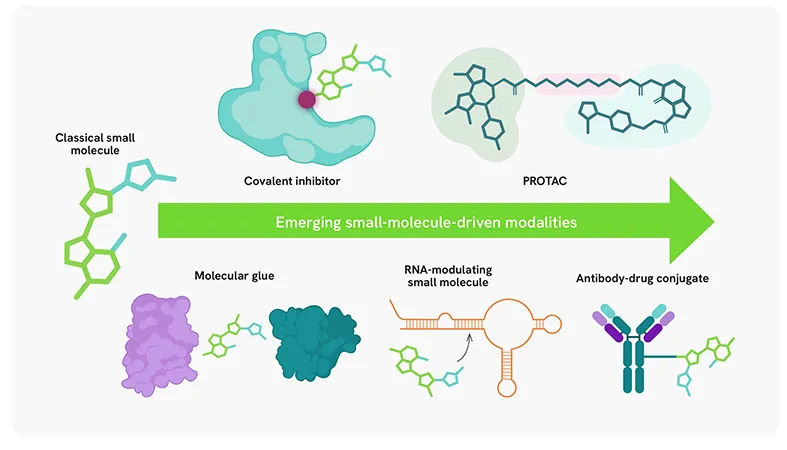
Today, that definition has broadened considerably. Advances in chemical biology and a deeper understanding of disease mechanisms have revealed that small molecules can influence biology in ways that extend far beyond simple target binding. Emerging modalities exploit cellular pathways and macromolecular interactions to achieve therapeutic effects through fundamentally different mechanisms of action.
Proteolysis-targeting chimeras (PROTACs), for example, harness the cell’s own degradation machinery to selectively eliminate disease-driving proteins. Molecular glues similarly act by inducing or stabilizing protein–protein interactions to alter protein function (2). Covalent inhibitors have recently re-emerged as a powerful strategy, forming strong bonds with specific amino acid residues to achieve durable target engagement and prolonged pharmacodynamic effects (3). In parallel, small molecules capable of binding RNA structures are opening new avenues for directly modulating RNA processing, translation, and splicing in diseases (4). Additionally, antibody–drug conjugates leverage highly potent small-molecule payloads delivered by antibodies to combine targeted delivery with strong pharmacological activity (5).
As scientists embrace these non-classical modalities, they are reassessing long-standing ideas about what makes a “good” small-molecule drug. No longer constrained by classical rules, small-molecule therapeutics demand discovery strategies capable of navigating broader chemical space and more complex mechanisms.
How can research teams more efficiently advance early hits into optimized small- molecule candidates?
Advancing early hits into optimized small-molecule candidates increasingly depends
on integrated, iterative workflows rather than linear progression. Modern hit-to-lead
optimization brings together chemical design, synthesis, and biological evaluation in
rapid design–make–test–decide (DMTD) cycles, allowing insights from each stage to
immediately inform the next.
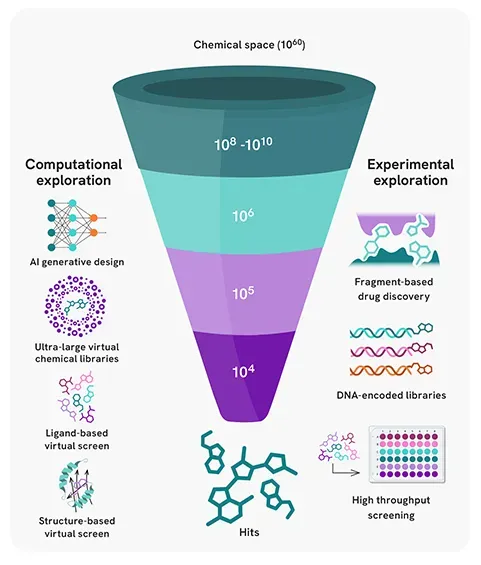
Within this cycle, chemical design is guided by structural hypotheses, binding-mode analysis, and machine learning–based property prediction to anticipate potency, selectivity, and developability early. Synthesis follows through virtual reaction planning and high-throughput methods that accelerate compound generation. Biological testing integrates mechanistic and phenotypic assays along with ADME profiling and pharmacokinetics studies to build a multidimensional picture of compound behavior. These results feed into multiparameter structure–activity relationship (SAR) analysis and AI-assisted prioritization, enabling evidence-based decisions about which molecules to advance and how to refine them in the next iteration.
Supporting this level of integration requires digital environments that connect data, context, and decision-making across disciplines. Signals One™ brings the entire DMTD cycle together in a unified platform. By centralizing chemical designs, experimental results, and analytical insights, Signals One helps teams translate complex data into coherent optimization strategies, accelerating the progression from early hits to high-quality small-molecule candidates.
A unified ecosystem for the next era of discovery
How are scientists navigating the vast chemi cal space to find high-quality small-molecule candidates?
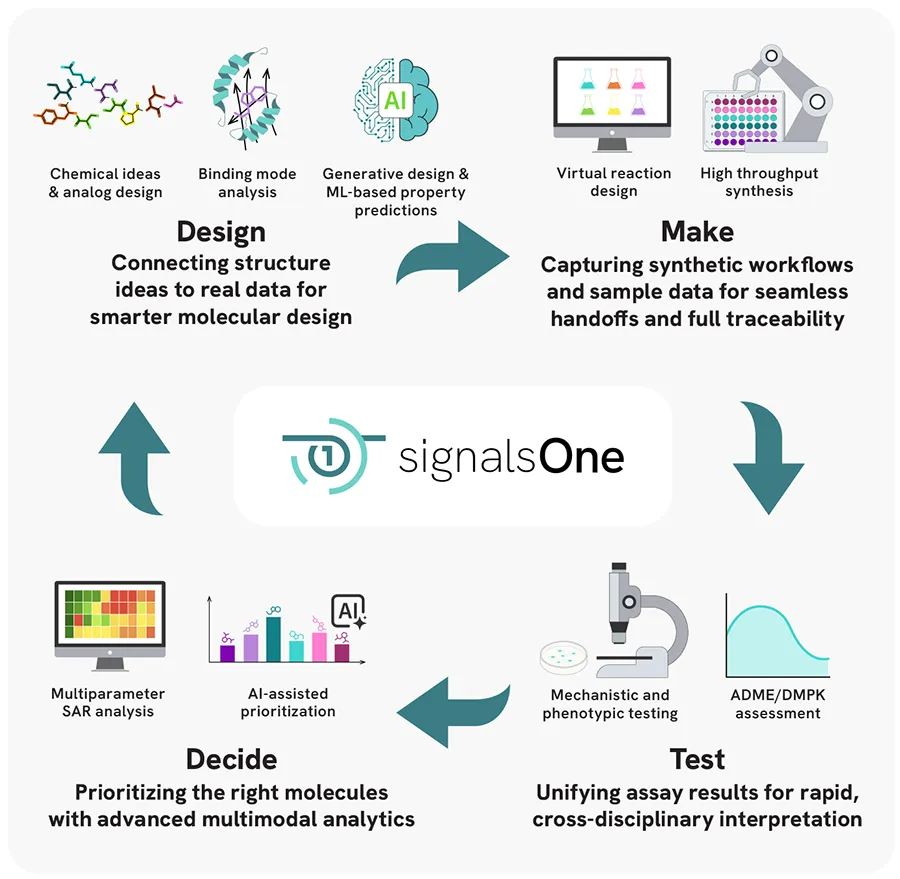
Navigating the vast drug-like chemical space remains one of the central challenges of small-molecule discovery. The sheer scale of possible molecules makes identifying high-quality candidates inherently difficult. At the same time, classical guidelines, such as Lipinski’s Rule of Five — originally developed to describe orally available compounds — are no longer applicable to emerging chemotypes whose size, flexibility, or polarity fall outside traditional norms (6).
Modern discovery programs meet this challenge by combining experimental and computational strategies that sample chemical space more broadly and intelligently. Computationally, ultra-large virtual libraries enable millions to billions of compounds to be evaluated in silico. Structure-based virtual screening uses three-dimensional target information to identify molecules that engage novel or transient binding sites, while ligand-based screening infers new candidates from known ligands’ structures (7). With generative and predictive models, AI can explore chemical space at a scale far be
yond human intuition (8). Solutions like Signals Xynthetica™ deliver such models directly within
Signals One™.
Experimental strategies then rapidly test and refine these computationally prioritized candidates. Fragment-based drug discovery enables very broad coverage of chemical space using only a few thousand molecular probes. DNA-encoded libraries dramatically expand experimental scale, allowing millions to trillions of barcoded compounds to be screened in a single experiment. High throughput screening complements these methods by assessing biological activity across large compound sets.
Across all of these workflows, progress depends on starting with accurate, standardized molecular representations. ChemDraw™ provides this foundation by allowing scientists to accurately sketch, refine, and encode chemically synthesized modalities. As chemical space expands, structural consistency ensures that chemical ideas move seamlessly from AI-powered design to computational analysis, remaining interpretable and actionable throughout the discovery pipeline.
References
- Southey, M. W. Y. & Brunavs, M. Introduction to small molecule drug discovery and preclinical development. Front. Drug Discov. 3, (2023).
- Eladl, O. Molecular glues and PROTACs in targeted protein degradation: mechanisms, advances, and therapeutic potential. Biochemical Pharmacology 242, 117297 (2025).
- Sutanto, F., Konstantinidou, M. & Dömling, A. Covalent inhibitors: a rational approach to drug discovery. RSC Med. Chem. 11, 876–884 (2020).
- Childs-Disney, J. L. et al. Targeting RNA structures with small molecules. Nat Rev Drug Discov 21, 736–762 (2022).
- Fu, Z., Li, S., Han, S., Shi, C. & Zhang, Y. Antibody drug conjugate: the “biological missile” for targeted cancer therapy. Sig Transduct Target Ther 7, 93 (2022).
- Roskoski, R. Rule of five violations among the FDA-approved small molecule protein kinase inhibitors. Pharmacological Research 191, 106774 (2023).
- Kattuparambil, A. A. et al. Exploring chemical space for “druglike” small molecules in the age of AI. Front. Mol. Biosci. 12, (2025).
- Liu, Y.-T. et al. Applications of Artificial Intelligence in Biotech Drug Discovery and Product Development. MedComm 6, e70317 (2025).




End-to-end workflow support across scientific disciplines.

The Standard for Chemical Drawing.

End-to-end Clinical Data Science Platform.