
Biotech Startup Data Management: The Hidden Bottleneck Slowing Early-Stage Biotech Companies — And It's Not the Science

Your science is working. Your first data is promising. The CRO results are coming in. The team is growing.
And somehow — despite all that momentum — you're spending more time chasing files, reconciling spreadsheets, and managing email threads than actually doing science.
It doesn't feel like a crisis. It feels like friction. But in early-stage biotech, friction is expensive. And the founders who recognize it early are the ones who scale.
If this sounds familiar, you're not alone. And more importantly — it's not a problem with your team, your science, or your ambition. It's a structural problem that almost every biotech startup faces. The most successful companies solve it deliberately, and they solve it before it becomes the thing that slows down their next raise.
You built a biotech to make discoveries — not to manage data chaos. But somewhere between your first experiments and your first funding milestone, the tools and workarounds that got you through pre-seed have quietly become the friction slowing down your momentum.
The question isn't whether you'll hit this wall. It's whether you'll see it coming in time to do something about it.
This Is a Biotech Scaling Problem, Not a Science Problem
McKinsey's research on scaling startups is clear: even companies that develop successful products have a greater than 80 percent chance of failure. Science isn't usually what kills them. According to McKinsey's analysis of investor portfolios, 65 percent of failures are attributed to people and organizational issues — not the underlying technology or discovery.
The biotech's that do make it — the ones McKinsey calls "centaurs," companies that reach $100M or more in annual recurring revenue within four years of product-market fit — share one defining trait: deliberate operational infrastructure built early. They didn't wait for the chaos to force their hand. They built the bedrock before they needed it.
And then there's the life science software sprawl problem — a challenge that has become endemic across growing organizations of every kind. The result is scientific data silos, manual reconciliation, and decisions made on numbers nobody fully trusts.
In most industries, that's an efficiency problem. In biotech, it's a risk to research data reproducibility, compliance, and investor confidence.
Unlike other startups, drug discovery companies depend on scientific traceability. A missed data connection isn't just an operational inconvenience — it can delay an IND submission, undermine confidence during due diligence, or force scientists to repeat experiments that took months to complete.
The Real Problem: Scientific Data Fragmentation in Biotech R&D
Imagine it's 8pm on a Thursday. Your lead investor wants updated pipeline data before tomorrow's board meeting. Your CRO has emailed new assay results. Three scientists have slightly different versions of the same dataset. Someone has been trying to reconstruct an experimental decision from six months ago. Nobody is questioning science, but everyone is spending time finding information instead of making decisions. That's what R&D data fragmentation looks like in practice.
Early-stage biotech companies accumulate tools the same way any startup does: one problem, one tool, one quarter at a time.
A team hits a specific operational pain point. Someone finds a tool that solves it. The tool is adopted. Six months later, a different team has a different problem and finds a different tool. Two years later, you're running a patchwork of disconnected applications — none of which were chosen as part of a coherent scientific data management strategy, and none of which talk to each other.
The typical fragmented biotech data management stack looks something like this:
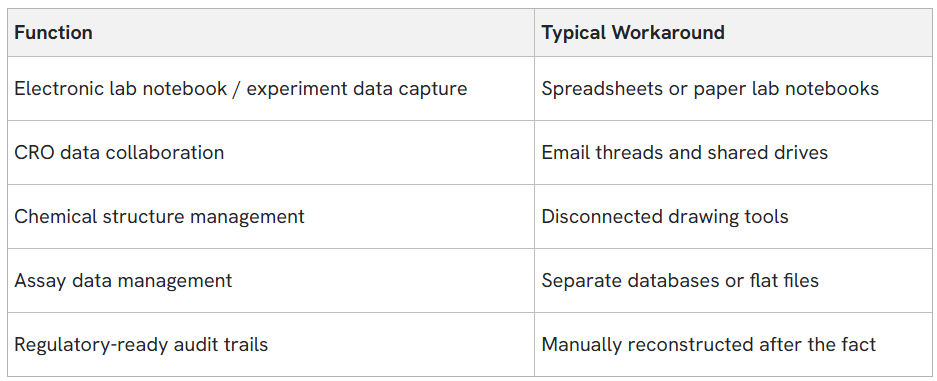
Each tool was a reasonable solution to a specific problem. Together, they create a coordination quagmire. And the hidden costs aren't just time — they're scientific data integrity, reproducibility, and investor-readiness.
The Symptoms Every Founder Recognizes
Imagine it's 8pm on a Thursday. Your lead investor wants updated pipeline data before tomorrow's board meeting. Your CRO has emailed new assay results. Three scientists have slightly different versions
You know you've hit this wall when:
- Hours are lost every week reconciling CRO data management from external teams and internal scientists
- There's no single place to answer: "What's the current status of this drug discovery pipeline?"
- New scientists spend their first weeks learning workarounds instead of doing science
- Audit trail gaps become visible — and painful — during due diligence
- Reports from different systems contradict each other and nobody is sure which numbers to trust
- You cannot answer basic operational questions about your R&D pipeline in real time from a single place
If three or more of these describe your organization right now, you're not behind schedule. You're at an inflection point. And the decision you make next will either compound in your favor — or against you.
The Window That Matters Most
McKinsey's centaur research identifies three distinct growth phases every successful startup moves through: Build and Launch, Grow, and Scale. At each inflection point, companies can get stuck. And the research is explicit about what separates the ones that get through from the ones that don't.
The bedrock isn't glamorous. It's R&D data infrastructure, integrated systems, and process discipline. But it's what everything else is built on. And the founders who get it right understand something that the ones who struggle often don't: the best time to build the foundation is before you need it.
There is a window between first data and first funding where the decisions you make about laboratory data management either accelerate your trajectory or become technical debt you'll spend the next two years paying down.
The founders who wait to think about biotech data infrastructure spend the first six months of that round of rebuilding, not accelerating. They migrate data. They retrain the team. They reconcile inconsistencies that have compounded over 18 months. And they do all of this while trying to execute the milestones that justified the rise in the first place.
The founders who get it right do the opposite. They recognize that scientific data management is a scientific asset — not an IT problem — and they deploy a proven, science-ready foundation early
There are two options:
Option A: Continue extending your existing toolset and accepting the growing operational overhead that comes with it.
Option B: Invest in a science-ready data foundation that gives your team a consistent way to capture, manage and share knowledge as you scale.
The best time to make this decision is before you need it. The second-best time is now.
What "Biotech Operational Readiness" Actually Looks Like
Here's the concrete difference between two early-stage biotech companies — both with promising science, both with funding needs, both hiring their first wave of scientists.
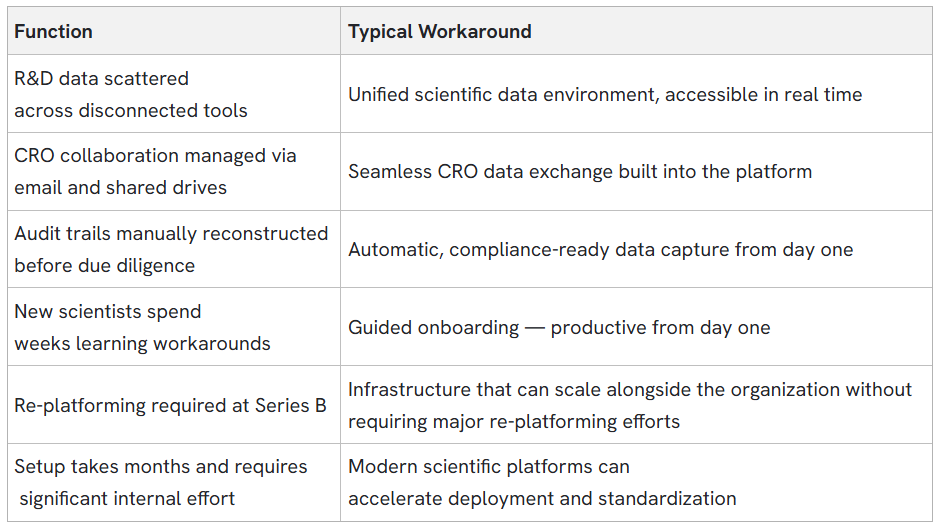
The difference isn't just operational efficiency. It's a scientific velocity. It's investor confidence. It's the ability to walk into partnership discussions, CRO collaborations, and regulatory submissions with data you trust — because the infrastructure was there before you needed it.
McKinsey's scaling research is explicit: the biotech's that reach $100M+ valuations fastest built the operational bedrock early. They didn't wait until the chaos forced their hand. They made the deliberate choice — and it compounded in their favor.
Interested in how emerging biotech companies are approaching digital foundations today?
In our next article, we'll explore practical approaches that growing biotech organizations are using to create scalable, science-ready data environments without adding unnecessary complexity.
Stay tuned for more insights from Revvity Signals: Email Newsletter Signup - Revvity Signals
➡ Check out our latest blogs and articles from Revvity Signals: Blog | Revvity Signals

Diana Tran
Principal Product Marketing Professional for Signals One, Signals NotebookDiana Tran, M.S. is a Principal Product Marketing Manager at Revvity Signals Software, responsible for the go-to-market strategy, positioning, and messaging for Signals One and Signals Notebook. With more than 10 years of experience in healthcare, biotechnology, and technology marketing, she specializes in bringing innovative software solutions to market and helping organizations navigate digital transformation. Diana holds a Bachelor of Science from MCPHS University and a Master of Science in Global Marketing Management from Boston University