
Breaking Down Silos Between Chemists, Biologists, and Data Scientists
Modern drug discovery is no longer a mosaic of isolated disciplines. Every program depends on chemists, biologists, and data scientists working together, and that requires shared access to experiments and data. In many organizations, those teams still live in separate systems with siloed data and distinct vocabularies.
The result is predictable: assay design sits in one place, synthesis and registration in another, analysis scripts somewhere else, and an electronic lab notebook (ELN) that really serves just one group or another. What should be collaborative R&D becomes a relay race of file exports, email threads, and meetings just to agree on “what actually happened” in the lab.
Team unity today relies on interconnected workflows and cross-disciplinary collaboration – but these things don’t happen by accident.
The Cross-Disciplinary Collaboration Challenge
Different groups bring distinct scientific questions and specialized tools. Chemists connect molecular design, synthesis, registration, and analytical characterization with biological activity to guide compound optimization. Biologists investigate how compounds affect targets and biological systems, using reliable assays, appropriate controls, and clear sample provenance. Data scientists draw on well-structured chemistry and biology data, supported by experimental context and provenance, to develop reliable analyses and predictive models. All three share a common goal: turning results into actionable insights that guide the next experiment.
When each discipline documents work in its own formats, with inconsistent IDs and metadata, friction is baked in. A biologist exports assay results into a spreadsheet; a chemist reconciles those results with compound and batch records; a data scientist spends days cleaning and joining the files before any analysis starts. Errors creep in, context gets lost, and the ELN ends up as a partial record rather than the backbone of collaborative R&D.
The solution is a connected research environment, with an ELN linking experimental records to specialized systems and making data and context accessible across disciplines.
What True Integration Looks Like
An integrated environment does more than warehouse data. It provides chemists, biologists, and data scientists shared context for every experiment, with an ELN connecting chemistry, biology, and analysis workflows. That means shared controlled vocabularies, consistent identifiers and metadata and linked experimental records, and visualization tools accessible across teams.
Here’s what an end-to-end workflow might look like:
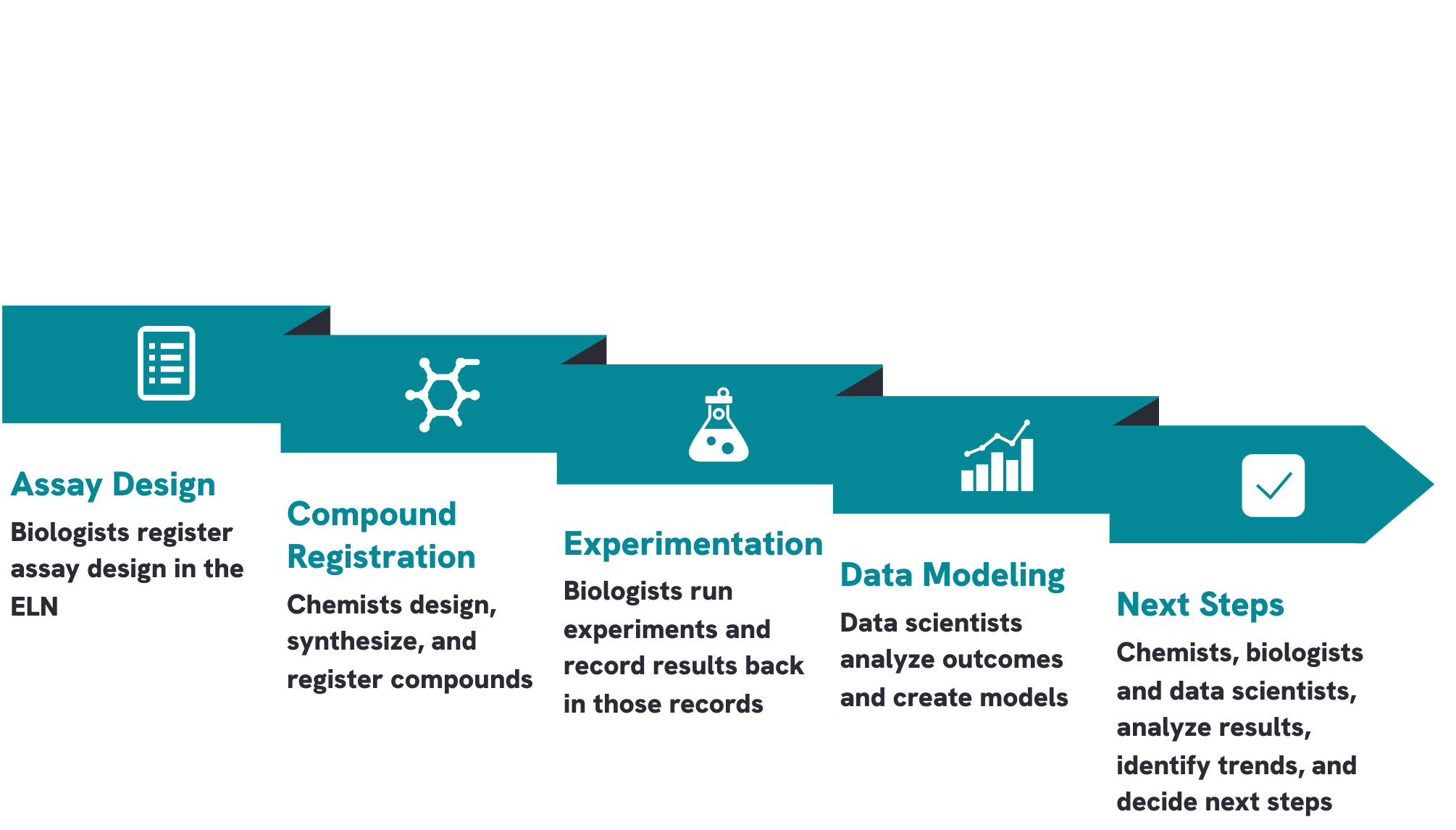
APIs and cloud-based notebooks connect the steps in this workflow. Shared terminology, consistent identifiers, and clear data provenance help teams understand which compound record is authoritative, what an assay result represents, and which dataset version supports a decision. The ELN becomes an active part of collaborative research, not just a place to archive experiments after the fact.
Benefits of Bridging Domains
When cross-disciplinary workflows are built into everyday tools, the benefits show up quickly.
- Faster decision cycles. With chemists, biologists, and data scientists all looking at the same record, teams spend less time chasing files and more time testing hypotheses.
- Better foundations for FAIR data. Consistent identifiers, structured metadata, and traceable records help make data Findable, Accessible, Interoperable and Reusable (FAIR).
- Less duplication. When everyone can see which compounds have been made, which assays have run, and what the outcomes were, there is less accidental repetition.
- Better reproducibility and richer insights. Traceable links between experimental design, materials, methods, results, and analysis help scientists reconstruct what happened, while cross-disciplinary interpretation turns those results into stronger ideas.
Instead of stitching partial stories from separate systems, teams generate richer insights using the ELN to sync chemistry workflows, biological readouts, and analytics.
Best Practices for Building Cross-Disciplinary Workflows
Reviewing Signals Notebook and Signals One implementations, several factors have emerged as critical to successful integration and the building of cross-disciplinary workflows.
- Choose an ELN that combines scientific functionality and ease of use with integration capabilities and room to scale
- Involve chemists, biologists, data scientists, and IT early to define shared requirements
- Standardize identifiers, core metadata, and controlled vocabularies.
- Invest in training and change management to support adoption across disciplines.
- Measure cross-team adoption and collaboration outcomes, not just logins or experiment counts.
The Revvity Signals Approach
Drug discovery depends on collaboration, but disconnected systems can make it harder than it should be. The right research environment supports the distinct needs of chemists, biologists, and data scientists while connecting their work through shared data and experimental context.
As organizations invest in automation and AI, those connections become even more important. New tools are most useful when teams can interpret their outputs together and apply them to the next scientific decision.
The Revvity Signals approach centers on a configurable ELN that supports scientists’ workflows and connects with the wider research environment. The goal is not to make every discipline work in the same way, but to help them work effectively together.
To explore how Revvity Signals platforms support connected, cross-disciplinary science, schedule a demo today.

Nicolas Triballeau, Ph.D.
Director, Drug Discovery ChemistryNicolas Triballeau is a Director, Drug Discovery Chemistry at Revvity Signals. With 17 years of experience in drug discovery, he has not only provided direct project support and led teams but has also played a significant role in establishing scientific standards and ontologies. Nicolas holds a master's degree in chemical engineering with a specialization in organic chemistry, a Pharm.D. and a Ph.D. in Drug Design from the University of Paris.