
Examples of Real-World Structure Elucidations Using Structure Elucidator Suite
The efficiency of Structure Elucidator Suite has been confirmed over the years by solving over 1000 real world problems related to the structure determination of new natural products. Examples are presented in this Elucidation of the Month blog.
Computer Assisted Structure Elucidation of Distahlianin A
Cadinane-type sesquiterpenoid dimers are structurally rare natural products, with only a limited number having been isolated from higher plants to date. Stahlianthus involucratus ("Wan Gai Pie" in Dai medicine), a traditional medicinal herb native to the Xishuangbanna Dai Autonomous Prefecture of Yunnan, China, has long been used for the treatment of traumatic injuries, rheumatic pain, and related ailments. Previous phytochemical studies have shown that extracts of S. involucratus are rich in cadinane sesquiterpenoids, which exhibit a range of biological activities, including anti-inflammatory, analgesic, antipyretic, and antioxidant effects. A phytochemical investigation by Ji et al. [1] resulted in the isolation of three architecturally unprecedented cadinane sesquiterpenoid dimers, designated distahlianins A–C. Among them, distahlianin A (1) possesses a particularly remarkable carbon skeleton featuring an unusual 5,6-spirocyclic core fused to an oxygenated heterocycle, giving rise to an intricate 6/6/5/6/6/6 hexacyclic framework.
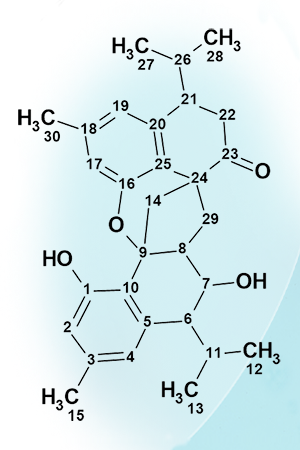
1
The structure of Distahlianin A was determined from the HR-ESI-MS, 1D and 2D NMR, and IR spectra and was confirmed by X-ray analysis. We used this data to challenge the ACD/Structure Elucidator expert system.
Distahlianin A (1) was isolated as colorless crystals from methanol. The HR-ESI-MS spectrum displayed an ion peak at m/z 461.2689 [M+H]+ (calcd. 461.2686), corresponding to the molecular formula C30H36O4 with 13 degrees of unsaturation. The 13C and 1H data, as well as selected HMBC and COSY correlations available from [1] are presented in Table 1.
Table 1. NMR spectroscopic data of Distahlianin A.
| Label | δC | δC calc (HOSE) | XHn | δH | H Mult. | COSY | H to C HMBC |
|---|---|---|---|---|---|---|---|
| C 1 | 157.5 | 153.44 | C | ||||
| C 2 | 116.6 | 114.41 | CH | 6.62 | s | C 10, C 1 | |
| C 3 | 139 | 136.38 | C | ||||
| C 4 | 123.2 | 121.56 | CH | 6.51 | s | ||
| C 5 | 141.8 | 137.31 | C | ||||
| C 6 | 53.8 | 49.75 | CH | 2.7 | t | 2.30, 3.70 | C 10, C 4, C 5 |
| C 7 | 75.5 | 72.88 | CH | 3.7 | u | 2.70, 2.81, 4.13 | |
| C 8 | 49.4 | 52.37 | CH | 2.81 | u | 1.95, 3.70 | C 14, C 9 |
| C 9 | 87.9 | 86.38 | C | ||||
| C 10 | 121 | 121.74 | C | ||||
| C 11 | 27.4 | 28.33 | CH | 2.3 | u | 0.68, 1.13, 2.70 | |
| C 12 | 25.4 | 25.04 | CH3 | 1.13 | d | 2.3 | |
| C 13 | 22.0 | 21.64 | CH3 | 0.68 | d | 2.3 | |
| C 14 | 38.5 | 44.32 | CH2 | 2.19 | u | ||
| C 14 | 38.5 | 44.32 | CH2 | 3 | u | C 29, C 24, C 9, C 25 | |
| C 15 | 21.1 | 21.29 | CH3 | 2.24 | s | C 2, C 4, C 3 | |
| C 16 | 153.9 | 152.79 | C | ||||
| C 17 | 115.7 | 114.29 | CH | 6.47 | s | C 25, C 16 | |
| C 18 | 138.1 | 135.63 | C | ||||
| C 19 | 120.4 | 122.37 | CH | 6.64 | s | C 25 | |
| C 20 | 137.8 | 138.33 | C | ||||
| C 21 | 45.5 | 48.36 | CH | 3.2 | u | 2.16, 2.48 | C 19, C 25, C 20 |
| C 22 | 39.3 | 38.97 | CH2 | 2.88 | u | ||
| C 22 | 39.3 | 38.97 | CH2 | 2.48 | u | 3.2 | C 24, C 23 |
| C 23 | 211.5 | 209.19 | C | ||||
| C 24 | 52.8 | 54.58 | C | ||||
| C 25 | 125 | 120.06 | C | ||||
| C 26 | 33.4 | 32.49 | CH | 2.16 | u | 0.73, 1.02, 3.20 | |
| C 27 | 21.4 | 21.23 | CH3 | 1.02 | d | 2.16 | |
| C 28 | 17.3 | 20.33 | CH3 | 0.73 | d | 2.16 | |
| C 29 | 49.5 | 39.3 | CH2 | 1.95 | u | 2.81 | C 24, C 7, C 9, C 23 |
| C 29 | 49.5 | 39.3 | CH2 | 2.56 | u | ||
| C 30 | 21.3 | 21.13 | CH3 | 2.25 | s | C 17, C 19, C 18 | |
| O 1 | OH | 7.78 | u | C 2, C 10, C 1 | |||
| O 2 | OH | 4.13 | u | 3.7 |
The spectroscopic information shown in Table 1 along with the molecular formula of the compound was entered into Structure Elucidator, and the program created a Molecular Connectivity Diagram, MCD (Figure 1).
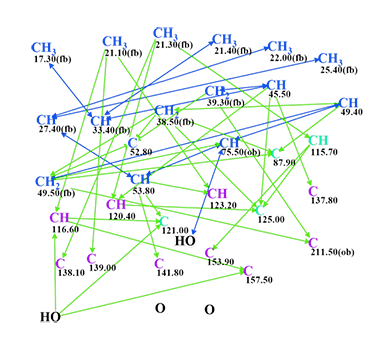
Figure 1. Molecular connectivity diagram (MCD) of distahlianin A. Hybridizations of carbon atoms are marked by corresponding colors: sp2 – violet, sp3 – blue, not sp – light blue. Labels “ob” and “fb” are automatically set by the program to carbon atoms for which neighboring with heteroatom is either obligatory (ob) or forbidden (fb). The HMBC connectivities are marked by green arrows, while COSY connectivities by blue arrows.
We see that MCD contains four light blue carbon atoms with ambiguous hybridization. Consequently, both possible hybridizations (sp3 and sp2) must be checked for all these carbons during the structure generation. Structure generation accompanied by 13C chemical shift prediction and structural filtering was initiated. It was completed with the following result: k = 46 → (Structure Filtering) → 3, tg = 9 s. The three structures of the output file ranked in increasing order of average deviations of calculated chemical shifts from experimental ones are presented in Figure 2.
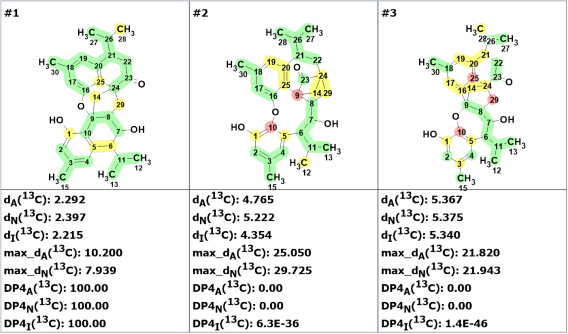
Figure 2. The ranked output file. 13C chemical shift prediction was carried out using the HOSE code-based method, the neural networks, and the incremental approach. Average deviations of 13C chemical shifts determined by these methods are denoted as dA, dN and dI correspondingly. Each atom is colored to mark a difference between its experimental and calculated 13C chemical shifts. The green color represents a difference between 0 to 3 ppm, yellow was >3 to 15 ppm, red > 15 ppm. DP4A, DP4N and DP4I are the probabilities of structure correctness calculated by the program.
Figure 2 shows that the top ranked structure #1 is identical to the structure of distahlianin A shown by the authors of [1]. The calculation of DP4 probabilities was carried out which gave values 100% for all three methods (Figure 2). This allows one to conclude that 13C chemical shift prediction distinguished structure #1 as a correct one with probability of 100%.
In the work [1], only key HMBC and COSY correlations were graphically represented on the molecular structure. Authors of many publications assume that such a connectivity representation confirms the correctness of the derived structure. Figure 3 shows the structures generated with the HMBC and COSY correlations visualized with arrows.
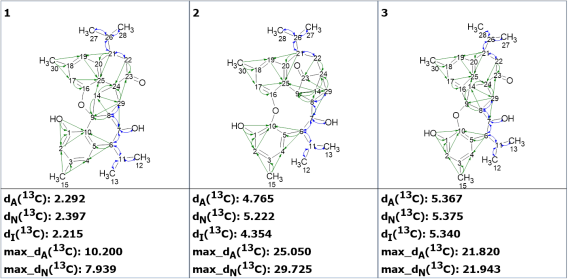
Figure 3. Structures of the output file. HMBC and COSY correlations are shown by green and blue arrows correspondently.
We see that all structures fully correspond to the key correlations, and the correct structure is revealed only using the prediction of chemical shifts. The incorrect structures have large average and maximum deviations. Therefore, a graphical representation of the correlations on a structure does not prove its correctness but only indicates that the given structure is consistent with the 2D NMR spectral data.
In conclusion, the structure of a new natural product characterized by a structurally unique carbon skeleton containing an intricate 6/6/5/6/6/6 hexacyclic framework was unambiguously and reliably elucidated in a few seconds using Structure Elucidator in fully automatic mode.
References
-
K.-L. Ji, Y.-H. Chen, Q.-Q. Song, X.-Y. Zheng, P. Sun, J.-M. Lu, G. Liang, Y.-Y. Fan. (2025). Distahlianins A−C: Architecturally Diverse Cadinane-Type Sesquiterpenoid Dimers from Stahlianthus involucratus. Org. Lett., 27, 10843−10848.
Recent Structure Elucidations
Cyathstrine A Structure Elucidation
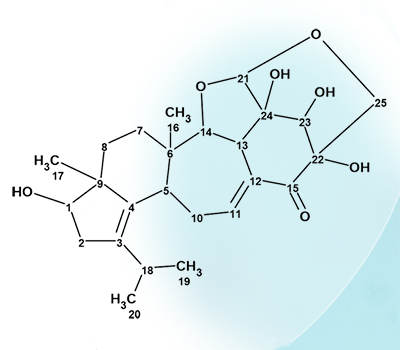
The example of Cyathstrine A (molecular formula C25H34O7) shows that the structure of a complex polycyclic natural product containing seven oxygen atoms was unambiguously determined using Structure Elucidator in a fully automatic mode almost instantly.
Verrucosin C Structure Elucidation
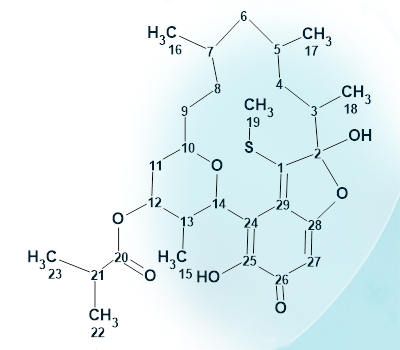
The structure of Verrucosin C (molecular formula C29H41O7S−) was quickly and unambiguously elucidated using Structure Elucidator in fully automatic mode. This was possible due to the comprehensiveness of the initial data set provided, including 2D NMR spectroscopic data.
Spiromastixone Z4 Structure Elucidation
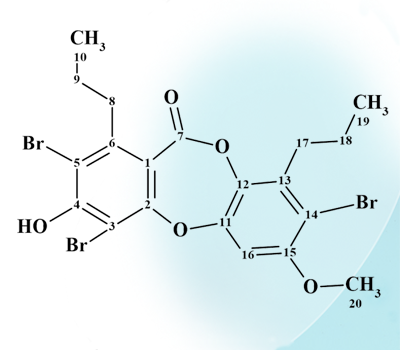
According to Crew’s rule, if the ratio of the number of hydrogen atoms to the number of skeletal atoms in a molecule is less than one, then significant difficulties typically arise in elucidating the structure using one- and two-dimensional NMR spectroscopy. It was interesting to see how ACD/Structure Elucidator handles this problem in an “ab initio” mode with Spiromastixone Z4 (molecular formula C20H19Br3O5).
All previous elucidations
(±)-Salvicatone A
4-Bromobenzoic-biscognienyne A
5α-Cyprinol
α-botryoxanthin A
A Heterodimer from P. kaurabassana
Abyssomicin W
Acremolin
Actinobenzoquinoline
Aetheramide
Afzeliindanone
Alistonitrine A
Aquatolide
Arboridinine
Ascidia sydneiensis SAAF
Asidia SAAF
Aspergillamide C
Asperjinone
Asperspiropene A
Aspochalasin H1
Astellifadiene
Bacillusin A
Barmumycin
Biatractylonoid D
Bidysoxyletine
Boerelasin B
Busseihydroquinone F
Callyspongiolide
Canumycin C
Cascarinoid A
Chloraserrtone A
Ciliatonoid A
Comatulin A
Coniothyrione
Cycloshermilamine D
Damirine B
Daphmacromine A
Davidone F
Delicoferone A
Dermacozine O
Dichocetide D
Dimericbiscognienyne A
Emodacidamide A
Ent-Kaurane-Type Diterpenoid
Epohelmin A
Epoxyroussoenone
Euphorikanin A
Flueggether A
Furaquinocin L
Gancao Cyclooctenone A
Garcimulin A
Gelstriamine A
Geralcin A
Geranylphenazinediol
Gymnopalyne A
Hectoramide B
Herqupenoid A
Hypocrolide A
Indol alkaloid
Iridiod Glycoside
Isatisindigoticanine I
Janthinolide A
Jatrophalactam
Laevinoid A
Lancolide E
Lasionectrin
Leonuketal
Lobocrassin A
Lucidumone
Lyaline (Structure Revision)
Lycojaponicumin
Lycojaponicumin D
Mandelalide A
Manginoid A
Mannolide A
Mantidisflavin A
Matsutakone—Pleurocin A
Mauritamide B
Melohemsine J
Myrtinol E
Neosetophomone A
Nicotabin A
Nordine
Norflavicansone
Orbicularisine
Oroidin
Penerpene A
Pepluacetal
Peyssonnoside A
Phomopsterone A
Phoriospongin A
Phosphoiodyn A
Piperkadsin C
Plebeianiol A
Polypropionat
Protuboxepin A
Pseudochelin A
Psychotripine
Puberunine
Rhodimer
Rhodomollacetal A
Rumphellol A
Ruthmycin
Saccharobisindole
Sarglaperoxide A
Schiglautone A
Schizocommunin
Securamine H
Setosol
Sinensilactam A
Sophaline C
Spiroaxillarone A
Spirochensilide A
Spiroschincarin A
Strophasterol A
Strynuxline A
Symmetric Helical Synthesis Product
Synthetic product C14H13N3O
TAEMC161 (Viridol)
Tasiamide B
Teotihuacanin
Tetrabromobenzofuropyrrole
Trichilianone D
Trichoderpyrone
Trichopsistide A
Trigoflavidol A
Tronoharine
Two Polyenol Natural Products (Adenosine and Uridine)
Uncarilin A
Vagiallene
Virosaine
Waspergillamide A
Wheldone
Zanthplanispine