
How AstraZeneca is Overcoming Obstacles to Analytical Data Access

Using Spectrus to drive efficiencies, deliver insights & prepare for AI
The Data Accessibility Problem
The Cost of Ineffective Analytical Data Management
The initial synthesis of drug product occurs years before it transitions into the development environment. Analytical teams in discovery collect volumes of data to understand structure and develop chromatographic methods for purification (including complex chiral methods) in the lead up to candidate nomination. Unfortunately, this work is often lost in the transition to development. Analytical teams in development regenerate analytical data, reassign spectra, and redevelop chromatographic methods because organizations lack effective analytical data management that would allow them to leverage the data and knowledge acquired earlier in discovery. At best they rely on personal networks and email, making data accessibility highly siloed, inconsistent, and time-consuming.
Nichola and her team recognized this was true for R&D at AstraZeneca and decided to be the changemakers, starting with their own division.
Goals—Breaking Down Barriers to Data Access
- A centralized, cloud-based solution to make analytical data accessible to all functions within the organization
- Both raw and processed analytical data to be stored and made accessible, live (immediately re-useable)
- Make analytical data available for the development of machine learning models
The Analytical Data Management Strategy
Starting Small
ACD/Labs’ applications on the Spectrus Platform were already ingrained in analytical workflows at AstraZeneca. Groups were using these tools to analyze and interpret NMR and LC/MS data and manage analytical knowledge, primarily within the development functions.
Embarking on the Global Analytical Database (GAD) project, the team decided to fully capitalize on their global licenses of Spectrus applications and use ACD/Labs services to integrate hardware and software, automate workflows, and fully realize their vision of centralized, accessible analytical knowledge.
ACD/Labs Software
Spectrus Processor
NMR Workbook Suite
MS Workbook Suite
Spectrus DB Enterprise
Automation services for hardware and software integrations & data flows
Integrated Instruments
92 analytical instruments*
33 Bruker NMR instruments:
59 Agilent Q-TOF and Waters MassLynx, LC/MS instruments:
*New instruments are continually added in ongoing efforts to further expand the data being managed in the GAD.
AstraZeneca’s Global Analytical Database
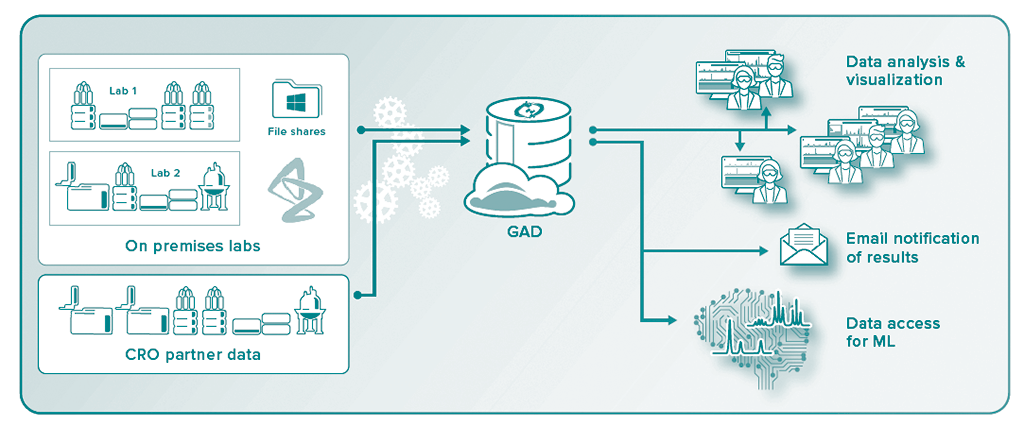
The automated analytical data management system at AstraZeneca collects raw NMR and LC/MS data from analytical instruments, extracts metadata, adds structures from the ELN or registry, processes the data according to the datatype, and creates a database record in a cloud-based, searchable repository. Raw instrument data files are copied to an archive for regulatory and IP purposes.
Usage
Hundreds of analytical, medicinal, and computational chemists access the GAD across the globe (Waltham and Gaithesburg, US; Cambridge and Macclesfield, UK; Gothenburg, Sweden; and Oss, the Netherlands)
Benefits Being Realized
Available Data
Analytical data is available minutes after it has been acquired, and searchable for users to find regardless of where it was acquired. The data is also accessible to automation workflows and for data scientists for ML applications.
Time Savings
Accessing historical data for patent and publication writing is quick and easy and no longer requires contacting an analyst to retrieve it.
Consistent Data
No matter which instruments the data are generated from, consistent metadata and processing means that the data is easy to find using one or more search terms, making comparisons of data possible and data re-use easier.
Easy, Standardized Reporting
Everyday reporting of data—NMR, MS, and analytical UHPLC has been standardized across sites and publishing results is faster than ever. Scientists can gather all the data they need with a few mouse clicks.
Efficiency
Colleagues in downstream workflows no longer need to repeat experiments—they can gather project data easily before they start on refinement and further investigations.
AI/ML-ready Data
Analytical data is standardized and engineered, beyond anything previously available, for data science projects.
Insights
Scientists are able to pull trends from data that would be difficult to identify without the large volume of standardized data.
Quote from Prakash Rathi
We now have a foundational platform where the data is organized and accessible. We’re expanding on that to use it in different ways. This project will continue to grow over time.
An AI Outlook
The data in AstraZeneca’s Global Analytical Database is standardized and contextualized so not only is it useful for scientists, it is also available for data science applications. The teams at AstraZeneca are heavily investing in methods to characterize, understand, and predict data; and are leveraging the ability to quickly build an understanding of relationships between data and certain properties—insights that otherwise would require more rigorous experimentation or be unavailable to them.
Quote from John Ulander
We’re embracing the use of analytical data to build models that put it to use beyond its primary purpose. The future application of our analytical data could pattern recognition algorithms that would make the traditional data interpretation of spectra and chromatograms scientists undertake today, a thing of the past.
Quote from Richard Lewis
We are using our analytical data to build our own predictors for NMR spectra. We may be able to use chromatography data to predict retention times and decide on the best purification methods without relying on method screening. That’s both efficient and contributes to more sustainable, green chemistry.
Analytical data is at the center of R&D and raises unique challenges in data digitalization projects. AstraZeneca have successfully digitalized their analytical data, made it broadly accessible, and ensured it can be leveraged for machine learning projects.
Learn more about AstraZeneca’s Global Analytical Database:

End-to-end workflow support across scientific disciplines.

The Standard for Chemical Drawing.

End-to-end Clinical Data Science Platform.