Search

Your Notifications (0)

There are currently no notifications. You're all set!

ChemAnalytical Workbook™

Better Decisions from Analytical Data

Centralize, process, and share analytical data from all your instruments and analytical techniques in one searchable database. Connect chemical structures with spectra to accelerate analysis and decision-making.
ChemAnalytical Workbook

Explore

Decisions from Multi-Technique Analytical Data

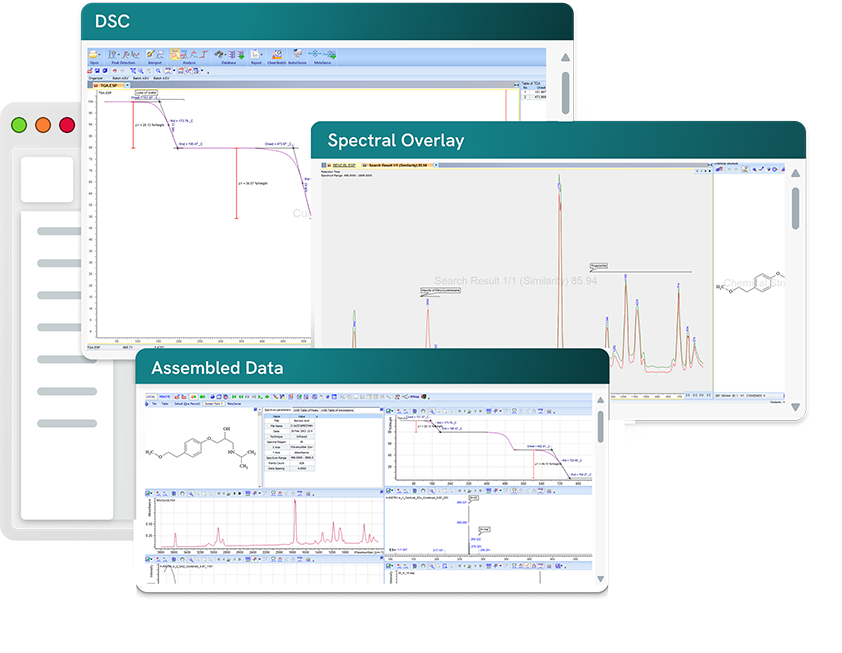
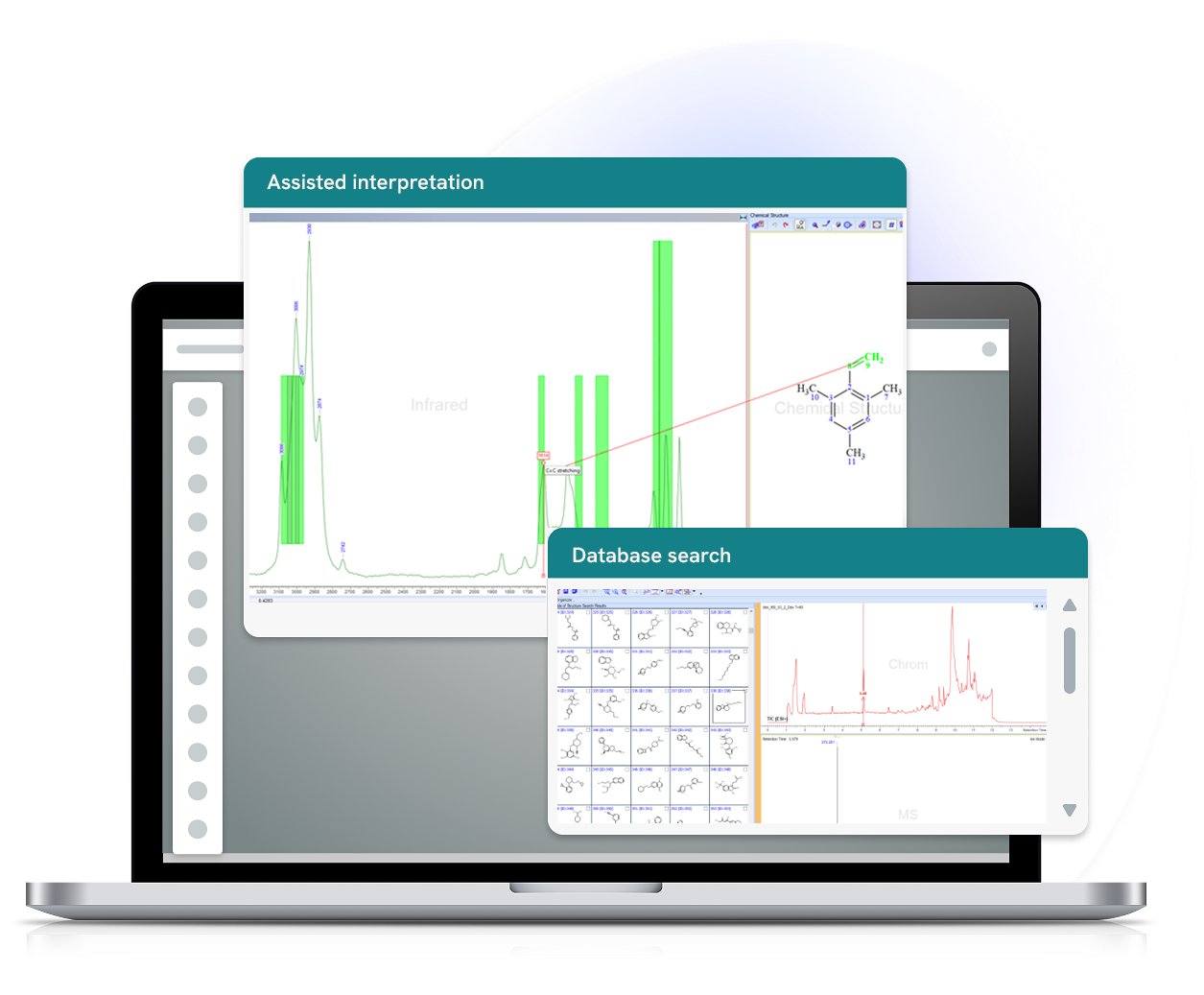
ChemAnalytical Workbook helps you centralize analytical data. Manage and assemble data from different techniques and formats, in one application.

Create a database of analytical data—LC/MS, GC/MS, 1D & 2D NMR, UV, IR, and more

Connect structure(s) and interpretation information with spectra and chromatograms

Search the database using a variety of spectral, structural, textual, and numerical criteria

Import, process, and interpret analytical data from all major instrument vendor formats
Benefits

Accessible analytical data for better scientific decisions

One Workspace for Analytical Data

Bring all your analytical data together in one place regardless of technique or instrument.

Find Previous Analyses with Ease

Say goodbye to searching multiple systems. Chemical and spectral search parameters help you find the information you need quickly and easily.

Connect Data with Chemical Context

Link chemical information (chemical structures, reactions, and schema) with analytical data, so data is easier to understand and reuse.

Accelerate Decision-Making

Process, interpret, compare, and reanalyze analytical data in one interface for faster, more confident project decisions.

Generate Consistent Reports

Create comprehensive multi-technique reports using customizable templates for sharing and review. Assemble publication-ready analytical data.

Enhance Data Access & Collaboration

Make analytical results, their interpretation, and knowledge gained easier to access, so data can be quickly understood and re-used.

How it Works

Decisions from Multi-technique 
Analytical Data Made Easy


  1. Import raw NMR, LC/MS, GC/MS, or other analytical data from any major instrument vendor
  2. Process and interpret the data with technique-specific tools
  3. Search the shared database to speed data analysis and structure characterization
  4. Store results to the database with a few clicks
  5. Share & report your analysis

Features of ChemAnalytical Workbook

    General

    • Create database records that include analytical data; instrument metadata; chemical, biological and toxicological information; descriptive text notes; batch and project IDs; and storage of/links to associated documents (Microsoft Word, Excel and PowerPoint, Adobe PDF, text files, and more)
    • Import processed CDS data from all major vendors
    • Extensive support for data import and export
    • Import data from >150 analytical instrument vendor file formats
    • Export data for use in third-party applications
      Review the list of supported formats
    • Use mathematical and logical operations to generate calculated values based on other data in the database record
      Store single structures, reactions, and multi-step chemical schema
    • Manually or automatically create reaction maps for complex chemical processes and multi-step reactions

    Data Entry and Manipulation

    • Standardize data entry forms with mandatory fields, drop-down lists, or checkboxes set to your specifications
    • Validate input against specified criteria
    • Merge, intersect, or compare databases
    • Customize and extend the functionality of your database with scripting

    Search

    • Search internally created libraries and commercial libraries in Spectrus format
    • Search by molecular structure (exact/substructure/similar); Markush structure using query atoms and bonds; peaks, spectra, or other spectral/chromatographic elements; text or numerical values; formula weight or range; and a variety of spectral searching capabilities (peak/exact/similar)
    • Search multiple data fields simultaneously
    • Query multiple databases at the same time
    • Save complex search queries to perform similar searches in other databases

    Reporting

    • Print reports directly from the database record
    • Create custom report templates
    • Export to Microsoft Office documents (Word, PowerPoint), and Adobe PDF

    Enterprise-Level Tools

    • Define access levels for individual users or groups of users; restrict viewing, adding, deleting, and modification functions for databases, records, projects, components within reactions, and attached files
    • Search local and remote databases

    General Features

    • Handle all analytical data—chromatographic (LC/MS, GC/MS, HPLC), mass spectral, 1D and 2D NMR, optical (Raman, IR, UV/Vis), thermal, gravometric, XRPD, and more
    • Process data with technique specific tools: peak detect/peak pick, smooth, correct baseline, integrate, calculate peak areas, etc.
      • Automate data processing if desired
    • Assisted spectral analysis and interpretation
      • Attach chemical structures to chromatographic peaks to evaluate consistency through color-coded ‘MS Match’
      • Evaluate spectrum/structure consistency using quantitative NMR Match Factor values
      • Use included databases to help structure identification
      • Optical databases: ST Japan IR Demo Library, IRDEMO, IR Assigned Polymers, and Raman Assigned Amino Acids
      • Chromatographic methods database (1444 HPLC/UHPLC and 275 GC methods with structure assignments)
    • Attach chemical structures and structure fragments to spectra and chromatograms
    • Visualize series of spectral and chromatographic data
    • Create comprehensive reports including annotations on chromatograms and spectra, method parameters, peak tables, formatted NMR multiplet reports, and more

    Additional MS Tools

    • Detect peaks and generate extracted ion chromatograms (XICs), total ion chromatograms (TICs), and total absorbance chromatograms (TACs)
    • Automate extraction of relevant chromatograms from structure/formula/mass
    • Automatic confirmation of mass/molecular formula
    • Interpret mass spectra based on assigned mass or chemical structure

    Additional Optical Tools

    • Handle a variety of optical techniques including infrared spectroscopy (IR, NIR, FIR, MIR, UV-Vis), absorption, Raman, reflectance, fluorescence, phosphorescence, circular dichroism (CD), and spectroscopic ellipsometry
    • Import data from Bruker, JASCO, PerkinElmer, Shimadzu, Thermo Scientific (Nicolet, Galactic), and more
    • Advanced peak fitting for peak deconvolution—model an experimental spectrum with a sum of analytical peak functions: Gauss, Lorentz, or mixed (Gauss and Lorentz). Peak positions, intensities, widths, and shapes (fraction of Lorentz function, in the case of the mixed model) are adjusted during iterative optimization to fit the calculated summary curve to points in the experimental spectrum.

    Other Techniques

    • Handle a wide range of analytical data, including EELS (Electron Energy Loss Spectra), thermal analysis (DSC, DTA, TGA), DMA, calorimetry, titrimetric methods, voltametric methods, x-ray methods (powder diffraction, fluorescence, and photoelectron), ESR spectroscopy, and kinetics
    • Perform various X- and Y-axis conversions and data manipulation manually or automatically

    Which Product Best Suits Your Needs?

    Building on the foundation of scientific decision-making with multi-technique analytical data, Spectrus ADMS brings analytical knowledge management, workflow automation, and AI-ready analytical data to your organization.

    ChemAnalytical Workbook
    Spectrus ADMS
    ChemAnalytical Workbook For scientists and project teams
    Spectrus ADMS For R&D organizations
    ChemAnalytical Workbook Analyze, interpret, and report analytical data
    Spectrus ADMS Manage, govern, and reuse analytical knowledge
    ChemAnalytical Workbook Access data with chemical context
    Spectrus ADMS Centralize analytical knowledge
    ChemAnalytical Workbook Support project collaboration and decisions
    Spectrus ADMS Enable organization-wide data accessibility and reuse
    ChemAnalytical Workbook Improve analytical workflows
    Spectrus ADMS Transform and digitalize analytical data management

    What Our Customers Say About ChemAnalytical Workbook

    Quote from Dr. Zarko Kulic

    “Having access to a reference database of fully interpreted analytical data means we don't have to solve the same structure multiple times. Quick identification of known compounds allows us to concentrate on investigating the unknowns. We can combine our data and simplify our workflow, enabling easy, centralized access to information for data mining."

    Dr. Zarko Kulic Schwabe Pharmaceuticals

    Quote from Matthew Jones

    "In the short time I played with the IR tools I was able to get more out of the data than with the original instrument vendor software."

    Matthew Jones Takeda

    Compatible with All Your Analytical Instruments and Techniques

    ChemAnalytical Workbook FAQs

    Ready to take the next step?

    Request a Quote

    Connect with our solutions experts to discuss your needs and explore pricing options.

    Contact Us

    Take a Tour

    Discover how ChemAnalytical Workbook can improve analytical data access and collaboration.

    Request a Demo

    Stay up to Date

    Stay up to date on all the latest insights, research and product news from Revvity Signals.

    Stay up to date