
Signals One™ Bioregistration: Data Modeling and Capture of Large, Complex Biological Entities

Bioregistration for Complex Biological Molecules
With the rapid growth of nucleic acid-based drug products and other biologics, scientists, lab managers, and research directors must manage increasingly complex therapeutic molecules. Yet fragmented registration systems hinder the ability of organizations to effectively capture, track, manage these complex biologics throughout R&D workflows.
Biopharmaceutical companies, CROs, and academic research institutions relying on fragmented registration systems struggle to support large biological molecules—DNA, RNA, antibodies, peptides—and cell lines. This leads to inconsistent data, duplicate records, and poor traceability. Disconnected registration systems also make it difficult to visualize sequence data, track lineage and genealogy, and standardize registration between teams and facilities. Manual workflows, disconnected systems, and limited integration with existing research tools further reduce efficiency, impede collaboration, and interfere with governance and compliance.
Most software tools are made for one or two modalities, frustrating scientists whose modality isn’t properly captured. They are forced to search elsewhere for solutions that supports their research, requiring the organization’s IT team to cobble together API connections across a frankenstack of software.
Once separate updates across both SaaS and on-premises software are added to the account, each team and the overall organization can only move as fast as dictated by this technical debt. Doing less with more, adding AI interns to the team, and having to update such a fragmented system not only demotivates scientists whose research is not being fully captured; it relies on awkward workarounds driven by a “don’t fix what isn’t broken” and “this is how we’ve always done it” mindset, where the cost and effort of fixing a piecemeal registration system keeps IT clinging to an increasingly unworkable status quo.
Signals One bioregistration helps laboratories standardize and centralize registration of large therapeutic modalities with a unified system, improving data consistency, traceability, and collaboration. With seamless integration across Signals One applications, bioregistration supports complex biologics, sequence visualization, lineage tracking, and configurable libraries, thus reducing manual workflows, preventing duplicate records, and allowing scalable, enterprise-wide biologics data management for global companies.
Integrated Biologics Registration
Leverage native functionality within Signals Notebook and across Signals One for individual or bulk material access and registration, as well as external API support for additional integrations. The unified environment provides a consistent user interface, with applications and data connected through seamless, built-in integrations.
Signals One bioregistration has these core capabilities:
- Biological Material Libraries - Configure libraries for biological entities (e.g. DNA, RNA, Protein, Antibody, Cell Lines, Custom).
- Lineage - Capture, track, and visually explore material relationships across different types.
- Calculated Properties - Calculate biologically relevant material properties.
- Bulk registration - Accelerate data ingestion while improving consistency, traceability, and scalability.
Advanced Visualization
Sequence Visualization for DNA, RNA, and Proteins
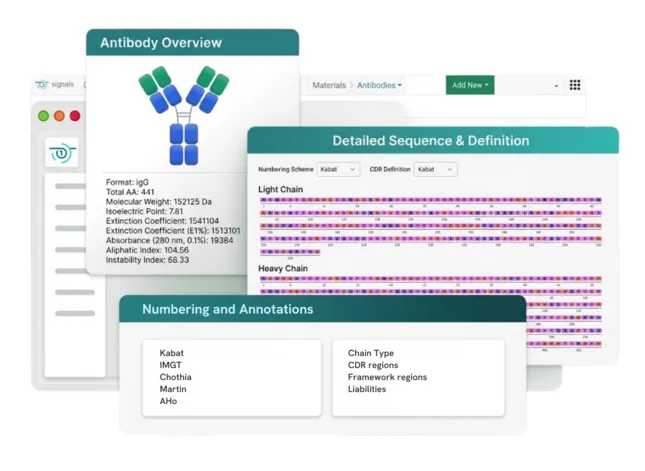
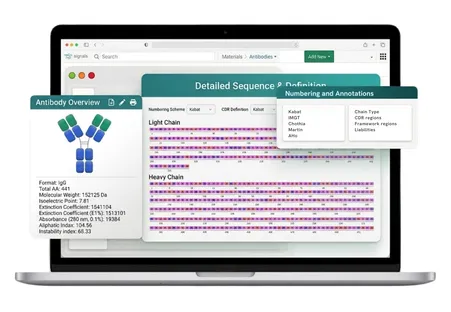
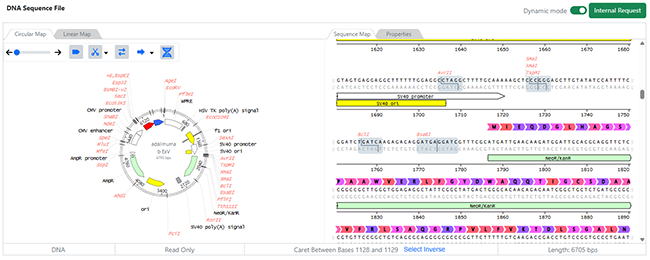
Visualize DNA, RNA, and protein sequences with annotations and translated views, supported by HELM, monomer library management, and BLAST sequence searches throughout Signals Notebook. Use the sequence viewer to display annotations and relevant sites. Plasmid sequences are captured in BioDesign, our enterprise SaaS that focuses on cloning and plasmid modeling. All sequence modifications are immediately sent to BioDesign and saved in Signals One. Likewise, RNA oligonucleotides are captured by ChemDraw, with all modifications sent to ChemDraw and saved in Signals One.
Lineage Visualization
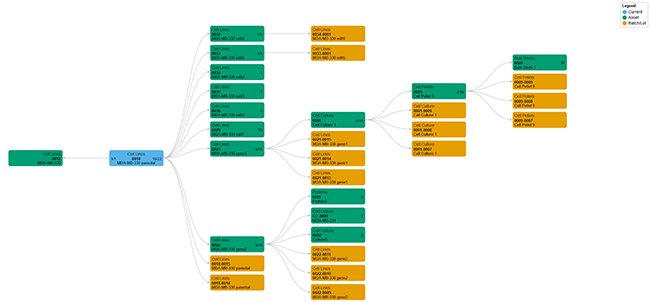
Visually explore and manage the lineage or genealogy of cell lines, antibodies, and other biological entities. This allows users to capture and review parent-child relationships between material entities and visually explore lineage and genealogy.
Scalable Scientific Operations
Streamline Materials Registration
Easily register complex biological entities with pre-configured libraries for cell lines, antibodies, plasmids, and primers. There is further custom library support for DNA, RNA, and peptides.
lexible Registration Workflows
Signals One streamlines registration and access to molecules, individually, in bulk, or via external APIs. It includes native biological file support for premiere sequence banks, including FASTA, GenBank, GenPept, and Swiss-Prot.
Material Inventory Management for Biologics
Enhance material tracking in Signals Notebook and throughout Signals One with unique configurable identifiers to prevent duplicate matching. Audit trail captures relevant metadata based on material IDs.
Advanced Biologics Material Templates
Unlock support for custom, complex materials with configurable templates for DNA, RNA, and proteins when creating a drug class modality, such as antibodies. Fit-for-purpose bioregistration capabilities capture metadata, calculated properties, and biological context required for drug discovery. This allows standardized management of biological entities beyond basic inventory tracking.
Signals One
Supporting Large Molecule Bioregistration
Scientific teams can accelerate biologics research with standardized complex molecule registration to improve data consistency and discoverability while reducing manual tracking.
Signals One bioregistration supports scalable scientific operations with enterprise-wide material governance, improved collaboration across teams and facilities, and seamless integration of biologics registration into existing workflows.
ecurity policies allow for managing user access to each material library. Best of all, it is integrated seamlessly with the entire Signals One solution.
Extend the Power of Signals Notebook
Learn how Signals One bioregistration can help you standardize biologics data capture, improve traceability, and accelerate scientific workflows.

End-to-end workflow support across scientific disciplines.

The Standard for Chemical Drawing.

End-to-end Clinical Data Science Platform.