
How Can Molecular Biology Teams Scale Therapeutic Design with Connected Workflows?
To keep pace with modern drug discovery, molecular biology teams need approaches that can support complexity without slowing down the science.
Molecular biology has long relied on scientists moving step by step through construct design, cloning, and experimental testing. As therapeutic development grows more sophisticated, these familiar routines can start to slow progress, driving a shift toward workflows that are more connected, efficient, and better equipped to support the needs of modern research.
What’s breaking down in today’s molecular biology workflows?
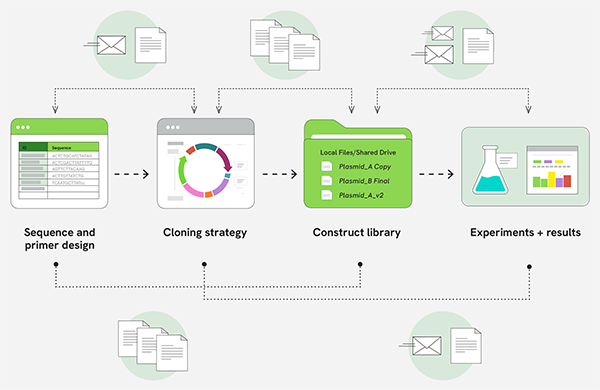
Many of today’s molecular biology workflows were not built for the scale and complexity of modern therapeutic research. In practice, scientists often work across a patchwork of disconnected tools: analyzing sequences and designing primers in one platform, recording construct information in a spreadsheet, and sharing results through email or local folders. Each step may seem manageable on its own, but together these disconnected systems create friction across the workflow.
Another source of friction is the complexity of the tools themselves. Some cloning software platforms offer large feature sets and complicated interfaces, many of which are not part of scientists’ routine work. Instead of helping researchers move faster, these tools can slow them down. Scientists spend valuable time navigating menus, exporting files, reformatting information, and re-entering data rather than focusing on construct design and experimental planning. These issues do more than delay individual tasks. Over time, teams can lose track of validated constructs, repeat work that has already been done, and struggle to identify which sequences, protocols, or design decisions led to successful outcomes. Knowledge remains fragmented across people, files, and systems instead of becoming shared organizational expertise. As therapeutic programs grow in size and complexity, this fragmentation makes it increasingly difficult to scale effective cloning workflows across projects, teams, and the broader organization.
How do connected design-to-experiment workflows reduce friction and boost productivity?
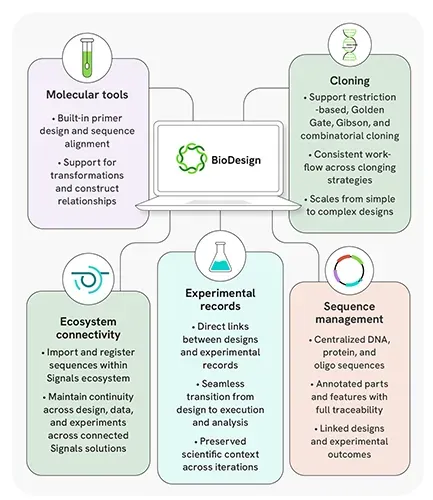
Connected design-to-experiment workflows offer a way to reduce many of the bottlenecks. Signals BioDesign™ enables this connected approach by combining the core capabilities molecular biologists rely on in one environment. Its sequence management tools centralize DNA, protein, and oligo sequences, while supporting annotation and full traceability. Built-in molecular biology tools allow scientists to perform primer design, sequence alignment, and construct relationship analysis, helping them move efficiently through everyday workflows without switching between multiple applications. Signals BioDesign also accommodates a range of cloning strategies, such as Golden Gate and Gibson Assembly methods, facilitating consistent workflows across simple and complex designs.
This connectivity extends beyond construct design. Construct records can link directly to experimental planning, materials registration, and results analysis, creating a clearer path from initial idea to tested outcome. Centralized sequence libraries, along with duplicate detection and similarity searching, help teams find and reuse existing knowledge instead of repeating work, while real-time collaboration and API connectivity support coordination across teams, systems, and locations.
Together, these features reduce manual work, improve traceability, and allow teams to move faster with greater consistency. By keeping designs, records, and results connected, Signals BioDesign makes it easier to collaborate, avoid duplicated effort, and maintain visibility across iterative therapeutic development workflows.
How can molecular biology workflows scale across teams without adding complexity?
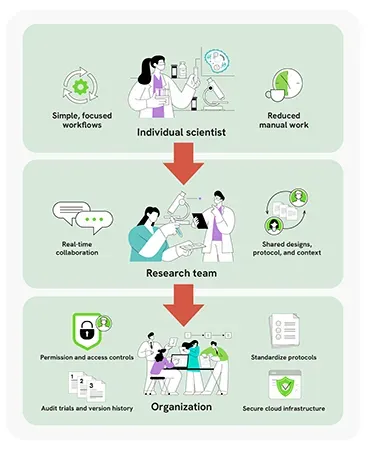
Molecular biology workflows need to scale as teams expand and therapeutic programs grow more complex. A process that works for one scientist or a small project can become harder to manage as more collaborators, constructs, and experiments are added. Signals BioDesign supports that progression without adding unnecessary complexity.
At the individual scientist level, Signals BioDesign simplifies everyday molecular biology work by focusing on core functions such as construct design, cloning strategy development, primer design, and sequence validation. By emphasizing the functions that drive daily productivity, it helps scientists focus more on the biology and less on software navigation.
As work expands across the research team, Signals BioDesign supports bulk cloning operations and makes workflows easier to share and extend. Centralized sequence libraries, real-time collaboration, and connected workflow context help teams work in a shared environment rather than through disconnected files and ad hoc handoffs. This can reduce duplicated work and improve visibility into existing constructs and protocols.
At the organizational level, Signals BioDesign adds the structure needed for broader scale. Standardized protocols, permission controls, audit trails, metadata capture, and secure cloud infrastructure support consistency, governance, and oversight as more users and projects are added. In this way, Signals BioDesign helps organizations scale molecular biology workflows by combining user-friendly tools with the controls needed for broader deployment.
Molecular design at the scale of therapeutic complexity
As therapeutic modalities continue to evolve, molecular biology workflows will need to support greater scale, speed, and coordination. Disconnected tools and manual handoffs may no longer be enough for teams managing increasingly iterative and collaborative design cycles. Connected, cloudnative solutions like Signals BioDesign point toward a more sustainable model by linking design, experimentation, and shared knowledge in one environment, supporting continued innovation.

End-to-end workflow support across scientific disciplines.

The Standard for Chemical Drawing.
End-to-end Clinical Data Science Platform.