
A Technology Guide to Streamlining Molecular Biology Workflows

Top considerations for implementing a centralized molecular design ecosystem
Modern molecular biology teams design thousands of constructs across antibodies, vaccines, cell and gene therapies, and protein therapeutics. Despite these high-stakes goals, many labs remain constrained by disconnected desktop tools, spreadsheets, and manual file sharing that stall research velocity. To address this fragmentation, purpose-built cloud solutions are emerging to modernize construct design workflows.
Centralized molecular cloning ecosystems like Signals BioDesign™ accelerate design and reduce friction in everyday cloning workflows. By focusing on core cloning features and automating primer design and validation, these solutions integrate directly with experimental execution, eliminating tool-switching and streamlining bulk operations for faster research.
When evaluating or implementing a centralized molecular cloning ecosystem, teams should consider:
1. Prioritizing core molecular biology workflows
In molecular biology, a large proportion of research output is driven by a relatively small set of core workflows. Effective cloning ecosystems should therefore prioritize these essential activities, including cloning, primer design, and protein engineering. Signals BioDesign accelerates these workflows by natively supporting core molecular biology methodologies, from the traditional restriction/ligation cloning to more advanced approaches such as Golden Gate and Gibson Assembly. These workflows are delivered through intuitive interfaces designed for speed and accuracy, enabling scientists to work efficiently without sacrificing rigor.
In addition, Signals BioDesign integrates tools for primer design, sequence validation, and cloning strategy optimization, eliminating reliance on manual spreadsheets. Primers are automatically associated with their corresponding cloning plans and output sequences, while design decisions are linked to experimental outcomes. Signals BioDesign also flags potential assembly failures before experimental work begins. Detecting these issues at the design stage reduces costs and minimizes the rework associated with failed wet-lab assemblies.
2. Planning for scalability and high-throughput operations
A critical bottleneck in therapeutic development occurs when transitioning from a single-construct discovery to library-scale production. Scalability at this stage is essential for advancing diverse therapeutic modalities, including antibody libraries, vaccines, and other complex biologics.
At the same time, molecular biology teams often face a trade-off between scalability and usability. Desktop tools offer simplicity for individual scientists but lack the infrastructure for coordinated, large-scale work, while enterprise platforms provide the necessary scale and trace ability but often introduce complexity that can hinder everyday usability.
Signals BioDesign addresses this gap through bulk cloning capabilities that enable researchers to process up to 1,000 constructs simultaneously. These high-throughput workflows are executed through the same intuitive interface used for single-construct design, allowing teams to scale seamlessly from early-stage experiments to production-level development. Furthermore, Signals BioDesign preserves usability at scale by automating primer registration, tracking, and sequence validation.
3. Ensuring data integrity, security, and traceability
For high-value therapeutic intellectual property, data integrity and security form the foundation of the asset. Signals BioDesign addresses these requirements through a combination of unique ID systems, structured metadata, and built-in audit trails that enable end-to-end traceability across molecular design and cloning workflows, while reducing the manual documentation and connectivity burdens associated with disconnected tools.
Crucially, designed sequences are automatically registered into the materials inventory and linked to experimental results, ensuring continuity from design through execution. At the same time, standardized metadata capture ensures that data is immediately usable and structured for long-term analysis and knowledge extraction.
To balance collaboration with protection of sensitive assets, Signals BioDesign incorporates granular permission management, allowing organizations to control access at multiple levels. This approach supports secure, scalable collaboration, from small research teams to large organizations.
4. Transitioning to a centralized, cloud-native environment
At the core of a successful transition is a structured data migration strategy — moving construct libraries and sequencing data from isolated, on-premises desktop tools into scalable, cloud-native repositories (1). Cloud migration is as much a cultural change as a technological one (1). Adopting a centralized molecular cloning ecosystem is an operational shift that requires thoughtful planning across data, workflows, and user experience. It requires rethinking molecular biology workflows to fully leverage connectivity and collaboration. Rather than replicating legacy desktop patterns in a new system, organizations can use this opportunity to redesign workflows around connectivity, traceability, and automation.
Preparing scientists who are accustomed to desktop tools is also critical. Moving to the cloud forces formerly siloed teams to work together more tightly and adopt new, collaborative practices focused on automation, continuous integration, and real-time visibility. Clear communication and training help ensure adoption and enable teams to realize the full value of a centralized system.
In this context, Signals BioDesign is designed to support the transition by providing an intuitive user experience. Most teams can complete this migration with minimal onboarding, while the Revvity Signals team remains available to provide guidance as needed.
5. Addressing organizational requirements for ecosystem implementation
Organizations must consider the structural and governance factors that influence successful implementation of a centralized molecular design ecosystem. This includes shifting from individual filebased workflows to collaborative, centralized design environments. Best practices involve designating a platform administrator to manage permissions and standardize protocols, defining appropriate access and permission structures, and aligning with IT and security requirements.
Equally important is the ability to capture and operationalize institutional knowledge. When sequence data remains siloed, organizations risk losing knowledge, leading to unnecessary duplication of scientific effort. Centralized, searchable sequence repositories transform individual expertise into a durable organizational asset, enabling more efficient discovery. Within Signals BioDesign, intelligent sequence search capabilities — such as duplicate detection and BLAST-based similarity — help researchers quickly identify existing constructs and avoid redundant work.
Cloud-native collaboration further strengthens this model by enabling coordinated, multi-user workflows across geographies. Teams can work simultaneously within a shared environment while maintaining appropriate safeguards through role-based permissions and enterprise-grade security. In parallel, standardized protocols can be deployed globally and shared across teams, ensuring consistency across sites.
Connecting every step of the molecular biology workflow
Signals BioDesign integrates directly with Signals Notebook™ and Signals One™ to maintain experimental context across molecular design, execution, and analysis. This connectivity enables end- to-end molecular biology workflows that reduce manual handoffs, support collaboration at scale, and strengthen data integrity. By embedding molecular design within an integrated informatics environment, organizations can accelerate therapeutic development from early design through downstream analysis.
REFERENCE
1. Kansara, M. Advancements in Cloud Database Migration: Current Innovations and Future Prospects for Scalable and Secure Transitions. SSRAML (2024).
From Molecular Design to Therapeutic Development
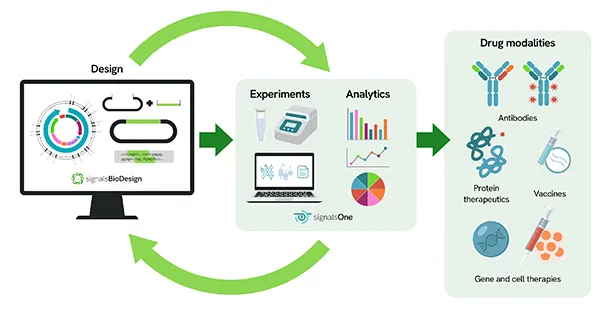
The cloud-native molecular design software BioDesign sets the foundation for molecular biology innovation, accelerating experimental workflows and analytics to transform molecular insights into diverse drug modalities, including antibodies, protein therapeutics, vaccines, and gene and cell therapies.
Signals BioDesign capabilities
| Feature | What it Enables |
| Automated primer design and tracking | Eliminates manual spreadsheets and tracking errors while linking design decisions directly to experimental outcomes. |
| Logic and error handling | Reduces downstream risk and wet-lab rework by identifying cloning errors and faulty sequences before they reach the laboratory. |
| Bulk cloning | Supports high-throughput, production-scale operations by enabling multiple constructs to be produced simultaneously. |
| Centralized searchable repositories | Prevents duplicate work and preserves institutional knowledge by allowing scientists to reuse existing constructs and organizational assets. |
| Unique ID system and audit trails | Supports compliance and data integrity requirements through automated tracking and end-to-end traceability for intellectual property-sensitive programs. |
| Signals integration | Streamlines workflows from design to experimental execution by preserving experimental context and reducing manual data transfer within Signals. |
| Cloud-native SaaS architecture | Minimizes IT overhead by eliminating manual software installation and updates while supporting enterprise security and global accessibility. |
| Permission and role-based management | Enables secure collaboration while protecting intellectual property through scalable, granular access controls. |
EXPERT ADVICE
Building Molecular Biology Workflows That Scale with Science
By embedding sequence design into a connected informatics ecosystem, Signals BioDesign helps teams preserve knowledge, improve collaboration, and support complex therapeutic development.
Molecular biology sits at the center of modern drug discovery. From engineering plasmids and proteins to constructing antibodies, cell therapies, and gene-editing systems, researchers rely on DNA design as the foundation for countless experimental workflows. Yet many teams still manage these critical activities using standalone desktop applications, shared folders, and manual handoffs. While these tools may work for individual scientists or small groups, they often become difficult to scale as organizations grow and therapeutic programs become more complex.
Revvity Signals BioDesign™ was developed to address these challenges by integrating molecular design directly into the broader Revvity Signals ecosystem. Leading this effort is Larry Mulcahy, a product manager at Revvity Signals whose background spans molecular and cell biology, biochemistry, endocrinology, and academic drug discovery. Drawing on years of bench research and scientific informatics consulting, Mulcahy is helping create software that connects sequence design with the full design–make–test–decide cycle, enabling scientists to work more efficiently while maintaining complete traceability across projects.
What led you from hands-on research into software product management?
My transition happened through an informatics opportunity that combined my scientific background with my interest in solving problems at scale. Most scientists are used to cobbling together tracking systems and dealing with frustrating software throughout their academic careers, so I saw an opportunity to help build better tools.
At Revvity Signals, we always keep the user at the center of what we build. The scientific rigor and attention to detail I developed during my research career are crucial when designing software for specialized fields like molecular biology. Effective solutions for scientists require a deep understanding of experimental workflows, data challenges, and the fundamental biology that drives their work.
What is fundamentally broken in many molecular biology workflows today?
One of the biggest problems is that scientists often use different tools and do not have a unified way to share what they have designed or built. As a result, a surprising amount of knowledge remains with individual researchers. Organizations often realize this only when someone leaves. Suddenly, they discover freezers full of constructs they do not fully understand or designs that no one knew existed.
Maintaining FAIR principles — making data findable, accessible, interoperable, and reusable — becomes very difficult when organizations depend on individuals to preserve and share information consistently. With desktop tools, organizations rely on users to maintain good data-sharing practices so that sequences, annotations, and institutional knowledge remain centralized. By contrast, cloud-based solutions make it easier to centralize this information and allow users to access their work from any browser. Desktop tools are simply difficult to scale beyond individual labs or small companies.
That shift is what drove the development of Signals BioDesign. Existing cloning tools addressed individual workflows, but customers increasingly wanted a more connected solution — one that integrated molecular design with the broader research environment and preserved the scientific context needed to support collaboration, traceability, and informed decision-making.
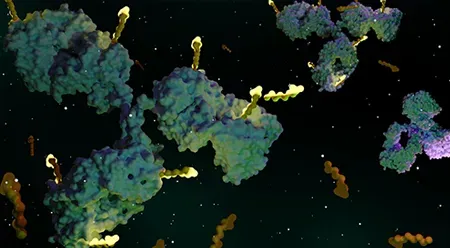
As therapeutic modalities grow more complex, integrated molecular design tools help researchers connect sequence design with downstream experimentation and decision-making.
Why is it increasingly important to connect molecular biology and chemistry in drug discovery workflows?
Historically, areas like biology and small molecule work were often separate teams, but their work increasingly overlaps. Even relatively straightforward activities, such as assay development, can bring chemists and biologists together.
That convergence is even more pronounced with newer therapeutic modalities that combine multiple design strategies, including linkers, payloads, and non-natural side chains or amino acids. These programs are neither purely biologics nor purely small molecules. Researchers are trying to develop therapies that deliver the best outcomes regardless of modality, so there is much greater synergy between these groups than there used to be.
What challenges do organizations face when scaling molecular biology workflows?
The biggest challenge is ensuring that informatics systems grow alongside the science. As teams expand, ad hoc tools, file-based workflows, and manual handoffs break down, leading to loss of traceability, duplicated work, and lower confidence in results. BioDesign and the broader Signals ecosystem reflect a different approach: centralize molecular design work early, preserve lineage and context, and connect molecular biology directly to downstream execution. Scaling succeeds when design is treated as a governed, connected part of the scientific record rather than as an isolated desktop activity.
“Organizations often realize this only when someone leaves. Suddenly, they discover freezers full of constructs they do not fully understand or designs that no one knew existed.”
How does intelligent sequence searching and centralized libraries improve knowledge management?
Search is essential for leveraging organizational knowledge. In scientific informatics, effective search can save significant time, reduce repetitive work, and foster collaboration. When designs are stored in a centralized system, scientists can quickly identify related constructs, discover work they may want to reuse, and see who originally created a design. That visibility makes it much easier to share expertise and build on previous efforts rather than starting from scratch.
Is Signals BioDesign focused on one therapeutic modality, or is it designed for broader use?
It is modality agnostic. In the initial release, the emphasis is on designing proteins and plasmids, which I see as the fundamental building blocks for many downstream applications.
Whether researchers are developing antibodies, engineering cells, or creating entirely new therapeutic constructs, plasmids and proteins are central components. As we hear additional customer use cases, we will continue to expand the solution, but the core idea is that these foundational design capabilities support a wide range of modalities.
How do you see Signals BioDesign shaping the future of molecular biology in drug development?
BioDesign focuses on the planning steps required to build molecules in living cells or cell-free systems, recognizing the plasmid as a durable foundation across many therapeutic modalities and assays. By embedding molecular design directly within the broader Signals ecosystem, BioDesign ensures that design intent, verification, and lineage remain traceable as work moves downstream and across teams.
At its core, this is not just about solving cloning — it ultimately supports scientific decision making. Scientists have always been able to clone molecules; the critical challenge is understanding how a construct was created, tracing decisions back through its history, and investigating unexpected results. When design information is saved, linked, searchable, and retrievable, researchers can quickly answer questions such as how a plasmid was made or why a particular cell line is behaving unexpectedly.
This creates a continuous scientific record that supports increasingly complex, collaborative development workflows and enables more informed decisions throughout the research and development process. As science and design tools evolve, BioDesign advances alongside them through close customer partnership and scientifically aware, adaptable software.
Larry Mulcahy and his team at Revvity Signals are advancing molecular biology informatics by connecting sequence design to the full
design–make–test–decide workflow, improving collaboration, traceability, and knowledge sharing across drug discovery programs.
This interview has been condensed and edited for clarity.
Drug discovery is complex.
Signal OneTM simplifies it.
One cloud- native solution for the complete Design-Make-Test-Decide Lifecycle:
- Real time collaboration
- AI ready data+AI/ML
- Enterprise analytics

End-to-end workflow support across scientific disciplines.

The Standard for Chemical Drawing.

End-to-end Clinical Data Science Platform.