
From Sample to Insight: A Connected Approach to Managing Complexity in Assay Development

The Next Bottleneck in Discovery
How are scientific teams managing complexity as their biologics programs move from design through experimentation and analysis? This white paper is the second installment in a series that addresses that question through the lens of several critical biologics workflows.
In the first white paper, we focused on a foundational workflow: entity creation and lineage, with a spotlight on cell line propagation. The methodical, deliberate nature of that workflow highlights the importance of careful governance, continuity, and traceability as data accumulates over multiple development cycles.
In this paper, we shift focus to high-throughput experimentation and sample diversity, with a spotlight on next-generation sequencing (NGS). As a representative assay modality, NGS illuminates the data management challenges common to any omics workflow with branching samples and frequent handoffs.
What’s at stake?
As assay workflows scale, scientific teams need to have confidence in the data they generate and the experimental context that surrounds it. Without such confidence, even well-executed experiments can fail to deliver meaningful, usable results.
A harmonized data management solution like Signals OneTM is fundamental to maintaining this level of trust, traceability, and context. It’s the connective tissue between samples, experiments, and results, helping ensure that data remains reliable and interpretable as omics workflows accelerate and branch across teams and experiments.
Spotlight on Assay Development for Next-Generation Sequencing
Different omics, shared data challenges
Genomics, proteomics, metabolomics—today’s biologics teams work across a range of high-throughput assay modalities where the cost of a wrong decision is especially steep. While the specifics of these workflows vary, they present a similar set of high-stakes data management challenges. These are the challenges that shape if and how teams can move from experimentation to interpretation. Whether you’re working with protein expression data or metabolite profiles, that move isn’t possible unless you trust that your assay data is complete, correct, and properly contextualized.
In this paper, we focus on next-generation sequencing (NGS) as a representative framework for exploring these challenges and potential solutions. The goal is to surface patterns that resonate with scientific teams working across omics-based experimentation, and to point toward a future in which data complexity supports (rather than slows) decision-making.
An overview of the NGS workflow
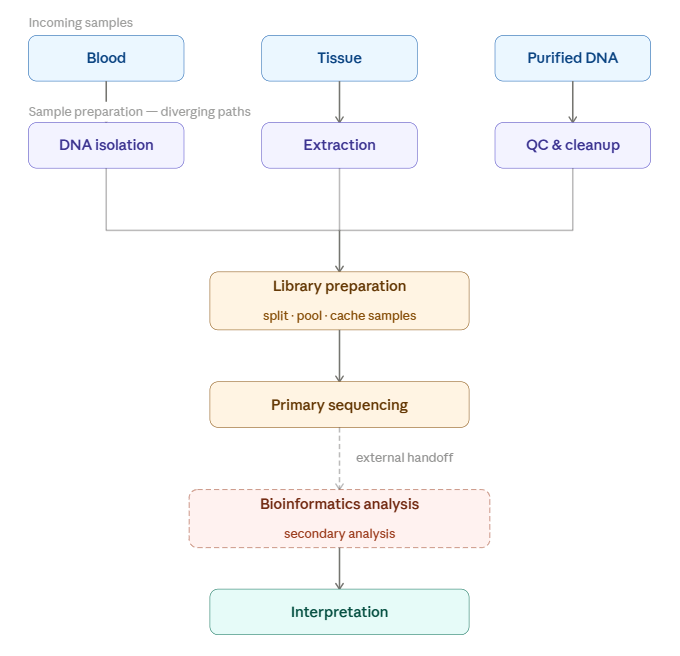
No two NGS workflows are exactly alike. At a high level, however, they share a structure that helps explain why data management challenges increase as assay workflows scale.
A typical NGS workflow begins with a variety of incoming sample types—blood, tissue, or purified DNA, for example. Depending on the nature of that starting material, preparation paths can diverge widely. Blood samples may require DNA isolation; tissue samples may undergo additional extraction steps; purified DNA may move directly into cleanup steps. Teams often split, pool, and cache materials prior to sequencing to ensure that each limited sample provides maximum experimental value.
Once they’ve prepared the samples, teams typically have the primary sequencing data sent to a bioinformatics partner for secondary analysis. Once the results are returned, the experimental team can begin interpretation, provided the underlying data and the full experimental context are accessible and trusted.
Where Complexity Outpaces Structure in NGS Workflows
Sample Branching Impedes Traceability
In many modern lab workflows, teams routinely split, pool, and re-split samples to conserve scarce material and run parallel assays. Over time, this branching can make it difficult to trace sample lineage across multiple teams, instruments, and systems. And wherever lineage gaps emerge, the consequences of failure increase. That’s because teams may struggle to pinpoint where an assay went wrong, identify affected samples, and confidently backtrack to an earlier step to resume the workflow.
This often results in wasted samples, reduced statistical significance, and, in some cases, entire assay runs rendered unusable. The costs may be substantial: valuable bench time lost, expensive materials consumed without producing meaningful results, and rare patient samples—sometimes impossible to replace—gone forever.
Metadata Breaks Down Under Real-World Conditions
When metadata fails to meet consistent standards, it’s rarely because of carelessness at the bench. In fact, the opposite is usually true: scientific teams are deeply committed to experimental rigor and data integrity. The challenge lies in the nature of biologics, which are inherently variable and rarely conform to “perfect” starting conditions.
That’s why idealized metadata strategies that assume flawless execution at the keyboard often fail. Teams working with variable materials are forced to develop adaptations and workarounds on the fly, which keeps the work moving forward but leads to inconsistent annotations, lost context, and growing gaps in the metadata over time. When these inconsistencies extend beyond the bench, their impact multiplies, hampering external bioinformatics partners and downstream analytics teams.
Handoffs Between Teams and Digital Systems Lead to Failure
Workflows rarely look the same across organizations. A company’s scale, internal culture, and operational realities shape ownership structures and handoff protocols, which become as unique as fingerprints.
In some organizations, a single individual may own the end-to-end NGS workflow; in others, responsibility is distributed across teams, roles, or even third-party partners. Each time the workflow crosses one of these boundaries, responsibility for its inputs and outputs may become blurred, especially when these expectations aren’t explicitly defined.
This ambiguity around responsibility introduces real operational risk. Missing or ambiguous information can quickly become a problem. Completed work may be reinterpreted, duplicated, or discarded entirely, creating friction and delaying important experimental outcomes. These impacts aren’t limited to internal teams, either. External collaborators, such as bioinformatics partners, also depend on receiving well-contextualized data to deliver timely, accurate analyses.
When a Data Management Solution Supports the Science
From Sample Chaos to Structured Tracking of Branches/Splits
A structured data management approach brings order to the complexity of branching NGS workflows by preserving lineage from every derived sample back to its original ID, even as teams split, pool, and recombine samples. With clear visibility into how samples relate across divergent paths, teams can confidently trace results and quickly identify an assay’s point of failure and which samples are affected. Instead of losing entire runs, this allows scientists to recover from a known “good” point, reuse cached materials, and protect scarce samples.
From Metadata Sprawl to Guided Context
A guided data management solution can help individuals capture information cleanly and accurately, even under changing or imperfect conditions. Structured intake protocols reduce ambiguity without adding friction at the keyboard, while built-in guardrails limit the accumulation of ad hoc exceptions while still allowing a degree of flexibility. With these supports in place, scientists (and the bioinformatics partners they rely on) can trust their metadata—not because conditions were perfect, but because variability was expected and managed by design.
From Fragile Handoffs to Recoverable Workflows
Effective data management doesn’t come from software that forces a single, prescribed process on organizations. Instead, scientific teams need solutions that will adapt to them—to their unique ownership models, handoff protocols, and collaboration patterns. The goal is to preserve workflow continuity without requiring teams to change how they operate, and to ensure that the right level of context is preserved and shared across boundaries, team structures, and external partnerships.
In this way, a harmonized data management solution acts as a critical bridge. It helps data survive transitions between people, systems, and workflow stages without losing integrity. That continuity supports more than traceability for documentation’s sake; it creates a clear path to recovery when failures occur and ensures that everyone—including external bioinformatics teams—receives data that is complete, interpretable, and anchored in the experimental context.
Signals NotebookTM templates • Standardized metadata capture • Sample lineage and traceability • Multistep assay workflow guidance • Version control and audit trails • API-based data integration • Contextual analytics and visualization • Request and task management
Designed to Connect, Not Replace
No single platform owns the entire NGS workflow, and it shouldn’t try to. Specialized systems, such as bioinformatics pipelines, often operate externally; despite this separation, they play a critical role in downstream analysis. A connective data management environment should be designed to recognize that gap and work with it to build a coherent scientific record.
An ecosystem like Signals One is designed to do just that. By cleanly ingesting external data, it grounds downstream analysis in complete, interpretable data that’s connected to the experimental context.
Guided integration points and a network of APIs enable this level of connectivity, helping minimize the ongoing burden of manually updating custom connections as instruments and systems evolve. As a result, teams can reliably reconnect omics data generated elsewhere to the originating samples, experimental metadata, and lineage, preserving continuity across the workflow.
Assay Development for the Real World of Biologics
Scientific teams need assay workflows designed not for the rare moments when everything goes perfectly, but for the reality of biologics research. Across modalities, teams face a “norm” of variable starting materials, branching experiments, and frequent handoffs. Systems that can’t accommodate this level of complexity and unpredictability are simply unsuited to today’s high-throughput scientific workflows.
What teams need instead is a harmonized data management ecosystem that provides the structure needed to hold these workflows together and keep them moving reliably forward. By preserving context, maintaining traceability, and supporting recovery when things go wrong, this ecosystem accelerates the journey from experimentation to interpretation, building confidence at every step.
All white papers in this series from the team at Revvity Signals echo this imperative for a data management ecosystem. From the careful development of cell lines to the fast-moving and high-throughput nature of assay development, the underlying requirement is the same: connected, well-governed, decision-ready data that supports discovery at every stage.
Want to see Signals One in action? Request a demo today
End-to-end workflow support across scientific disciplines.

Intuitive data capture and collaboration with self-service integration.
Turning drawings and ideas into knowledge.

End-to-end workflow support across scientific disciplines.

The Standard for Chemical Drawing.
End-to-end Clinical Data Science Platform.